Oil Prices Surge Amid Iran-Israel Tensions, Global Energy Market Alarms
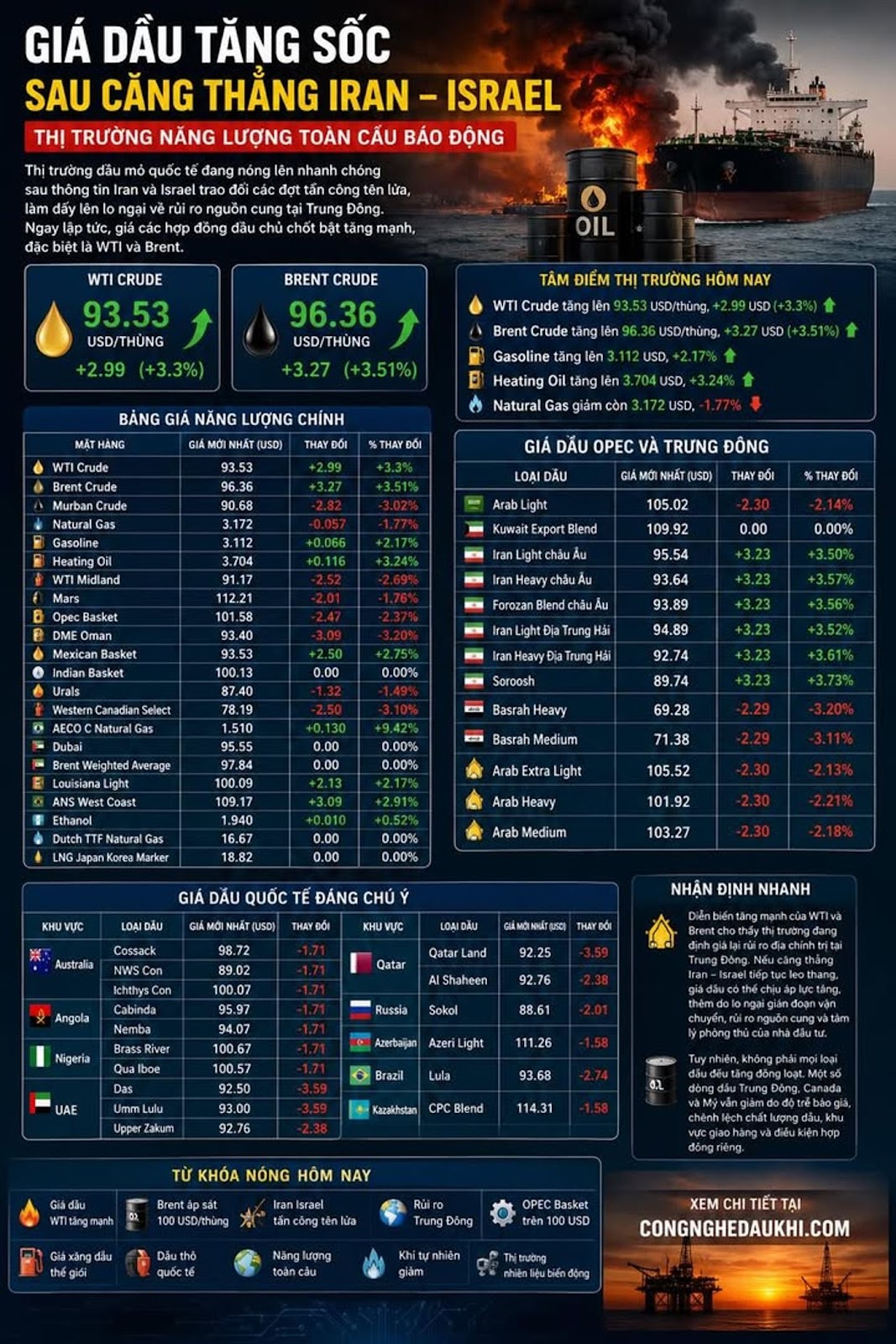
The international oil market is heating up rapidly following reports of missile exchanges between Iran and Israel, raising concerns about supply risks in the Middle East. Major crude oil benchmarks have immediately jumped significantly, with WTI and Brent leading the surge.
As geopolitical tensions escalate in one of the world's most critical energy regions, market participants are closely monitoring whether this new round of missile escalation could push oil prices above the $100 per barrel mark and trigger a global fuel price shock.
Market Focus Today
The oil market reacted swiftly to the developments in the Middle East, with benchmark crude contracts experiencing notable increases:
- WTI Crude rose to $93.53 per barrel, up $2.99 (3.3%)
- Brent Crude increased to $96.36 per barrel, up $3.27 (3.51%)
- Gasoline prices climbed to $3.112, up 2.17%
- Heating Oil rose to $3.704, up 3.24%
In contrast, Natural Gas decreased to $3.172, down 1.77%, indicating that speculative capital is flowing more heavily into crude oil and liquid fuels.
Key Energy Price Summary
| Commodity | Latest Price | Change | % Change |
|---|---|---|---|
| WTI Crude | $93.53 | +$2.99 | +3.3% |
| Brent Crude | $96.36 | +$3.27 | +3.51% |
| Murban Crude | $90.68 | -$2.82 | -3.02% |
| Natural Gas | $3.172 | -$0.057 | -1.77% |
| Gasoline | $3.112 | +$0.066 | +2.17% |
| Heating Oil | $3.704 | +$0.116 | +3.24% |
OPEC and Middle East Oil Prices
The price movements show significant variation across different crude grades, with Iranian crude experiencing notable increases while some OPEC grades declined:
| Crude Type | Latest Price | Change | % Change |
|---|---|---|---|
| Arab Light | $105.02 | -$2.30 | -2.14% |
| Kuwait Export Blend | $109.92 | $0.00 | 0.00% |
| Iran Light (Europe) | $95.54 | +$3.23 | +3.50% |
| Iran Heavy (Europe) | $93.64 | +$3.23 | +3.57% |
| Forozan Blend (Europe) | $93.89 | +$3.23 | +3.56% |
| Arab Extra Light | $105.52 | -$2.30 | -2.13% |
| Arab Heavy | $101.92 | -$2.30 | -2.21% |
Notable International Oil Prices
| Region | Crude Type | Latest Price | Change |
|---|---|---|---|
| Australia | Cossack | $98.72 | -$1.71 |
| Australia | NWS Con | $89.02 | -$1.71 |
| Angola | Cabinda | $95.97 | -$1.71 |
| Nigeria | Brass River | $100.67 | -$1.71 |
| UAE | Das | $92.50 | -$3.59 |
| UAE | Umm Lulu | $93.00 | -$3.59 |
| Russia | Sokol | $88.61 | -$2.01 |
Market Analysis
The sharp increase in WTI and Brent prices indicates that the market is reassessing geopolitical risks in the Middle East. If tensions between Iran and Israel continue to escalate, oil prices could face additional upward pressure due to concerns about transportation disruptions, supply risks, and defensive positioning by investors.
However, not all oil grades are rising uniformly. Some Middle Eastern, Canadian, and American crude grades are still declining due to price reporting lags, quality differentials, delivery regions, and specific contract conditions.
Geopolitical Context
The Middle East remains a critical region for global energy security, accounting for approximately one-third of global oil production and over 60% of global oil trade. Any significant disruption to oil flows from this region can have immediate and substantial impacts on global oil prices and energy markets.
The Strait of Hormuz, through which approximately 20% of global oil supplies pass, has been a particular point of concern during periods of heightened tensions in the region.
Market Implications
The current price movements reflect several key factors:
- Supply Risk Premium: Markets are incorporating a risk premium for potential supply disruptions
- Regional Differentiation: Not all crude benchmarks are moving in tandem, reflecting regional supply and demand dynamics
- Product Spreads: Heating oil and gasoline are showing stronger gains than crude, indicating refining margins may be tightening
- Alternative Energy Impact: Natural gas prices are declining as capital flows toward crude oil
Future Outlook
Market analysts are closely monitoring several factors that could influence the direction of oil prices:
- The trajectory of Iran-Israel tensions and potential escalation
- Responses from major oil-producing countries and OPEC+
- Global demand indicators, particularly from major economies
- Strategic petroleum reserve release policies
- Seasonal demand patterns in key consuming regions
As the situation develops, energy market participants will be watching for any signs of sustained supply disruptions or potential diplomatic interventions that could ease tensions in the region.
The current market reaction demonstrates the sensitivity of global energy markets to geopolitical developments, particularly in a region so critical to global energy security.