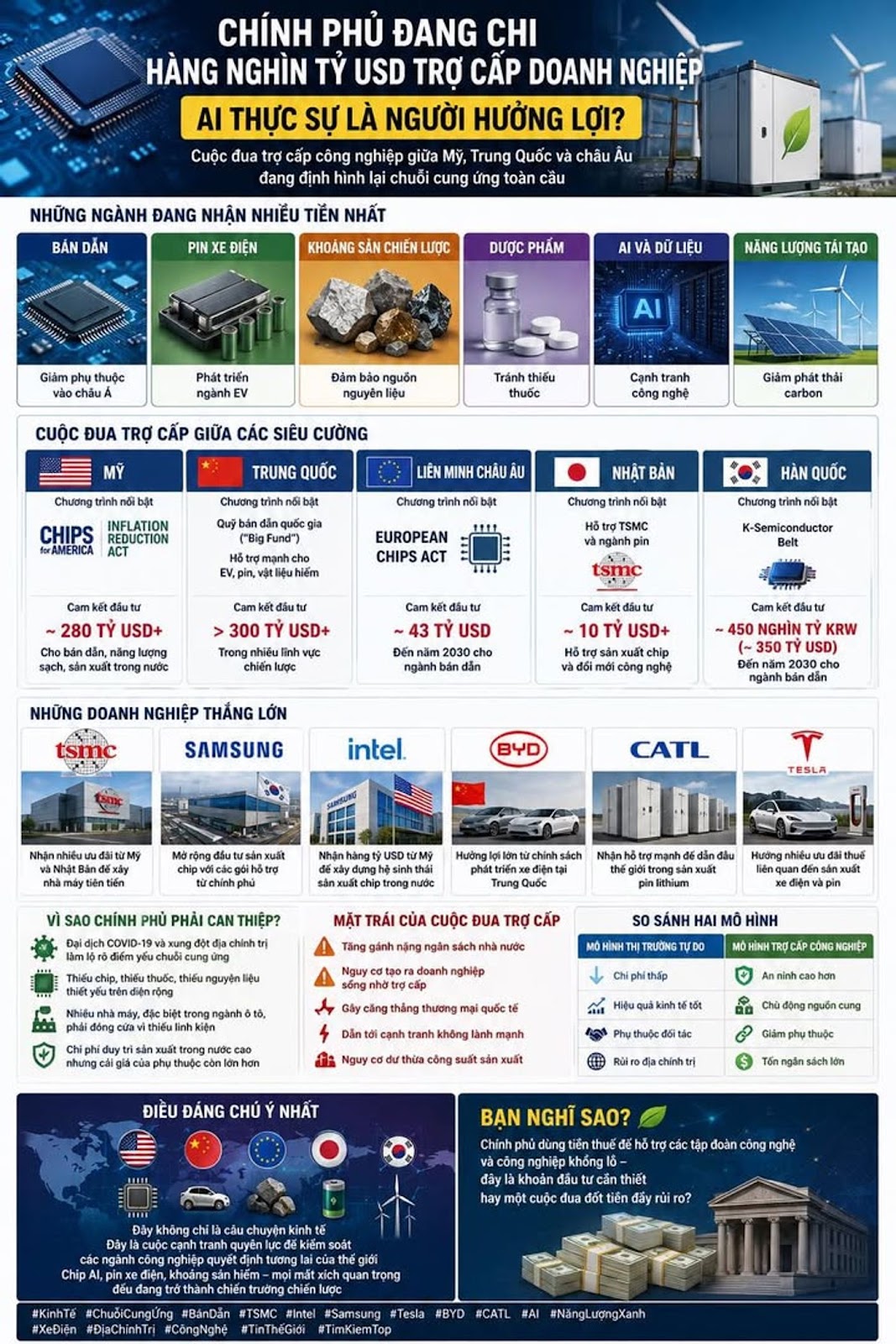
Government Subsidies in the Trillions: Who Really Benefits?
In an era of increasing geopolitical tensions and supply chain vulnerabilities, governments worldwide are pouring trillions of dollars into corporate subsidies. But are these massive investments truly saving the global economy, or are they simply fueling an unprecedented spending race between the United States, China, and Europe?
The COVID-19 pandemic, coupled with recent geopolitical conflicts, has exposed critical weaknesses in global supply chains. From semiconductors and strategic minerals to pharmaceuticals, many nations discovered they were overly dependent on geopolitical rivals or single-source production regions.
The result is an unprecedented wave of industrial subsidies sweeping across the globe. Rather than letting markets self-adjust, governments are directly injecting hundreds of billions of dollars into domestic enterprises to gain advantages in industries deemed critical for the future.
Strategic Industries Receiving the Most Funding
| Industry | Strategic Objective |
|---|---|
| Semiconductors | Reduce dependence on Asia |
| Electric vehicle batteries | Develop domestic EV industry |
| Strategic minerals | Secure raw material supplies |
| Pharmaceuticals | Prevent medicine shortages |
| AI and data | Technological competitiveness |
| Renewable energy | Reduce carbon emissions |
The Subsidy Race Between Global Powers
| Region | Key Programs |
|---|---|
| United States | CHIPS Act, Inflation Reduction Act |
| China | National Semiconductor Fund, EV support |
| European Union | European Chips Act |
| Japan | Support for TSMC and battery industry |
| South Korea | K-Semiconductor Belt plan |
The United States alone has committed hundreds of billions of dollars to semiconductor, battery, and clean energy production projects. China, in turn, has spent even more in many strategic areas, particularly electric vehicles, lithium batteries, and rare materials.
Major Corporate Winners
- TSMC receiving substantial incentives to build facilities in the US and Japan
- Samsung expanding semiconductor manufacturing investments with government support packages
- Intel securing billions to build a domestic semiconductor manufacturing ecosystem
- BYD and CATL benefiting from China's EV development policies
- Tesla enjoying numerous tax incentives related to EV and battery production
Why Government Intervention is Necessary
For decades, globalization enabled businesses to produce where costs were lowest. However, the pandemic revealed the vulnerabilities of this model when the world faced shortages of masks, chips, medicines, and essential raw materials.
Many automobile plants had to shut down due to a shortage of just a few semiconductor components. Governments realized that maintaining domestic production capacity may be expensive, but the cost of dependence is far greater.
The Dark Side of the Subsidy Race
| Risk | Potential Impact |
|---|---|
| Increased national debt burdens | Fiscal strain on government budgets |
| Subsidy-dependent enterprises | Reduced market competitiveness |
| International trade tensions | Potential trade conflicts |
| Unfair competition | Market distortions |
| Production capacity glut | Resource misallocation |
Some experts warn that this race could create new investment bubbles similar to what occurred in the solar energy industry.
Comparing the Two Models
| Free Market Model | Industrial Subsidy Model |
|---|---|
| Lower costs | Enhanced security |
| Better economic efficiency | Supply chain control |
| Partnership dependence | Reduced dependence |
| Geopolitical risks | Larger budget expenditures |
The Most Significant Development
What's happening today is not just an economic story. It represents a power competition between the United States, China, the European Union, Japan, and South Korea to control the industries that will determine the world's future.
From AI chips and electric vehicle batteries to rare minerals, every critical link is becoming a strategic battlefield. If this trend continues to accelerate, the world may enter a new era where governments play a larger role than ever in determining which enterprises succeed and which are left behind.
Public Debate
What are your thoughts on governments using taxpayer money to support massive technology and industrial corporations? Is this a necessary investment or a risky money race?
The ongoing subsidy race represents a fundamental shift in global economic policy, moving away from pure market-driven approaches toward strategic government intervention in critical industries. As this trend continues, we may witness a redefinition of global economic relationships and the emergence of new economic blocs based on technological self-sufficiency rather than pure comparative advantage.