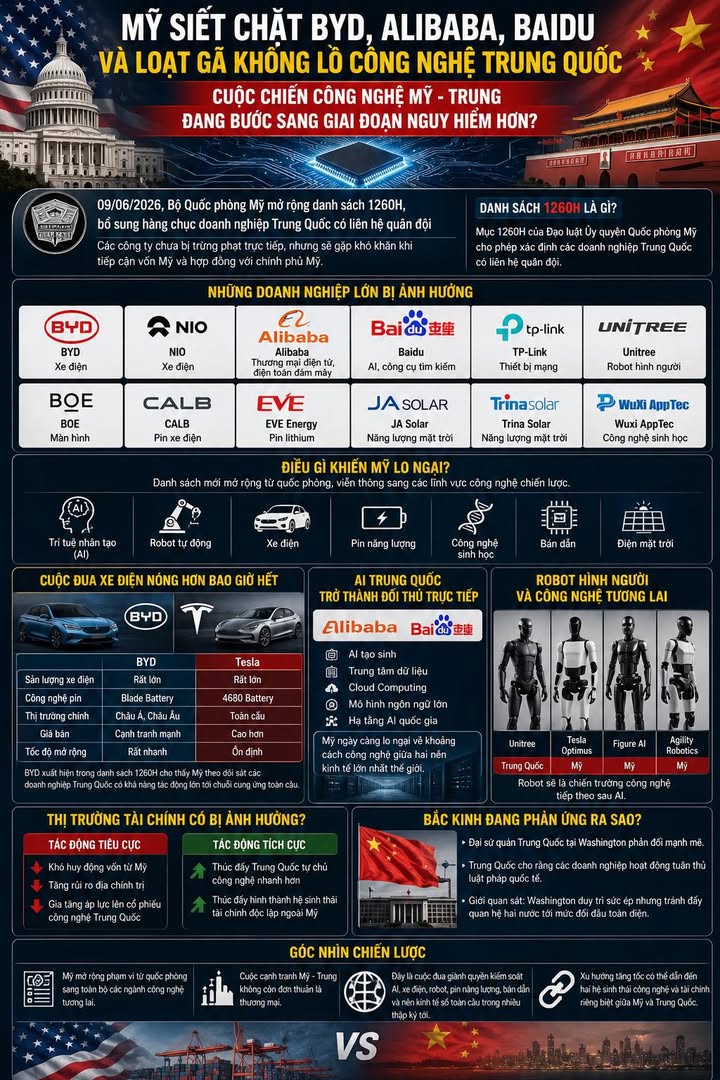
US Tightens Grip on BYD, Alibaba, Baidu and Major Chinese Tech Giants
The recent expansion of the U.S. Department of Defense's "1260H list" to include dozens of major Chinese technology companies signals a potentially more dangerous phase in the tech war between Washington and Beijing. On June 9, 2026, the Pentagon added numerous Chinese enterprises operating in strategic sectors such as electric vehicles, artificial intelligence, energy storage, robotics, semiconductors, biotechnology, and renewable energy to the list of entities with alleged ties to the Chinese military.
While these companies have not yet been subjected to direct sanctions, their inclusion on the 1260H list could significantly impede their ability to raise capital, access American investors, and participate in U.S. government contracts. This development raises critical questions about whether the world is witnessing the beginning of a "Technology War 2.0" that could be even more intense than the previous confrontation with Huawei.
Strategic Expansion of the 1260H List
The recent expansion of the 1260H list marks a significant strategic shift by the United States. Previously, Washington's focus had been primarily concentrated on defense and telecommunications sectors. The current list, however, demonstrates a broader approach targeting industries that form the foundation of future economic growth.
The sectors now under heightened scrutiny include:
- Artificial Intelligence (AI)
- Autonomous Robotics
- Electric Vehicles
- Energy Storage Technologies
- Biotechnology
- Semiconductors
- Solar Energy
These industries represent not just current economic powerhouses but also the technological pillars that will shape the global economy for decades to come.
Major Companies Impacted by the New Designations
The expanded 1260H list includes some of China's most prominent technology companies across various strategic sectors. These enterprises now face increased scrutiny and potential restrictions in their international operations.
| Company | Primary Sector |
|---|---|
| BYD | Electric Vehicles |
| Nio | Electric Vehicles |
| Alibaba | E-commerce, Cloud Computing |
| Baidu | AI, Search Engines |
| TP-Link | Networking Equipment |
| Unitree | Humanoid Robotics |
| BOE | Display Technology |
| CALB | Electric Vehicle Batteries |
| EVE Energy | Lithium Batteries |
| JA Solar | Solar Energy |
| Trina Solar | Solar Energy |
| Wuxi AppTec | Biotechnology |
The Intensifying Electric Vehicle Race
BYD's inclusion on the 1260H list is particularly noteworthy, as the company has emerged as China's largest electric vehicle manufacturer and one of Tesla's most formidable competitors globally. The U.S. designation indicates Washington's growing concern about Chinese companies that could significantly influence global supply chains.
The competition between BYD and Tesla represents more than just a market battle—it reflects the broader strategic competition between the world's two largest economies. The technological approaches of these two companies differ significantly, with each pursuing distinct battery technologies and market strategies.
| Criteria | BYD | Tesla |
|---|---|---|
| Electric Vehicle Production | Very Large | Very Large |
| Battery Technology | Blade Battery | 4680 Battery |
| Primary Markets | Asia, Europe | Global |
| Pricing Strategy | Highly Competitive | Premium |
| Expansion Pace | Very Rapid | Steady |
The U.S. designation of BYD suggests that Washington views the company not just as a commercial competitor but as a strategic entity that could reshape the global automotive industry and energy landscape.
Chinese AI Emergence as Direct Competitors
Alibaba and Baidu have evolved beyond their origins as internet companies to become major players in the global artificial intelligence landscape. These Chinese tech giants are investing heavily in multiple AI-related technologies, positioning themselves as direct competitors to American counterparts.
Both companies are focusing substantial resources on:
- Generative AI development
- Data center infrastructure
- Cloud computing services
- Large language models
- National AI infrastructure development
This aggressive expansion into AI technologies has heightened concerns in Washington about the narrowing technological gap between the United States and China. The U.S. government views advanced AI capabilities as critical for economic competitiveness, national security, and technological leadership in the coming decades.
The Robotics Frontier and Future Technologies
One of the most intriguing additions to the 1260H list is Unitree, a Chinese robotics company known for its affordable humanoid robots that directly compete with products from American firms. The inclusion of Unitree signals that robotics represents the next frontier in the tech competition between Washington and Beijing.
The global humanoid robotics landscape is rapidly evolving, with companies from both China and the United States racing to develop commercially viable products:
| Company | Country of Origin |
|---|---|
| Unitree | China |
| Tesla (Optimus) | United States |
| Figure AI | United States |
| Agility Robotics | United States |
Many industry experts predict that robotics will become the next major battleground in technology competition, following the current focus on AI. Advanced robotics capabilities could transform industries ranging from manufacturing and logistics to healthcare and elder care, making this sector of strategic importance to national economies.
Financial Market Implications
In the short term, the impact of the 1260H list expansion has been largely psychological, with markets reacting cautiously to the heightened tensions. However, longer-term consequences could be more significant:
- Reduced ability to raise capital from American investors
- Increased geopolitical risk premiums for Chinese technology companies
- Greater pressure on Chinese tech stock valuations
- Accelerated push for technological self-sufficiency in China
- Promotion of the development of independent financial ecosystems outside U.S. influence
Financial analysts suggest that while immediate market reactions may be muted, the cumulative effect of these designations could reshape global investment patterns and capital flows in the technology sector over the coming years.
China's Response and Countermeasures
The Chinese Embassy in Washington has issued a strong statement condemning the expansion of the 1260H list, asserting that these Chinese companies operate in compliance with international law and that the United States is employing discriminatory measures.
Chinese officials have emphasized that their country's technology companies contribute positively to global economic development and innovation. Meanwhile, observers note that Washington appears to be maintaining pressure while avoiding pushing the bilateral relationship to comprehensive confrontation, particularly ahead of high-level meetings scheduled in the near future.
China is likely to respond with countermeasures that could include:
- Expanding its own list of restricted foreign companies
- Accelerating domestic technology development initiatives
- Strengthening technological cooperation with other nations
- Diversifying financial markets away from U.S. dominance
Strategic Outlook: Beyond Trade to Technological Supremacy
The most significant aspect of the 1260H list expansion is not the inclusion of specific companies like BYD or Alibaba, but rather the broadening of U.S. focus from defense to encompass all future technology industries. This shift indicates that the U.S.-China competition has evolved beyond simple trade disputes into a race for control of foundational technologies that will define the global economy for decades.
The current trajectory suggests that the world may witness the formation of two separate technological and financial ecosystems—one led by the United States and its allies, and another centered around China. This bifurcation could have profound implications for global trade, investment, and supply chains.
As both nations continue to invest heavily in strategic technologies, the competition is likely to intensify across multiple fronts. The outcome of this technological race could determine not only economic leadership but also geopolitical influence in the 21st century.
The expansion of the 1260H list may represent just one chapter in what could become a prolonged and multifaceted technological competition between the world's two largest economies, with implications that extend far beyond the companies directly affected.