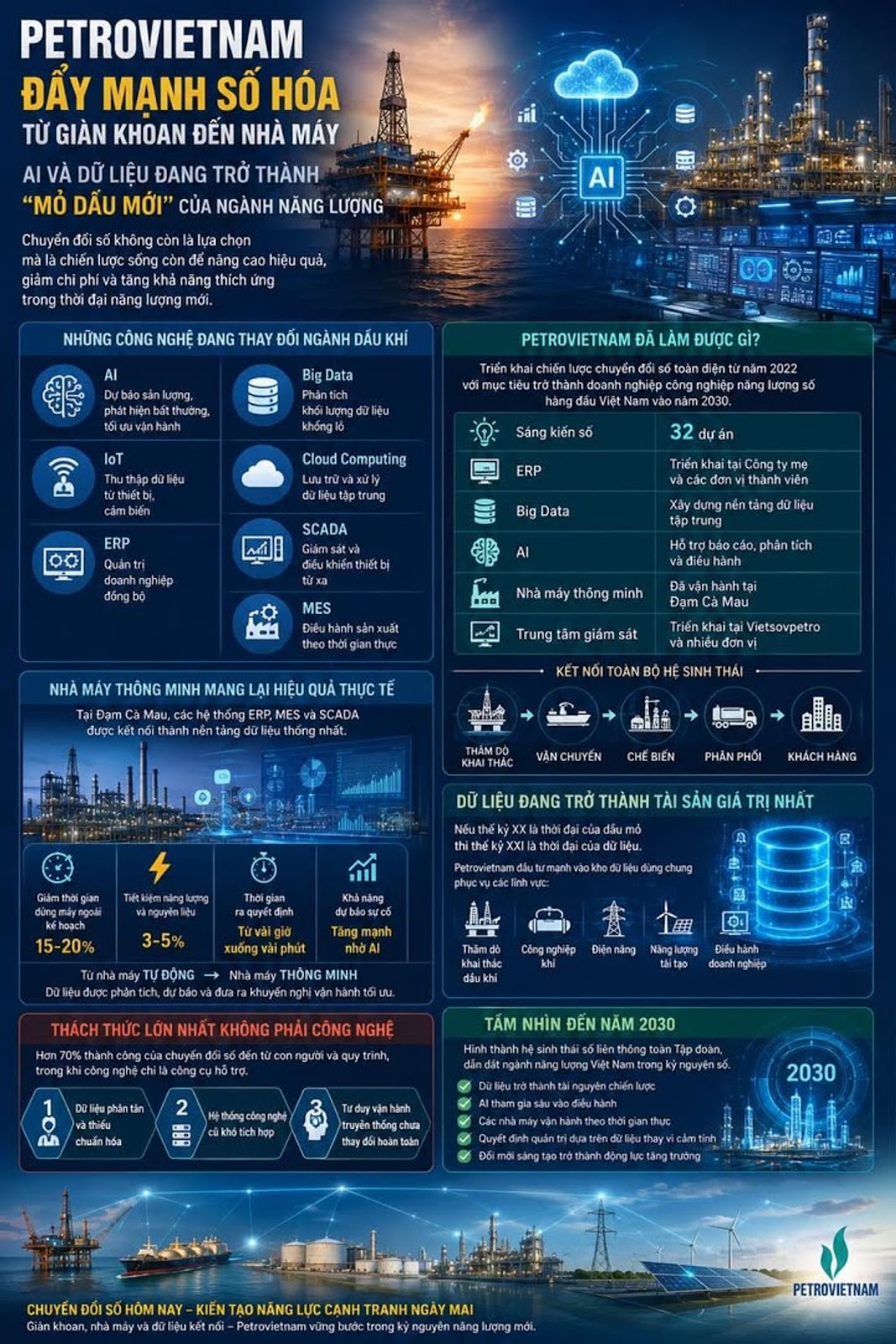
Data and AI: The "New Oil" in Vietnam's Energy Sector Transformation
In the rapidly evolving landscape of global energy, a quiet revolution is underway—one where data and artificial intelligence are becoming as valuable as the fossil fuels that powered the 20th century. For Petrovietnam, Vietnam's state-owned energy giant, digital transformation has evolved from a mere technological initiative to a critical survival strategy aimed at enhancing operational efficiency, reducing costs, and increasing adaptability in an increasingly volatile energy market.
The Energy Industry's Digital Revolution
The global energy industry is entering a new era where data, artificial intelligence, and automation are becoming decisive competitive factors. With Petrovietnam, digital transformation is no longer just a technology project but a vital strategy to improve operational efficiency, reduce costs, and increase adaptability amid growing market volatility.
From offshore drilling rigs to fertilizer plants, power stations, and gas processing facilities on land, data is being connected into a unified digital ecosystem, enabling enterprises to monitor, analyze, and make real-time decisions.
Technologies Reshaping the Oil and Gas Industry
| Technology | Role |
|---|---|
| AI | Production forecasting, anomaly detection, operational optimization |
| Big Data | Analysis of massive data volumes |
| IoT | Data collection from devices and sensors |
| Cloud Computing | Centralized data storage and processing |
| ERP | Integrated enterprise management |
| SCADA | Remote equipment monitoring and control |
| MES | Real-time production management |
Where operational decisions once depended heavily on engineers' experience, AI can now analyze millions of data points in just minutes, helping identify risks and propose solutions before incidents occur.
Petrovietnam's Digital Transformation Journey
Petrovietnam began implementing its comprehensive digital transformation strategy in 2022, with the goal of becoming Vietnam's leading digital energy enterprise by 2030.
Key Achievements
| Initiative | Outcome |
|---|---|
| Digital initiatives | 32 projects implemented |
| ERP | Deployed at parent company and subsidiaries |
| Big Data | Centralized data platform established |
| AI | Supporting reporting, analysis, and operations |
| Smart factories | Operational at Ca Mau Fertilizer Plant |
| Monitoring centers | Deployed at Vietsovpetro and other units |
Notably, Petrovietnam is not digitizing individual departments in isolation but is working toward connecting the entire ecosystem—from exploration and production to transportation, processing, and distribution.
Smart Factories Delivering Tangible Results
At the Ca Mau Fertilizer Plant, ERP, MES, and SCADA systems are connected into a unified data platform.
Documented Results
| Indicator | Improvement |
|---|---|
| Reduction in unplanned machine downtime | 15% - 20% |
| Energy and raw material savings | 3% - 5% |
| Decision-making time | Reduced from several hours to several minutes |
| Incident prediction capability | Significantly enhanced through AI |
This represents a crucial shift from automated factories to smart factories, where data is not only collected but also analyzed to provide operational recommendations.
Data: The Most Valuable Asset
If the 20th century was the age of oil, the 21st century is becoming the age of data. Industry experts note that companies with better data ownership and more efficient data exploitation will have greater competitive advantages, even when physical resources are no longer as abundant as before.
This is why Petrovietnam is heavily investing in a shared data repository serving various sectors:
- Oil and gas exploration and production
- Natural gas industry
- Electric power
- Renewable energy
- Corporate management
The Biggest Challenge Isn't Technology
Surprisingly, the greatest difficulty in digital transformation doesn't lie in AI or software. The three major current challenges are:
- Scattered and non-standardized data
- Difficulty integrating legacy systems
- Traditional operational thinking that hasn't completely changed
Many experts note that over 70% of digital transformation success comes from people and processes, while technology is merely a supporting tool.
Vision for 2030
Petrovietnam aims to create an interconnected digital ecosystem across the entire corporation by 2030, where:
- Data becomes a strategic resource
- AI deeply participates in operations
- Factories operate in real-time
- Management decisions are based on data rather than intuition
- Innovation becomes a growth driver
In the context of intense global competition in the energy sector and the shift toward greener, smarter models, the technology race may determine the position of energy corporations for many decades to come.
The Future Energy Workforce
A thought-provoking question arises: in the near future, will the most skilled oil and gas engineers be those operating offshore rigs or those who master AI and data?
As Petrovietnam and other global energy companies continue their digital transformation journeys, the answer to this question may well shape the future of the entire energy industry.