#Hydrodesulfurization #HDS #Refinery #OilAndGas #CongNgheDauKhi #LocHoaDau #NhienLieuSach #Diesel #Kerosene #NangLuong #HoaDau
If the HDS system suddenly stopped working for just 24 hours at a large oil refinery, millions of liters of fuel could fail to meet environmental standards and damage could reach tens of billions of dong, do you believe that to be true?
June 14, 2026 at 12:00, the topic of Hydrodesulfurization (HDS) continues to attract great attention in the global petrochemical industry as clean fuel standards become more and more stringent.
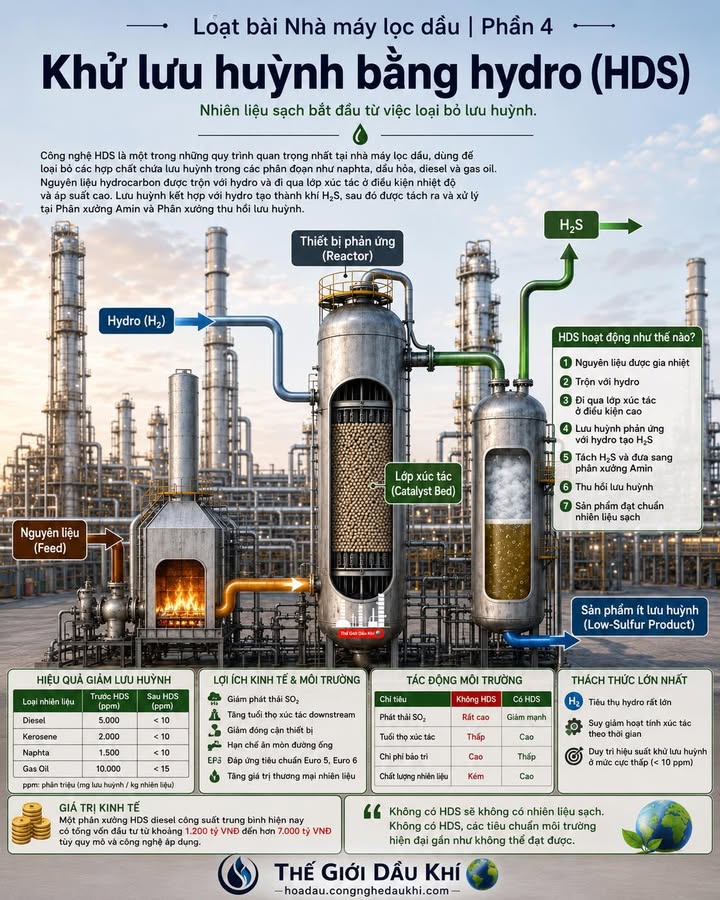
HDS is hydrogen desulfurization technology, considered one of the most important processes in modern oil refineries. This technology helps remove sulfur-containing compounds in naphtha, kerosene, diesel and gas oil before bringing the product to market.
️ HOW THE HDS SYSTEM WORKS
The petroleum raw material stream is fed into the heating furnace.
Pure hydrogen is added to the feed stream.
The mixture passes through a reactor containing a specialized catalyst layer.
Sulfur reacts with hydrogen to form H₂S gas.
H₂S gas is separated and transferred to the Amine treatment system and recovery workshopsulfur.
Clean low-sulfur fuel is sent to the next stages.
Table describing the HDS process
Function Stage
Heating the raw material Increases the reaction temperature
Hydrogen Addition Provides hydrogen for the reaction
Reactor HDS Sulfur removal
Separating H₂S Recovering toxic gases
Sulfur recovery Converted into commercial sulfur
End product Clean fuel meets standards
⚙️ MAIN CHEMICAL REACTIONS
Sulfur + Hydrogen compound
↓
Clean Hydrocarbon + H₂S
Thanks to this reaction, the sulfur content in fuel can be reduced from thousands of ppm to just a few ppm in accordance with international environmental requirements.
SULFUR REDUCTION EFFECTIVENESS
Fuel type Before HDS After HDS
Diesel 5,000 ppm is less than 10 ppm
Kerosene 2,000 ppm is less than 10 ppm
Naphtha 1,500 ppm is less than 10 ppm
Gas Oil 10,000 ppm below 15 ppm
ECONOMIC AND ENVIRONMENTAL BENEFITS
✅ Reduce SO₂ emissions
✅ Increase downstream catalyst life
✅ Reduce equipment scaling
✅ Limit pipe corrosion
✅ Meets Euro 5 and Euro 6 standards
✅ Increase fuel commercial value
Estimated environmental impact
Indicators No HDS With HDS
SO₂ emissions Very High Strongly reduced
Catalytic life Low High
Maintenance costs High Low
Fuel quality Poor High
THE BIGGEST CHALLENGE OF X-DEGREESUONG HDS
Operations engineers often face three most important problems
• Hydrogen consumption is huge
• Decreased catalytic activity over time
• Maintains desulfurization efficiency at extremely low levels
Especially as the trend of ultra-clean fuels is growing, the requirement for sulfur to be below 10 ppm causes pressure on the HDS system to increase significantly.
ECONOMIC VALUE
A current average capacity HDS diesel workshop has a total investment capital from about 1,200 billion VND to more than 7,000 billion VND depending on the scale and applied technology.
However, this cost is considered mandatory to meet modern fuel standards and avoid huge environmental fines.
️ STORY FROM THE ACTUAL OIL REFINING INDUSTRY
According to many oil refinery operation experts, just one abnormal loss of activity of the HDS catalyst can cause the entire line to reduce product quality. At that time, the plant has to reduce load or stop the system to replace the catalyst, causing billions of dong in damage every day.
That is why technology engineers always consider HDS as one of the most important "environmental shields" in the modern petrochemical industry.
Without HDS there will be no clean fuel. Without HDS, modern environmental standards are almost dryng can be achieved.
See more at hoadau.congnghedaukhi.com
#Hydrodesulfurization #HDS #RefineryOperations #PetroleumRefining #ChemicalEngineering #ProcessEngineering #OilAndGas #LowSulfurFuel #CleanFuel #CongNgheDauKhi #NangLuong #LocHoaDau #Diesel #Kerosene #MoiTruong #KySuHoaDau ️⚙️