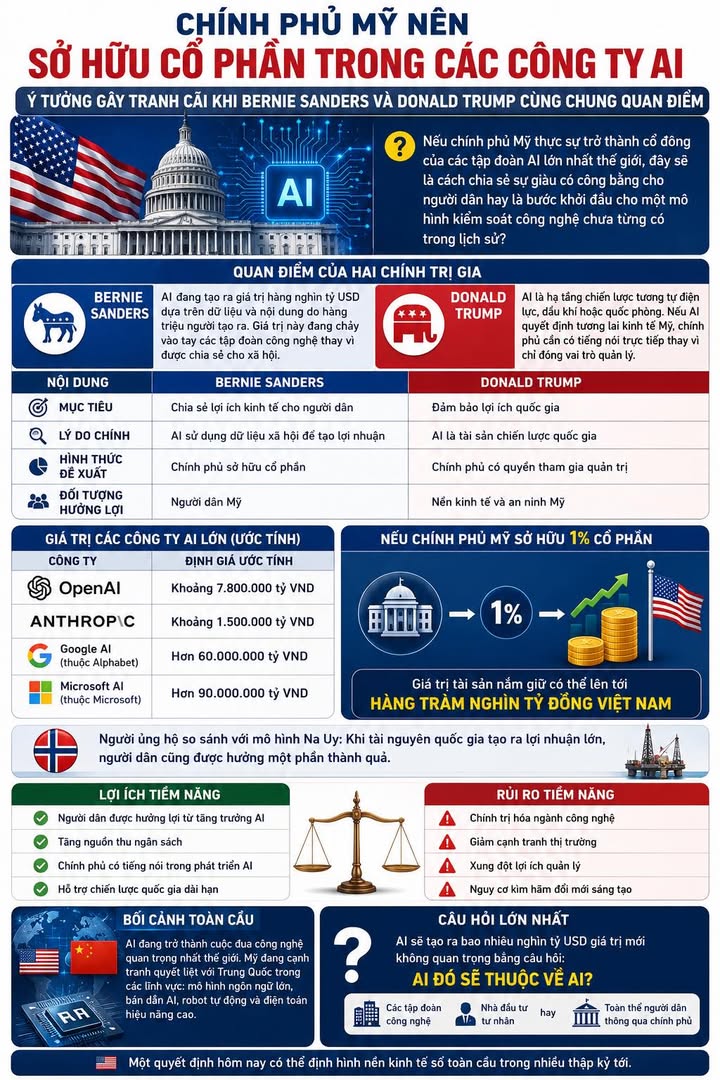
Government Ownership in AI Companies: When Sanders and Trump Find Common Ground
In an unusual political alignment, Senator Bernie Sanders and former President Donald Trump have both expressed interest in a radical proposal: that the U.S. government should own equity in major artificial intelligence companies. This unexpected convergence of views from across the political spectrum has sparked a profound debate about the future of digital economics and the governance of transformative technologies.
The suggestion that government should become a shareholder in AI enterprises represents one of the most significant policy discussions in recent technological history. While Sanders and Trump arrive at this position from fundamentally different ideological perspectives, their shared interest in government involvement highlights growing concerns about the concentration of power and wealth in the AI sector.
Sanders' Vision: Economic Justice Through Data Ownership
For Bernie Sanders, the impetus behind government ownership in AI companies stems from a deep concern about economic inequality. The senator argues that AI systems are generating trillions of dollars in value based on data contributed by millions of Americans – including their artwork, writings, images, videos, and other creative content.
"The wealth being created by AI doesn't emerge from a vacuum," Sanders has suggested in various forums. "It's built upon the collective contributions of ordinary people whose data and creative work form the foundation of these systems. Yet this value is being captured almost exclusively by a handful of tech corporations."
The Sanders approach envisions government ownership as a mechanism for redistributing some of this wealth back to the public. By holding equity in AI companies, the government could potentially generate revenue that could be used for social programs, infrastructure development, or direct payments to citizens.
Trump's Perspective: National Security and Strategic Control
Donald Trump's position, while reaching the same conclusion about government involvement, stems from a different rationale rooted in nationalism and strategic interests. Trump and his allies view AI not merely as an economic engine but as critical infrastructure comparable to electricity, oil, or national defense systems.
"If AI is going to determine America's economic and military future, then America should have a direct say in how it's developed and controlled," Trump has indicated in statements about technology policy. "We can't outsource our future to faceless corporations or foreign competitors."
This perspective emphasizes national security concerns, technological sovereignty, and ensuring that American leadership in AI is maintained through direct government participation in the governance of key AI enterprises. The Trump approach focuses less on wealth redistribution and more on strategic control over what is increasingly seen as the most important technology of the 21st century.
Comparing Visions: Sanders vs. Trump on AI Ownership
| Aspect | Bernie Sanders' Position | Donald Trump's Position |
|---|---|---|
| Primary Goal | Economic redistribution and shared prosperity | National security and strategic advantage |
| Core Rationale | AI value derives from societal data; benefits should be shared | AI represents critical infrastructure requiring state control |
| Proposed Mechanism | Direct government ownership of equity stakes | Government participation in governance and oversight |
| Intended Beneficiaries | American citizens through wealth redistribution | National economy and security apparatus |
| Philosophical Basis | Democratic socialism and economic justice | Economic nationalism and technological sovereignty |
The Scale of AI Valuations
The discussion about government ownership occurs against the backdrop of extraordinary valuations for major AI companies. The financial stakes involved are substantial, making the question of ownership particularly significant.
| Company | Estimated Valuation |
|---|---|
| OpenAI | Approximately $7.8 trillion VND |
| Anthropic | Approximately $1.5 trillion VND |
| Google AI | Part of Alphabet ecosystem valued at over $60 trillion VND |
| Microsoft AI | Part of Microsoft valued at over $90 trillion VND |
Even a small government stake in these companies could represent enormous value. For instance, a 1% ownership share across these major AI enterprises could translate to hundreds of trillions of Vietnamese đồng in government assets – resources that could significantly impact national budgets and public services.
The Norwegian Precedent: Resource Wealth and National Funds
Supporters of government ownership in AI often point to Norway's sovereign wealth fund as a model. Norway, after discovering its vast oil reserves, created a government fund to manage and invest the nation's resource wealth. This approach has allowed Norway to save and grow its oil wealth for future generations while using some of the returns to fund current services.
"AI represents our new oil," argues one proponent of government ownership. "Just as Norway recognized that natural resources belong to the people and should benefit them collectively, we should recognize that the value generated by AI – built on our collective data and creativity – should similarly benefit society."
This perspective suggests that government ownership could create a permanent source of public revenue while also giving citizens a stake in the digital economy's future growth.
Concerns and Criticisms
Despite the appeal of government ownership, significant concerns have been raised about potential negative consequences:
- Political Interference: Government ownership could lead to politicization of AI development, with systems potentially designed to align with political agendas rather than technical excellence.
- Reduced Innovation: The competitive drive that has fueled much of AI's rapid advancement could be diminished if government involvement slows decision-making or discourages risk-taking.
- Conflict of Interest: When government serves as both regulator and shareholder, conflicts of interest may arise, potentially compromising regulatory objectivity.
- Market Distortion: Government ownership could create an uneven playing field, disadvantaging private companies and potentially leading to less efficient resource allocation.
Benefits and Risks Assessment
| Potential Benefits | Potential Risks |
|---|---|
| Public sharing of AI-generated wealth | Politicization of technological development |
| Increased government revenue for public services | Reduced market competition and innovation |
| Greater public influence over AI development direction | Conflicts of interest between regulation and ownership |
| Long-term strategic alignment of AI with national interests | Slowed technological advancement due to bureaucracy |
| Creation of a sovereign wealth fund for digital assets | International perception of state-controlled innovation |
Geopolitical Context: The AI Race
This debate occurs amid intensifying global competition in AI, particularly between the United States and China. Both nations are investing enormous resources in developing large language models, AI semiconductors, autonomous systems, and high-performance computing – technologies widely seen as decisive for economic and military leadership in the coming decades.
The U.S. government's approach to AI ownership could significantly impact this competitive landscape. While China has pursued a state-led model of AI development with significant government involvement and direction, the United States has traditionally relied on market-driven innovation with government playing a supporting role through research funding and light-touch regulation.
A shift toward government ownership in AI would represent a fundamental realignment of America's approach to technological development, potentially making it more similar to China's model while maintaining some aspects of private enterprise.
Historical Significance
If implemented, government ownership in major AI companies would constitute one of the most significant transformations of American capitalism since World War II. The post-war period saw the emergence of the military-industrial complex and substantial government involvement in infrastructure and research, but never before has the government proposed becoming a direct shareholder in the most valuable technology enterprises.
This potential shift raises fundamental questions about the relationship between government, private enterprise, and technological progress in the digital age.
The Central Question of Ownership
Ultimately, the debate about government ownership in AI companies revolves around a fundamental question: who should benefit from the immense value being created by artificial intelligence?
Currently, that value primarily accrues to:
- Shareholders of major technology corporations
- Highly skilled AI professionals who command premium salaries
- Consumers who benefit from improved products and services
The proposal for government ownership suggests that the public – through their elected representatives – should also have a direct claim on this value, either through revenue generation or through influence over how AI systems are developed and deployed.
Conclusion: Shaping the Digital Economy
The unexpected convergence of Bernie Sanders and Donald Trump on this issue highlights the depth of concern about the trajectory of AI development and the distribution of its benefits. Regardless of which perspective prevails, the discussion itself marks a recognition that AI is not merely another technological advancement but a fundamental force reshaping our economic and social structures.
How the United States addresses questions of ownership, governance, and benefit-sharing in AI will likely influence the development of digital economies worldwide. The path chosen could establish precedents that shape the relationship between technology and society for generations to come.
In the end, the debate about government ownership in AI companies is part of a larger conversation about the kind of digital future we want – one where technological progress benefits all of society, or one where it primarily enriches existing power structures. The answer to this question may well determine the character of the 21st century economy.