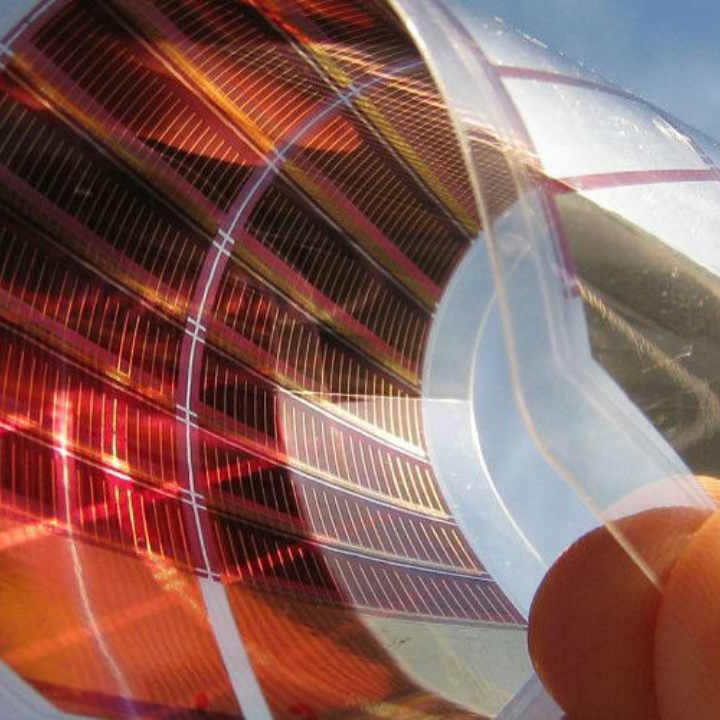
Trina Solar Shatters World Solar Panel Efficiency Record with Perovskite Technology
Solar technology has taken a monumental leap forward as Chinese company Trina Solar has officially broken the world record for solar module efficiency, achieving a conversion efficiency of 29.2% and an unprecedented peak power output of 907 watts. This achievement surpasses the previous record set by Qcells (South Korea), marking a significant milestone in the global renewable energy technology race.
Battle of Industry Titans
Last year, Qcells, a subsidiary of South Korea's Hanwha Corp, established the efficiency record for large-area silicon solar cells at 28.6%. This accomplishment was achieved by combining a top perovskite light-absorbing layer with a bottom silicon layer to capture a broader spectrum of sunlight. Compared to premium commercial solar panels typically operating at 21-23% efficiency, this technology promises to significantly reduce the footprint of solar projects and cut costs.
However, with Trina Solar's latest record, China has reclaimed the position of world leader in high-efficiency solar panel manufacturing. Trina's record not only surpasses the efficiency benchmark but also demonstrates commercial viability at an industrial scale.
Breakthrough Technology: Perovskite-on-Silicon Tandem
Trina's solar cells are no ordinary technology. Their record was achieved using a perovskite-on-silicon tandem design, stacking two different solar materials on top of each other to capture a wider spectrum of sunlight. The perovskite layer absorbs high-energy wavelengths while the silicon layer captures light that would otherwise pass through the perovskite layer, allowing the cell to convert more solar energy into electricity.
The company has also developed a new interconnection structure between the two layers that reduces energy loss and improves current flow through the cell, helping to push efficiency to record levels. Similar to Qcells' previous record, Trina achieved this breakthrough on standard 210mm industrial wafers rather than small laboratory cells.
| Metric | New Record (Trina Solar) | Previous Record (Qcells) | Commercial Solar Panels |
|---|---|---|---|
| Conversion Efficiency | 29.2% | 28.6% | 21-23% |
| Peak Power | 907 watts | Not disclosed | 300-400 watts |
| Cell Size | 210mm (industrial standard) | 210mm (industrial standard) | 156-166mm |
From Laboratory to Large-Scale Commercialization
While individual laboratory cells have achieved higher efficiencies at the micro level, we're now talking about commercial-scale applications. Traditional silicon solar panels are approaching the theoretical limit of what the technology can deliver. Perovskite-silicon tandem cells offer a solution by capturing a broader light spectrum and generating more electricity from the same panel area.
Trina Solar reports 29.2% efficiency on full-size cells and 32.6% on half-cut cells, demonstrating that the technology can be manufactured at commercial sizes. The resulting module produces 907 watts of electricity, a significant increase from the company's previous record of 808 watts and substantially higher than the power output of conventional solar panels currently deployed in the field.
Perovskite Materials: The Future of Solar Energy
Perovskite is a class of materials with a characteristic diamond-like crystal structure. Perovskite solar cells can convert a broader spectrum of sunlight than traditional silicon. In fact, perovskite can be deposited directly on top of traditional silicon solar cells, with these "tandem" cells absorbing the colors of light that silicon misses and pushing the theoretical maximum efficiency above 40%.
Moreover, unlike silicon which requires high-temperature, energy-intensive manufacturing, perovskite can be processed into ink and printed at room temperature, significantly reducing production costs. While commercial perovskite solar cells are already available, they haven't yet been widely deployed for standard rooftop installations, largely because pure perovskite cells degrade quickly when exposed to outdoor elements like moisture, heat, and UV light.
The Commercialization Race
However, several pioneering companies have begun producing and shipping them at large scale. This includes California-based Caelux, whose "Active Glass" technology allows power plants to build Hybrid-Tandem modules on existing assembly lines without redesigning silicon cells or complex upgrades. Meanwhile, UK-based Oxford PV has begun shipping modules with up to 24.5% efficiency to utility-scale customers in the US and Europe.
Trina Solar's breakthrough pushes perovskite technology further into commercial territory. Researchers have posted impressive efficiency numbers for years; the challenge has been replicating them on modules large enough for mass production. Now, the race is on to manufacture them at scale and keep them operating reliably outdoors for decades.
This breakthrough is not just an efficiency milestone but also proof of the commercial viability of perovskite-silicon technology, opening a new chapter in the global renewable energy landscape.