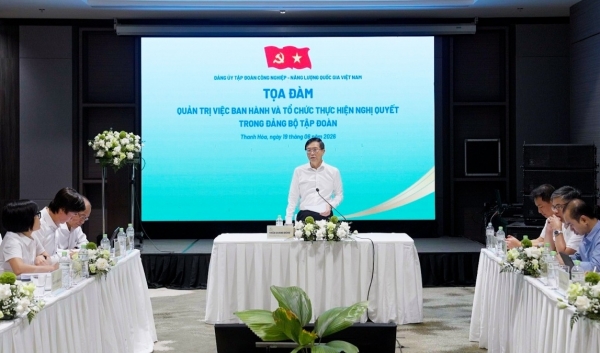
Implementing Party Resolutions in Practice: Petrovietnam Innovates Leadership Methods to Enhance Governance Effectiveness
On June 19, the Party Committee of Vietnam Oil and Gas Group (Petrovietnam) organized a significant seminar focused on governance. The program aimed to discuss the issuance and implementation of Party resolutions, thereby enhancing leadership effectiveness and direction in production and business operations.
Background and Significance
Petrovietnam, as a key economic pillar of Vietnam, has been entrusted with the critical task of implementing Party resolutions into practical business operations. The seminar represents a strategic initiative to align the state-owned enterprise's governance framework with national development goals while addressing contemporary business challenges.
The event brought together senior leadership, department heads, and key stakeholders to deliberate on innovative approaches to management that could position Petrovietnam more competitively in the global energy sector while fulfilling its national mandate.
Objectives of the Seminar
The seminar concentrated on solutions aimed at innovating leadership methods, with a vision to improve governance effectiveness at Petrovietnam. Participants discussed the adoption of target-based management and result-oriented governance, while emphasizing the pivotal role of data analytics and digital transformation in this process.
"In today's rapidly evolving energy landscape, traditional management approaches are no longer sufficient," stated a representative from the Party Committee. "We need to embrace modern governance frameworks that balance our socialist principles with contemporary business best practices."
Key Discussion Points
- Innovation in Leadership Methods: Participants shared experiences and methodologies for enhancing leadership and management in the modern context. The discussion focused on transitioning from hierarchical decision-making to more collaborative, data-informed approaches.
- Target-Based Management: The seminar emphasized identifying and tracking specific objectives to improve work efficiency. This includes developing key performance indicators (KPIs) that align both with national priorities and market demands.
- Digital Transformation: Significant attention was given to the importance of applying information technology to collect, analyze, and manage data more effectively. The potential implementation of enterprise resource planning (ERP) systems and data analytics platforms was explored.
- Integration of Party Principles with Business Operations: A critical aspect of the discussion was how to incorporate the principles and directives from Party resolutions into daily business operations without compromising operational efficiency.
- Stakeholder Engagement: The seminar addressed strategies for improving communication and coordination between different departments, subsidiaries, and external stakeholders.
Expected Outcomes
Through the adoption of new management methods, Petrovietnam anticipates enhancing not only work efficiency but also cohesion between various departments. This is expected to create a more positive and innovative work environment that can better respond to market challenges while advancing national energy security objectives.
"The transformation we're proposing is not merely procedural but cultural," explained a senior Petrovietnam executive. "We aim to foster an organization that values both collective achievement and individual initiative, guided by the principles of our Party but executed with modern business acumen."
Implementation Challenges
Bringing Party resolutions into practical implementation represents not only a crucial task but also a significant challenge for Petrovietnam. This requires unity and determination from all levels of leadership and staff across the organization.
The enterprise faces the complex task of balancing its dual role as a commercial entity and a state-owned enterprise implementing national policy. Additionally, the transition to new governance models requires substantial changes in organizational culture, employee training, and technological infrastructure.
Strategic Roadmap
The seminar outlined a multi-phase implementation strategy:
- Assessment Phase: Current governance structures and processes will be evaluated against the new framework.
- Planning Phase: Detailed implementation plans will be developed with specific timelines and responsibilities.
- Pilot Implementation: New governance approaches will be tested in selected departments or subsidiaries.
- Scaling Phase: Successful approaches will be expanded across the organization.
- Optimization Phase: Continuous improvement mechanisms will be established to ensure ongoing effectiveness.
Expected Impact on Petrovietnam's Operations
The transformation in governance is expected to yield several significant benefits:
- Enhanced decision-making processes through data-driven insights
- Improved operational efficiency and resource allocation
- Greater alignment between strategic objectives and daily operations
- Strengthened accountability across all organizational levels
- Increased ability to respond to market changes and technological disruptions
- Better integration of environmental, social, and governance (ESG) principles into business operations
Implementation Framework Summary
| Content Area | Implementation Approach | Expected Outcomes |
|---|---|---|
| Leadership Innovation | Discussion and application of new leadership models; training programs for middle and senior management | Enhanced leadership effectiveness; improved decision-making processes |
| Target Management | Development of KPIs aligned with national priorities; implementation of performance tracking systems | Improved work performance; better alignment of individual and departmental goals with organizational objectives |
| Digital Transformation | Implementation of ERP systems; establishment of data analytics capabilities; digital skills training | Optimized business processes; enhanced data-driven decision making; improved operational efficiency |
| Cultural Transformation | Change management initiatives; communication campaigns; recognition programs aligned with new values | More innovative and collaborative work environment; increased employee engagement |
Conclusion
The seminar concluded successfully, generating numerous practical ideas and solutions aimed at enhancing governance effectiveness and implementing Party resolutions in the most efficient manner within the current context.
"This represents a significant step forward for Petrovietnam," stated the Party Committee representative. "By modernizing our governance approach while maintaining our commitment to national development goals, we position ourselves to better serve both Vietnam's energy needs and the global energy transition."
As Vietnam continues its economic development journey, Petrovietnam's transformation in governance methods could serve as a model for other state-owned enterprises seeking to balance socialist principles with market-oriented efficiency in the 21st century.