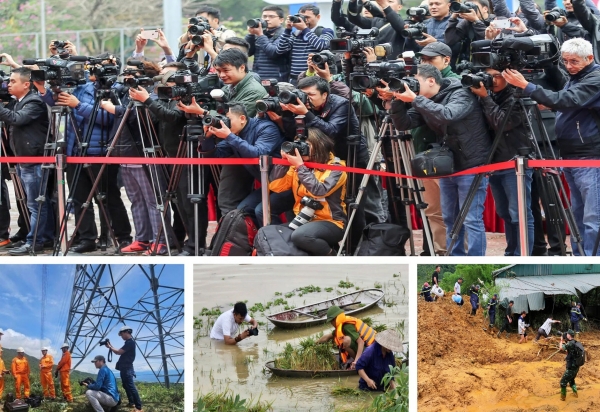
General Secretary and State President Tô Lâm: A Vision for the Future of Vietnamese Journalism
In the context of rapid digital development, General Secretary and State President Tô Lâm has delivered important messages about development orientations for Vietnamese journalism. According to these messages, in the current era of information overload, the greatest value of journalism is no longer just delivering news faster but helping society understand better and trust more.
The Context of the New Information Era
The world is witnessing an unprecedented explosion of information. Every day, billions of data points are created, shared, and accessed globally. The development of technology, particularly social media and digital platforms, has completely transformed how people receive and process information.
In this context, traditional journalism faces significant challenges. The competition for speed in news delivery has become fierce, but according to General Secretary and State President Tô Lâm, this is not the core factor determining the success of modern journalism.
The Core Values of Journalism in the New Era
In his article, General Secretary and State President Tô Lâm emphasizes that the greatest value of journalism in the era of information overload is no longer just delivering news faster but helping society understand better and trust more. This is an important orientation emphasizing information quality and social responsibility of media organizations.
General Secretary and State President Tô Lâm emphasized: "In the massive flow of information, journalism must maintain its role as a public opinion leader, providing accurate, objective, multi-dimensional information, contributing to guiding the thinking and actions of society."
The Responsibility of Journalism in Building Trust
The article clearly states that in the context of fake news and misinformation spreading rapidly online, legitimate journalism has the responsibility to become a reliable anchor for the public. This requires media organizations to:
- Ensure the accuracy and reliability of information
- Strengthen information verification before publication
- Provide multi-dimensional information, avoiding one-sidedness
- Maintain professional ethics, not chasing quantity at the expense of quality
Innovation to Adapt to New Trends
General Secretary and State President Tô Lâm also pointed out that to meet the requirements of the new era, Vietnamese journalism needs to proactively innovate and strongly apply information technology to operational activities. Specifically:
- Strong digital transformation, developing electronic press platforms
- Applying artificial intelligence and big data in content production and distribution
- Developing multi-media, multi-platform journalism forms
- Enhancing the capacity of journalists and editors in the digital environment
Challenges and Opportunities for Vietnamese Journalism
Vietnamese journalism faces many challenges but also numerous opportunities in the new context. The table below summarizes the main challenges and opportunities:
| Challenges | Opportunities |
|---|---|
| Competition from social media platforms | Expanding audience reach |
| Fake news and misinformation | Building reputable journalism brands |
| Changing information consumption habits of the public | Innovating journalism business models |
| Pressure on speed of news delivery | Focusing on quality and depth of content |
| Increasing demands on digital skills of the workforce | Applying new technologies to content production |
Proposed Solutions for the Future of Vietnamese Journalism
To effectively implement the development orientation for Vietnamese journalism as proposed by General Secretary and State President Tô Lâm, the article presents several important solutions:
Regarding Content and Information Quality
- Enhance in-depth information, analysis, and commentary
- Diversify genres and presentation styles
- Focus on social issues and people's lives
- Build effective information verification mechanisms
Regarding Organization and Operations
- Improve management and operational mechanisms for journalism
- Innovate organizational models and activities of media organizations
- Strengthen cooperation and collaboration between media organizations
- Build a team of high-quality editors, reporters, and journalists
Regarding Technology Application
- Invest in information technology infrastructure
- Develop modern electronic press platforms
- Apply artificial intelligence and big data in content production
- Build systems for analyzing and predicting information trends
Conclusion
General Secretary and State President Tô Lâm's article on the future of Vietnamese journalism provides an important orientation, affirming the core value of journalism in the era of information overload. According to this, journalism should focus on helping society understand better and trust more, rather than just chasing the speed of news delivery.
This is a profound message that guides the development of Vietnamese journalism in the coming time. By maintaining traditional values while proactively innovating and applying technology, Vietnamese journalism can meet the requirements of the new era, effectively fulfill its mission of information dissemination, propaganda, public opinion guidance, and serving the people.
Effectively implementing this orientation is not only the responsibility of media organizations but also requires the joint efforts of the entire society, from management agencies to readers, to build a healthy, trustworthy, and high-value information environment.
In this context, each media organization needs to clearly recognize its role and responsibility, continuously innovate, improve content quality, and apply technology effectively to deserve the people's trust and contribute to the sustainable development of the country.