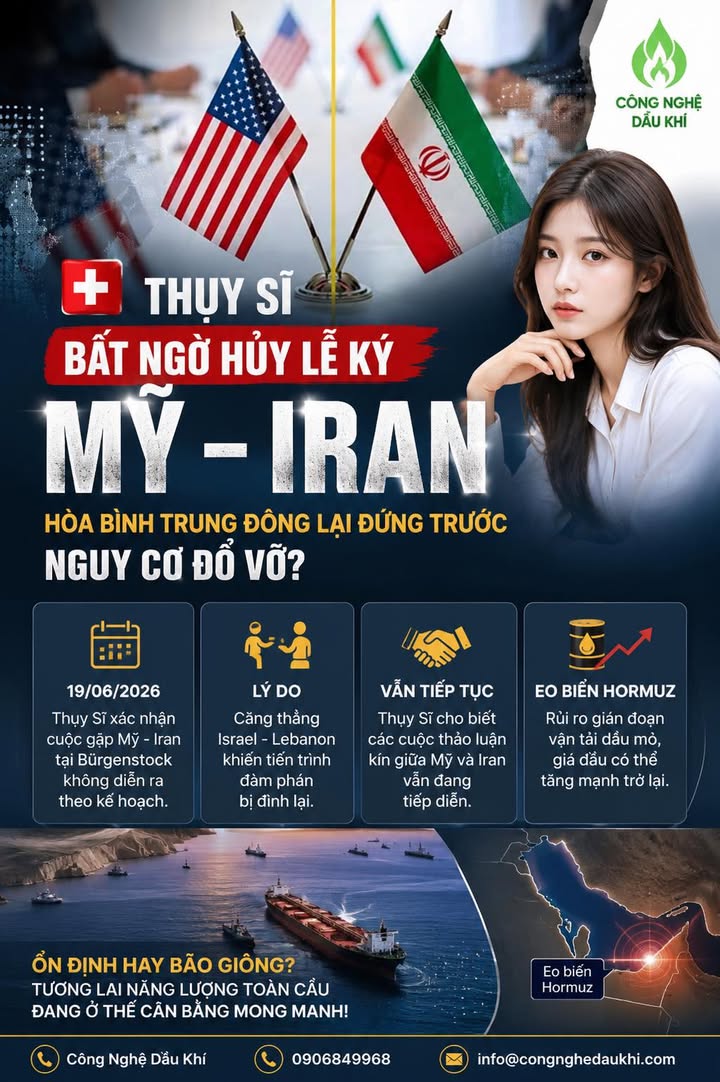
Switzerland Cancels US-Iran Peace Summit at Last Minute, Middle East Peace Process at Risk
In a dramatic development that has sent shockwaves through global diplomatic circles, Switzerland has confirmed the cancellation of a high-level meeting between American and Iranian delegations at Bürgenstock, just hours before the scheduled signing ceremony. This abrupt postponement has cast serious doubts over a 60-day negotiation process aimed at transforming a temporary ceasefire into a more comprehensive long-term agreement between Washington and Tehran.
The cancellation comes at a critical time when tensions in the Middle East have been escalating, raising concerns about potential disruptions to global energy markets and the stability of the entire region.
Dramatic Last-Minute Cancellation
On June 19, 2026, Switzerland's Ministry of Foreign Affairs officially announced that the much-anticipated summit between US and Iranian representatives at the Bürgenstock resort would not proceed as planned. This meeting was intended to mark the beginning of an intensive 60-day negotiation period to solidify the preliminary peace memorandum signed earlier by President Donald Trump and Iranian representatives.
The cancellation gained added significance when US Vice President JD abruptly canceled his trip to Switzerland at the final hour. Prior to this announcement, preparations at Bürgenstock had been virtually complete, with Switzerland fully prepared to host the delegations for what was expected to be a historic diplomatic breakthrough.
Timeline of Events
| Date | Event |
|---|---|
| June 15, 2026 | President Donald Trump and Iranian representatives complete electronic signing of preliminary peace memorandum |
| June 18, 2026 | Switzerland confirms US-Iran negotiations will take place at Bürgenstock |
| June 19, 2026 | Switzerland announces the meeting has been postponed |
| June 19, 2026 | US Vice President JD Vance cancels his trip to Switzerland |
| June 20, 2026 | Switzerland confirms secret discussions between US and Iran continue |
Key Figures in the Peace Process
| Person | Role |
|---|---|
| Donald Trump | President of the United States |
| JD Vance | Vice President of the United States |
| Abbas Araqchi | Foreign Minister of Iran |
| Mohammad Bagher Qalibaf | Head of Iranian negotiating delegation |
| Steve Witkoff | US Special Envoy |
| Jared Kushner | Member of US negotiating delegation |
Reasons Behind the Postponement
The primary factor behind the cancellation appears to be new military developments in Lebanon. As the United States and Iran were preparing to enter technical negotiations, fighting between Israel and Hezbollah once again escalated. Israeli airstrikes in southern Lebanon, coupled with retaliatory attacks from Hezbollah, created an extremely sensitive political environment.
Iran has expressed that the continued escalation of conflict undermines previous commitments made during the preliminary peace talks. In response, Israel has stated that they are not a party to the US-Iran agreement and will continue military operations as they deem necessary.
This development has created a complex diplomatic situation where progress on one front is directly threatened by developments on another, highlighting the interconnected nature of Middle Eastern conflicts.
The Strait of Hormuz: A Critical Flashpoint
One of the most crucial aspects of the peace process is ensuring the free flow of maritime traffic through the Strait of Hormuz. This strategic waterway is responsible for transporting the majority of crude oil exports from the Gulf region to global markets.
Any instability in this area could lead to significant price increases in oil markets, potentially triggering global inflationary pressures. The potential disruption of this vital shipping route represents one of the greatest risks to global energy security.
Potential Oil Market Scenarios
| Scenario | Potential Impact |
|---|---|
| US and Iran resume negotiations | Oil prices stabilize as geopolitical tensions ease |
| Negotiations continue to be delayed | Risk of significant oil price increases |
| Disruption of Hormuz shipping | Global energy crisis potential |
| Expansion of Israel-Hezbollah conflict | Highly volatile oil markets |
Current Status of Negotiations
Contrary to various rumors circulating on social media, Swiss authorities have confirmed that confidential discussions between the United States and Iran continue to take place at Bürgenstock. The Swiss government has declined to disclose the composition of participating delegations, citing the need to maintain diplomatic confidentiality.
This indicates that while the public meeting ceremony was canceled, the diplomatic process has not completely collapsed. Iranian delegation members led by Mohammad Bagher Qalibaf and Foreign Minister Abbas Araqchi are still reportedly traveling to Switzerland to continue exchanges with US representatives.
Conclusion: Uncertain Path Forward
As of 23:00 GMT on June 20, 2026, there is no confirmed evidence that the entire US-Iran peace process has failed completely. What is confirmed is that the public meeting scheduled for June 19 at Bürgenstock was postponed, while behind-the-scenes exchanges continue under Swiss mediation.
The path to a comprehensive agreement remains viable if all parties can control tensions in Lebanon. Conversely, any major military incident involving Israel, Hezbollah, or Iran could reverse the entire diplomatic process within hours.
The international community watches with bated breath as this delicate diplomatic dance continues, fully aware that the outcome could have profound implications for regional stability and global energy markets.