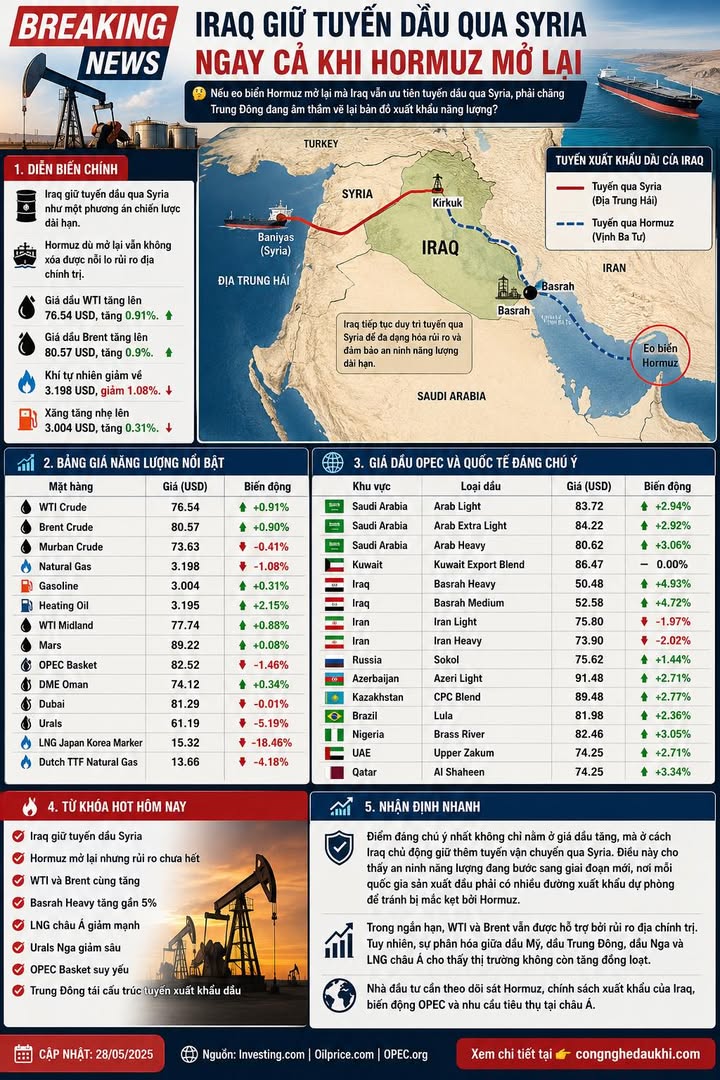
Iraq Maintains Syrian Oil Route Despite Strait of Hormuz Reopening
In a significant development reshaping the Middle Eastern energy landscape, Iraq has continued to prioritize its oil transportation routes through Syria even as the strategic Strait of Hormuz reopens to maritime traffic. This decision signals a fundamental shift in regional energy export strategies, potentially redrawing the map of oil flows in one of the world's most critical energy corridors.
The Strategic Decision
According to market reports, Iraq's persistence in utilizing the Syrian oil route represents a deliberate long-term strategic choice rather than a temporary measure. This approach reflects growing concerns among oil-producing nations about over-reliance on single choke points, particularly the Strait of Hormuz, through which approximately 20% of global oil supplies pass.
The decision comes amid fluctuating oil prices, with West Texas Intermediate (WTI) crude rising to $76.54 (+0.91%) and Brent crude reaching $80.57 (+0.9%). Meanwhile, natural gas prices decreased slightly to $3.198 (-1.08%), and gasoline showed modest growth at $3.004 (+0.31%).
Market Response and Price Movements
The energy market's reaction to Iraq's strategic shift has been varied, with different benchmarks showing divergent trends. While WTI and Brent crude prices have increased, the OPEC Basket has weakened, indicating a complex market dynamic influenced by multiple factors.
| Energy Commodity | Price | Change |
|---|---|---|
| WTI Crude | $76.54 | +0.91% |
| Brent Crude | $80.57 | +0.9% |
| Murban Crude | $73.63 | -0.41% |
| Natural Gas | $3.198 | -1.08% |
| Gasoline | $3.004 | +0.31% |
| Heating Oil | $3.195 | +2.15% |
| WTI Midland | $77.74 | +0.88% |
| Mars | $89.22 | +0.08% |
| OPEC Basket | $82.52 | -1.46% |
| DME Oman | $74.12 | +0.34% |
| Dubai | $81.29 | -0.01% |
| Urals | $61.19 | -5.19% |
| LNG Japan Korea Marker | $15.32 | -18.46% |
| Dutch TTF Natural Gas | $13.66 | -4.18% |
Regional Oil Pricing Dynamics
The pricing of different crude oil varieties reveals significant regional variations and market sentiments. While some benchmarks have strengthened, others have experienced notable declines, reflecting the complex interplay of geopolitical factors, supply-demand dynamics, and transportation considerations.
| Region | Oil Type | Price | Change |
|---|---|---|---|
| Saudi Arabia | Arab Light | $83.72 | +2.94% |
| Saudi Arabia | Arab Extra Light | $84.22 | +2.92% |
| Saudi Arabia | Arab Heavy | $80.62 | +3.06% |
| Kuwait | Kuwait Export Blend | $86.47 | 0% |
| Iraq | Basrah Heavy | $50.48 | +4.93% |
| Iraq | Basrah Medium | $52.58 | +4.72% |
| Iran | Iran Light | $75.80 | -1.97% |
| Iran | Iran Heavy | $73.90 | -2.02% |
| Russia | Sokol | $75.62 | +1.44% |
| Azerbaijan | Azeri Light | $91.48 | +2.71% |
| Kazakhstan | CPC Blend | $89.48 | +2.77% |
| Brazil | Lula | $81.98 | +2.36% |
| Nigeria | Brass River | $82.46 | +3.05% |
| UAE | Upper Zakum | $74.25 | +2.71% |
| Qatar | Al Shaheen | $74.25 | +3.34% |
Geopolitical Implications
The most significant aspect of Iraq's decision is not merely the price movements but the strategic realignment it represents in Middle Eastern energy politics. By maintaining the Syrian oil route, Iraq is demonstrating a commitment to diversifying its export options beyond traditional maritime choke points.
This approach reflects a broader recognition among energy-producing nations that security considerations must drive export strategy. Even with the Strait of Hormuz operational, the persistent geopolitical risks in the region have motivated countries to develop alternative transportation routes that can function independently of potentially volatile maritime passages.
Energy Security in Transition
The energy landscape appears to be entering a new phase where security concerns are paramount. Iraq's decision to maintain Syrian oil routes suggests a fundamental shift toward energy security through route diversification. This approach acknowledges that dependence on a single strategic passage, regardless of its current operational status, creates unacceptable vulnerability.
In the short term, WTI and Brent crude prices continue to receive support from geopolitical tensions. However, the market is showing increasing differentiation between different oil benchmarks, with American, Middle Eastern, Russian, and Asian LNG prices moving in divergent directions. This fragmentation indicates a more complex global energy market where regional factors significantly influence pricing.
Future Outlook
Market analysts suggest that investors should closely monitor three key factors: the operational status of the Strait of Hormuz, Iraq's evolving export policies, and OPEC production decisions. Additionally, consumption patterns in Asia, particularly China and India, will continue to play a decisive role in shaping global oil markets.
The emergence of alternative export routes through Syria could potentially reduce the strategic importance of Hormuz in the long term, provided these routes can maintain consistent operation and security. This development may encourage other Middle Eastern producers to explore similar diversification strategies, potentially leading to a more resilient and decentralized global oil transportation network.
As energy security becomes an increasingly prominent consideration in national strategies, the Middle East may be witnessing the early stages of a fundamental restructuring of its oil export infrastructure—one that prioritizes redundancy and diversification over concentration through traditional maritime choke points.