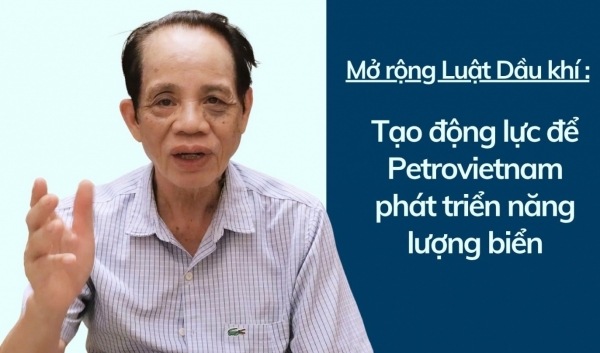
Dr. Ngô Đức Lâm Calls for Expanded Petroleum Law to Drive Petrovietnam's Offshore Energy Development
Maritime space is increasingly being recognized as a strategic development area crucial for Vietnam to achieve its double-digit growth targets. According to Dr. Ngô Đức Lâm, former Deputy Director of the Institute of Energy under the Ministry of Industry and Trade, improving and expanding the Petroleum Law will create favorable conditions for the Vietnam National Oil and Gas Group (Petrovietnam) to participate more deeply in offshore energy development and integrated energy industrial centers.
Strategic Context for Offshore Energy Development
With a coastline of over 3,260 km and a vast exclusive economic zone, Vietnam possesses enormous offshore energy potential. According to expert assessments, Vietnam's potential oil and gas reserves in the East Sea could amount to several billion tons equivalent. However, effectively exploiting these resources still faces numerous legal and technological challenges.
Dr. Ngô Đức Lâm emphasized: "In the context of global energy transition and increasing demand for clean energy, developing offshore energy not only brings economic benefits but also contributes to protecting the nation's maritime sovereignty."
Proposed Improvements to the Petroleum Law
According to Dr. Ngô Đức Lâm, the current Petroleum Law needs to be amended to create a legal framework suitable with modern offshore energy development trends. Key proposals include:
- Expanding the scope of petroleum activities to include offshore renewable energy forms such as offshore wind power and floating solar power
- Creating special mechanisms for Petrovietnam in developing integrated energy industrial centers
- Improving policies on benefit sharing and environmental protection in petroleum operations
- Building a transition roadmap to clean energy while ensuring national energy security
Petrovietnam's Role in the Offshore Energy Strategy
Petrovietnam is currently the leading enterprise in Vietnam's oil and gas exploitation. The group not only operates in oil and gas exploration and production but has also expanded to supporting industries and renewable energy.
According to the latest data, Petrovietnam accounts for approximately 70% of the country's oil and gas production and contributes about 20% to the state budget. However, facing the global energy transition trend, the group needs a more flexible legal framework to diversify its operations into clean energy forms.
| Indicator | 2022 | 2030 Target | 2050 Vision |
|---|---|---|---|
| Oil and gas production (million tons) | 18.5 | 20-22 | 15-18 |
| Renewable energy proportion (%) | 12 | 25-30 | 50-60 |
| Investment in clean energy (billion USD) | 2.5 | 5-7 | 10-15 |
Challenges and Opportunities
Offshore energy development in Vietnam faces numerous challenges:
- Technological challenges: High technology requirements in deep-water oil and gas exploitation and offshore renewable energy development
- Capital challenges: Investment in offshore energy requires large capital with long payback periods
- Human resource challenges: Shortage of high-quality human resources in the offshore energy sector
- Environmental challenges: Balancing resource exploitation and marine ecosystem protection
However, there are also significant opportunities:
- Favorable geographical location with large offshore energy potential
- Increasing interest from international investors in Vietnam's energy sector
- Government support policies for clean energy development
- Rapid global development of renewable energy technologies
Expert and Business Reactions
Dr. Ngô Đức Lâm's proposal has received support from many industry experts. Assoc. Prof. Dr. Trần Đình Long, an energy expert at Hanoi University of Science and Technology, commented: "Expanding the Petroleum Law is necessary to create conditions for Petrovietnam's energy diversification. However, a clear roadmap is needed to ensure national energy security during the transition process."
From the business side, representatives from several Petrovietnam member companies stated that amending the law would create significant momentum for enterprises investing in the offshore energy sector. Mr. Nguyễn Văn Hùng, General Director of Petrovietnam Technical Services Corporation (PTSC), shared: "We strongly support this proposal as it will help create a unified and favorable legal framework for activities related to offshore energy."
Future Vision
According to Dr. Ngô Đức Lâm, with an improved legal framework, Petrovietnam could become a leading regional integrated energy enterprise, not only exploiting traditional oil and gas but also developing clean energy forms such as offshore wind power, floating solar power, green hydrogen, and other advanced energy technologies.
He also emphasized the importance of developing integrated energy industrial centers: "These centers not only help optimize the energy value chain but also create supporting industries, promoting sustainable marine economic development."
Conclusion
Expanding the Petroleum Law according to Dr. Ngô Đức Lâm's proposal is considered a strategic step to create momentum for Petrovietnam and Vietnam's energy sector to develop strongly in the offshore energy field. This will not only help Vietnam maximize its offshore energy potential but also contribute to implementing COP26 commitments on transitioning to clean energy.
However, to achieve these goals, close coordination between ministries, sectors, enterprises, and stakeholders is needed, while ensuring sustainable development that balances economic, social, and environmental aspects.