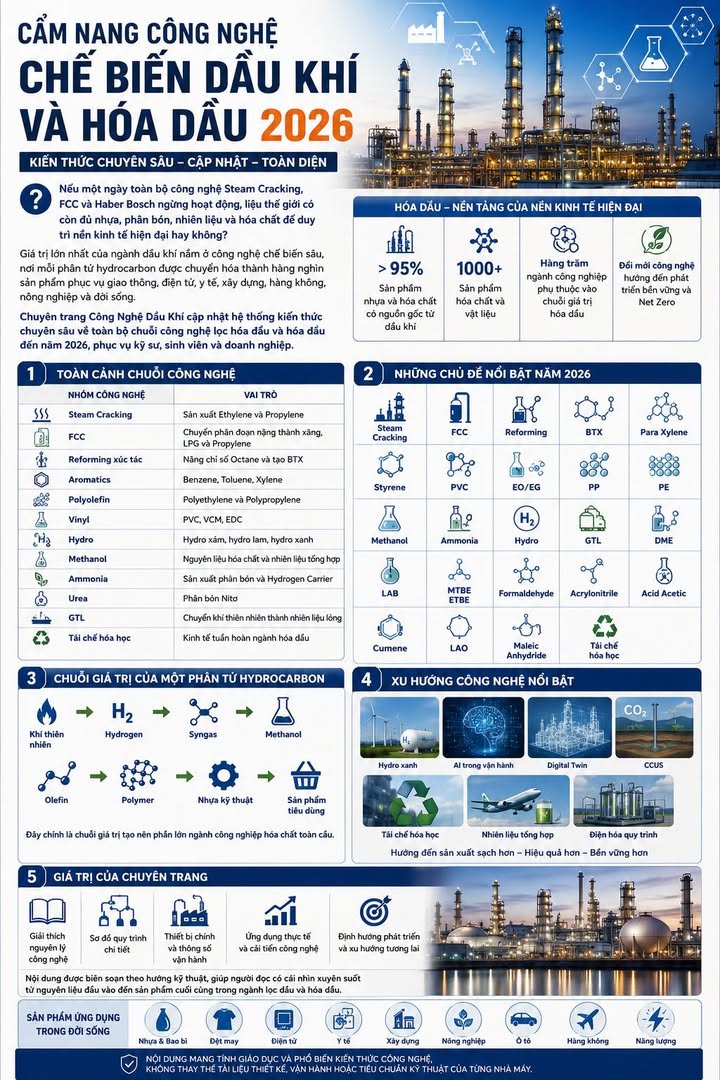
The Future of Petrochemical Technology: A Comprehensive Guide to 2026
The modern oil and gas industry has evolved far beyond mere crude oil and natural gas extraction. Today, the greatest value lies in deep processing technologies, where each hydrocarbon molecule is transformed into thousands of products that power transportation, electronics, healthcare, construction, aviation, agriculture, and daily life.
This comprehensive guide examines the entire chain of refining and petrochemical technologies through 2026, originally compiled to serve engineers, students, businesses, and energy sector stakeholders. We explore critical questions about the future of our modern economy and the technologies that sustain it.
What If Core Petrochemical Technologies Stopped Working?
Consider a scenario where essential technologies like Steam Cracking, Fluid Catalytic Cracking (FCC), and the Haber-Bosch process suddenly ceased operations. Would the world still have sufficient plastics, fertilizers, fuels, and chemicals to maintain our modern economy?
These technologies form the backbone of our industrial civilization. Steam Cracking produces the fundamental building blocks for plastics and synthetic materials. FCC transforms heavy petroleum fractions into valuable transportation fuels. The Haber-Bosch process synthesizes ammonia, which in turn becomes the foundation for nitrogen fertilizers that feed billions.
The answer to this hypothetical question reveals the critical importance of these technologies and the urgent need for innovation, sustainability, and circular economy principles in petrochemical manufacturing.
The Complete Petrochemical Technology Landscape
The petrochemical industry encompasses a complex web of technologies that convert hydrocarbon feedstocks into essential products. Below is a comprehensive overview of the major technology groups and their roles in modern manufacturing:
| Technology Group | Primary Function | Key Products |
|---|---|---|
| Steam Cracking | Production of basic olefins and aromatics | Ethylene, Propylene |
| FCC (Fluid Catalytic Cracking) | Conversion of heavy fractions | Gasoline, LPG, Propylene |
| Catalytic Reforming | Octane improvement and aromatic production | High-octane gasoline, BTX |
| Aromatics Extraction | Separation and purification of aromatic compounds | Benzene, Toluene, Xylene (BTX) |
| Polyolefin Production | Polymerization of olefins | Polyethylene, Polypropylene |
| Vinyl Chain | Production of vinyl derivatives | PVC, VCM, EDC |
| Hydrogen Production | Hydrogen generation and purification | Gray hydrogen, blue hydrogen, green hydrogen |
| Methanol Synthesis | Production of methanol from synthesis gas | Methanol for chemicals and fuel |
| Ammonia Production | Synthesis of ammonia from hydrogen and nitrogen | Ammonia for fertilizers and hydrogen carrier |
| Urea Production | Conversion of ammonia to urea | Nitrogen fertilizers |
| GTL (Gas-to-Liquids) | Conversion of natural gas to liquid fuels | Clean diesel, naphtha, waxes |
| Chemical Recycling | Breaking down plastics to molecular level | Feedstock for new plastics |
Key Petrochemical Technologies in Focus for 2026
As we approach 2026, several technologies are emerging as particularly significant due to their impact on sustainability, efficiency, and product diversification. Let's examine these technologies in detail:
Steam Cracking Technology
Steam cracking remains the primary method for producing ethylene and propylene, the fundamental building blocks of the petrochemical industry. By 2026, we expect significant advancements in:
- Feedstock flexibility, enabling greater use of ethane from shale gas and naphtha from diverse crude sources
- Energy efficiency improvements through advanced heat recovery systems
- Integration with carbon capture technologies to reduce environmental impact
- Development of advanced furnace designs for higher yields and longer run lengths
Fluid Catalytic Cracking (FCC)
FCC technology converts heavy petroleum fractions into more valuable products like gasoline, LPG, and propylene. Key developments by 2026 include:
- Next-generation catalysts for higher propylene yields
- Improved process controls for better product distribution
- Integration with alkylation units to maximize gasoline production
- Advanced emission control systems for environmental compliance
Aromatics and BTX Production
Benzene, Toluene, and Xylene (BTX) are essential intermediates for numerous chemical products. By 2026, we anticipate:
- Advanced separation technologies for higher purity BTX streams
- Integration of digital twins for process optimization
- Increased para-xylene production for PET manufacturing
- New catalytic processes for direct benzene production
Polyolefin Technologies
Polyethylene and Polypropylene production will see significant innovation by 2026:
- Advanced Ziegler-Natta and metallocene catalysts for tailored polymer properties
- New grades for sustainable packaging applications
- Improved reactor designs for higher capacity and efficiency
- Integration of artificial intelligence for quality control
Hydrogen Production Technologies
Hydrogen is becoming increasingly critical as the industry transitions to cleaner energy sources. By 2026, we expect:
| Hydrogen Type | Production Method | Environmental Impact | Projected Market Share by 2026 |
|---|---|---|---|
| Gray Hydrogen | Steam Methane Reforming (SMR) | High CO2 emissions | 60-65% |
| Blue Hydrogen | SMR with Carbon Capture | Lower CO2 emissions | 20-25% |
| Green Hydrogen | Water Electrolysis with renewable energy | Near-zero emissions | 10-15% |
Chemical Recycling and the Circular Economy
The concept of a circular economy is gaining traction in the petrochemical industry. By 2026, chemical recycling technologies will include:
- Advanced pyrolysis for plastic waste conversion
- Gasification technologies for mixed plastic streams
- Depolymerization processes for specific polymers
- Improved sorting and separation technologies for plastic waste
The Hydrocarbon Value Chain
Understanding the value chain of hydrocarbon molecules is essential to grasping the petrochemical industry's economic significance. The transformation from raw materials to final products involves multiple stages of processing:
| Stage | Key Processes | Primary Products | Market Value |
|---|---|---|---|
| Raw Materials | Crude oil extraction, natural gas processing | Crude oil, natural gas | Foundation of value |
| Primary Processing | Distillation, reforming, cracking | Naphtha, ethane, LPG | First value add |
| Intermediate Chemicals | Steam cracking, catalytic processes | Ethylene, propylene, syngas | Significant value increase |
| Basic Chemicals | Polymerization, chemical synthesis | Polyethylene, polypropylene, methanol | Major value increase |
| Specialty Chemicals | Further processing, formulation | Technical plastics, additives | High-value products |
| Consumer Products | Manufacturing, assembly | Packaging, automotive parts, electronics | Final consumer value |
This value chain represents the economic backbone of the petrochemical industry, transforming relatively low-value raw materials into essential products that enable modern life.
Emerging Technology Trends for 2026
The petrochemical industry is undergoing rapid transformation driven by technological innovation, environmental concerns, and changing market demands. Several key trends will shape the industry by 2026:
Green Hydrogen Revolution
The production of green hydrogen through water electrolysis using renewable energy is accelerating rapidly. By 2026:
- Electrolyzer costs are expected to decrease by 40-50%
- Renewable energy-powered hydrogen production will become economically viable in more regions
- Integration of hydrogen with carbon capture technologies will enable blue hydrogen production
- Hydrogen carriers like ammonia will gain traction for long-distance transport
Artificial Intelligence and Digital Transformation
AI and digital technologies are revolutionizing petrochemical operations:
- Predictive maintenance systems will reduce unplanned downtime by 30-40%
- Digital twins will enable virtual optimization of entire production facilities
- Machine learning algorithms will improve yield optimization and energy efficiency
- Advanced process control will enhance product quality consistency
Carbon Capture, Utilization, and Storage (CCUS)
CCUS technologies are becoming essential for reducing the carbon footprint of petrochemical operations:
- Advanced solvent systems will capture CO2 more efficiently
- Utilization pathways for captured CO2 will expand into building materials, chemicals, and fuels
- Storage infrastructure will develop in key industrial regions
- Integration with renewable energy will enable negative emissions technologies
Chemical Recycling and Circular Economy
The shift toward a circular economy is accelerating in the petrochemical sector:
- Advanced pyrolysis technologies will enable recycling of mixed plastic waste
- Chemical recycling capacity is projected to grow by 300-400% by 2026
- Extended producer responsibility schemes will drive recycling innovation
- New polymer designs will facilitate end-of-life recycling
Synthetic Fuels and Feedstocks
The development of synthetic fuels and alternative feedstocks is gaining momentum:
- Gas-to-liquids (GTL) technology will expand to utilize remote gas resources
- Methanol-to-olefins (MTO) processes will provide alternative routes to basic chemicals
- Bio-based feedstocks will increasingly complement fossil feedstocks
- Power-to-X technologies will enable production of chemicals from renewable electricity
The Educational Value of Specialized Petrochemical Resources
As the petrochemical industry becomes increasingly complex and technologically advanced, specialized educational resources play a crucial role in developing the next generation of engineers and industry professionals.
Comprehensive petrochemical technology resources serve multiple purposes:
- Technical Education: Providing detailed explanations of fundamental principles, process flow diagrams, and equipment specifications
- Industry Reference: Offering practical insights into real-world applications and operational challenges
- Innovation Catalyst: Highlighting emerging technologies and future trends that will shape the industry
- Knowledge Bridge: Connecting academic research with industrial implementation
Specialized resources that cover the entire value chain—from raw materials to final products—help professionals understand how different technologies interconnect and contribute to the overall manufacturing process.
The Path Forward: Toward a Sustainable Petrochemical Industry
As we approach 2026, the petrochemical industry stands at a crossroads. While traditional technologies will continue to form the backbone of manufacturing, significant changes are underway to address environmental challenges and meet evolving market demands.
The future of petrochemical technology will be characterized by:
- Integration of renewable energy and feedstocks
- Advanced digital technologies for optimization and efficiency
- Carbon management through capture, utilization, and storage
- Circular economy principles through chemical recycling
- Product innovation to meet sustainability requirements
These transformations will not happen overnight, but they are already underway. Companies that invest in research, development, and workforce training will be best positioned to thrive in the evolving petrochemical landscape.
Conclusion: The Indispensable Role of Petrochemical Technology
Returning to our initial question—what if core petrochemical technologies stopped working? The answer is clear: our modern civilization would face an immediate and profound crisis. From medical devices to food packaging, from automotive components to agricultural fertilizers, petrochemical products are woven into the fabric of our daily lives.
Yet the industry cannot remain static. The challenges of climate change, resource depletion, and environmental pollution demand innovation and transformation. By 2026, we expect to see petrochemical technologies that are more efficient, sustainable, and integrated with renewable energy systems.
The future belongs to those who can balance the essential role of petrochemical products with the urgent need for environmental stewardship. Through technological advancement, operational excellence, and circular economy principles, the industry can continue to provide the materials that enable modern life while reducing its environmental footprint.
As we navigate this transition, comprehensive educational resources and industry collaboration will be essential. By sharing knowledge, fostering innovation, and embracing sustainability, the petrochemical industry can build a future that meets both human needs and environmental imperatives.