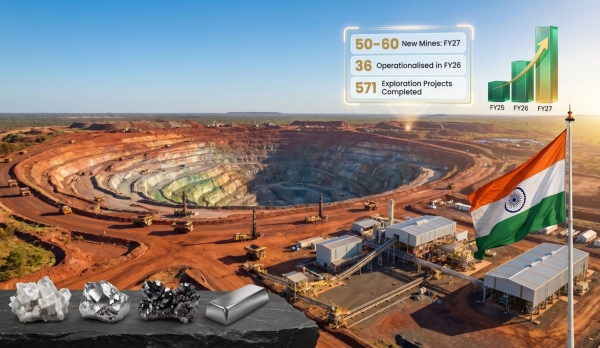
India Accelerates Mineral Self-Reliance Strategy
In an increasingly competitive geopolitical landscape and growing domestic technological demands, India is intensifying the development of its strategic mineral sector with ambitious targets for significantly enhancing mining and processing capabilities during the fiscal year FY2026-27. This initiative represents a critical component of a long-term strategy aimed at reducing import dependency, particularly from China, while simultaneously building domestic supply chains for high-tech industries such as electric vehicle batteries and renewable energy.
Strategic Background for Self-Reliance
India's mineral self-reliance strategy emerges from the necessity of reducing dependence on foreign sources, especially China, which currently dominates the market share of many crucial minerals. The Indian government recognizes that controlling raw material supplies is vital for domestic industrial development and long-term economic security.
In recent years, India has confronted numerous challenges stemming from its reliance on mineral imports from China, particularly amid border tensions and the China-US trade war. This dependency has rendered India vulnerable to political and commercial fluctuations, prompting a strategic reassessment of its mineral supply chain.
Detailed Plans for FY2026-27
According to the announced plan, India aims to substantially boost its mining and processing capabilities for strategic minerals during the FY2026-27 fiscal period. The government will focus on upgrading mining technologies, establishing modern processing mechanisms, and developing necessary logistics infrastructure to transport minerals from mines to processing facilities efficiently.
Additionally, the government will implement policies to encourage private investment in the mining and mineral processing sector through tax incentives, administrative simplification, and favorable conditions for both domestic and international investors.
Key Highlights of the Strategy:
- Development of dedicated mineral industrial parks with integrated infrastructure
- Investment in advanced mining and processing technologies
- Establishment of mineral research and development centers
- Training of high-quality human resources for the mineral industry
- Promotion of international cooperation in the mineral sector
Economic Significance
The mineral sector plays a crucial role in India's economy, contributing significantly to GDP and generating millions of jobs. Developing this sector not only helps reduce import dependency but also stimulates economic growth, creates domestic value chains, and enhances the competitiveness of dependent industries.
According to data from India's Ministry of Mines, the sector contributes approximately 2.5% of the national GDP and employs around 11 million people directly and indirectly. With the self-reliance strategy, these figures are expected to increase substantially in the coming years.
Reducing Dependence on China
China currently serves as a major supplier of various minerals to India, including iron ore, coal, phosphate rock, and rare earth minerals. This dependency has become a concern for both economic and national security.
To reduce this dependence, India is focusing on:
- Enhancing domestic extraction of available mineral resources
- Diversifying supply sources from countries such as Australia, Brazil, and Africa
- Developing domestic processing capabilities to reduce the export of raw materials
- Building strategic reserves for critical minerals
Applications in High-Tech Industries
India's mineral self-reliance strategy holds particular importance for high-tech industries like electric vehicle battery manufacturing and renewable energy. Minerals such as lithium, cobalt, nickel, and graphite are essential components in battery production, while others like silicon, copper, and aluminum are widely used in renewable energy equipment.
| Mineral | Applications in High-Tech Industries | Importance to India |
|---|---|---|
| Lithium | Electric vehicle batteries, energy storage devices | Domestically scarce, highly dependent on imports |
| Cobalt | Lithium-ion batteries, fuel cells | Primarily imported from the Democratic Republic of Congo |
| Aluminum | Electric vehicle frames, solar panel components | Abundant resources but requires processing technology upgrades |
| Copper | Electrical wiring, electronic components | Requires enhanced mining and processing capabilities |
| Graphite | Lithium-ion batteries, hydrogen fuel cells | Has extraction potential but requires advanced processing technology |
Challenges and Prospects
Despite significant potential, India's mineral self-reliance strategy faces numerous challenges. Complex administrative procedures, lack of advanced technologies, inadequate infrastructure, and environmental concerns related to mineral extraction represent primary barriers to implementation.
However, with strong government commitment and increasing private sector participation, the outlook for India's mineral industry remains optimistic. Industry experts predict that if effectively implemented, this strategy could help India reduce its import dependency on strategic minerals by 30-40% within the next 5-10 years.
Conclusion
India's mineral self-reliance strategy represents not merely an economic initiative but a strategic decision aimed at ensuring national security and global industrial positioning. By enhancing domestic mining and processing capabilities, India is moving toward a future with reduced foreign supply dependency and greater autonomy in developing critical high-tech industries.
The focus on the FY2026-27 period demonstrates the government's determination to accelerate this process. If successful, this strategy will not only transform India's mineral industry landscape but also contribute to positioning the nation as a significant global center for technological manufacturing.