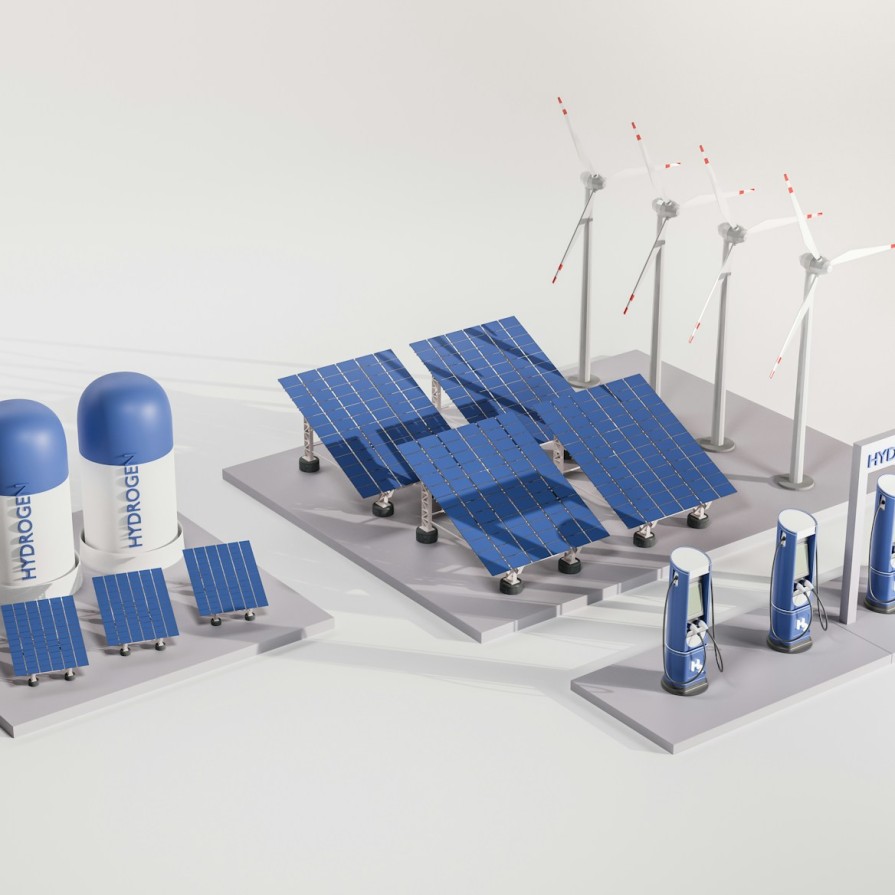
German Breakthrough: Converting Sunlight into High-Efficiency Hydrogen Fuel
Potential Solution for the World's Dirtiest Industries
A team of researchers in Germany has discovered a high-efficiency method to convert sunlight into hydrogen fuel, potentially addressing some of the most significant challenges facing the green hydrogen industry and offering a purification solution for some of the economy's dirtiest industries. The new prototype utilizes space-grade solar cells and serves as a proof-of-concept that completely clean fuel production could become commercially viable at scale in the future.
Breakthrough Technology from Fraunhofer Institute
Scientists at the Fraunhofer Institute for Solar Energy Systems ISE in Freiburg, Baden-Württemberg, have combined photovoltaic cells with proton exchange membrane electrolysis cells to create an entirely new system capable of converting sunlight into hydrogen with 31.3% efficiency. "Our new record shows that hydrogen can be produced very efficiently directly from sunlight," said Dr. Frank Dimroth.
The prototype relies on III-V solar cells, the highest-efficiency solar cells produced anywhere. "These cells have been used in spacecraft for a long time due to their high efficiency and durability."
Green Hydrogen: Clean Alternative for Hard-to-Decarbonize Industries
Green hydrogen has been hailed as an important clean alternative for hard-to-decarbonize industries such as steel production and maritime transport. While heavy fuel oil and coal provide energy for these industries, hydrogen burned at high temperatures. But instead of leaving behind carbon dioxide and other greenhouse gases and pollutants, hydrogen when burned leaves only water vapor.
| Comparing Green and Gray Hydrogen | |
|---|---|
| Green Hydrogen | Gray Hydrogen |
| Produced using renewable energy | Produced using fossil fuels |
| No greenhouse gas emissions during production | CO2 emissions during production |
| Higher cost | Lower cost |
| Future-oriented, sustainable | Current, unsustainable |
Challenges in Green Hydrogen Production
There's one major problem – hydrogen is only as green as the energy source used to produce it. The majority of hydrogen used in the global economy is gray hydrogen, produced from fossil fuels and thus ineffective at reducing an industry's carbon footprint. Green hydrogen, produced from renewable energy, has been promoted as a silver bullet for the clean energy transition for many years now, but as usual, reality is more complicated.
Global ambitions for green hydrogen have diminished significantly in recent years. A 2025 study on "The ambition-implementation gap for green hydrogen" found that by 2023, less than one-tenth of planned green hydrogen had been realized. "Tracking 190 projects over 3 years, we identified a large implementation gap in 2023 with only 7% of global capacity announced completed on time," as cited in the paper published in the scientific journal Nature Energy.
Efficiency and Renewable Energy Resources
In many, if not most, applications, useful renewable energy resources are better consumed directly rather than being used to produce hydrogen. A 2022 report from the International Renewable Energy Agency (IRENA) warned about "indiscriminate use of hydrogen," reminding that widespread hydrogen use "may not be aligned with the needs of a decarbonizing world," as it "requires dedicated renewable energy that could be used for other end uses." In other words, just because we can use clean energy for hydrogen without losing money, we're still losing efficiency, and those clean energy resources could be better used elsewhere. Simplified, green hydrogen is expensive and inefficient to produce.
The Fraunhofer Breakthrough: Potential Game Changer
For this reason, the breakthrough at the Fraunhofer Institute for Solar Energy Systems ISE could be a major disruptor. Instead of creating electricity from photovoltaic solar panels and then using that energy to produce hydrogen, the new prototype converts sunlight directly into hydrogen, bypassing the intermediate step. Since sunlight is an infinite resource, this new approach could be a game-changer, decarbonizing heavy industries without taking clean energy away from any other sector.
| Comparing Traditional and New Hydrogen Production Methods | |
|---|---|
| Traditional Method | New Method |
| 2 steps: Light → Electricity → Hydrogen | 1 step: Light → Hydrogen |
| Loses electrical conversion efficiency | Direct conversion, high efficiency |
| Requires electrical infrastructure | Simplifies system architecture |
| Efficiency around 15-20% | Efficiency of 31.3% |
Path to Commercialization
However, this model still has a long way to go before it can potentially reach the market and change everything. "Development is still in its early stages, and it's hard to say how quickly we can achieve competitive systems," Dimroth said in a press release related to the research. "To further develop this concept, we are looking for investors for our planned spin-off company, Clearsun Energy," Dimroth concluded.
Investment Context and Prospects
Fortunately, there's rarely been a better time to secure funding in green hydrogen research. After years of declining interest in the technology and the startup bubble nearly bursting, the current global energy crisis originating from the Strait of Hormuz has renewed investor interest in green hydrogen. Converting heavy industries to use green hydrogen is not just a sustainable choice but has become a strategic priority in the context of global energy security.
The discovery by the German researchers is not just a technological advancement but could spur a new wave of investment into clean energy, particularly as countries seek to reduce their dependence on fossil fuels and enhance energy security.
The future of green hydrogen looks brighter than ever, with advances like this, potentially transforming hydrogen from a luxury option into a practical solution for the world's most difficult-to-decarbonize industries.