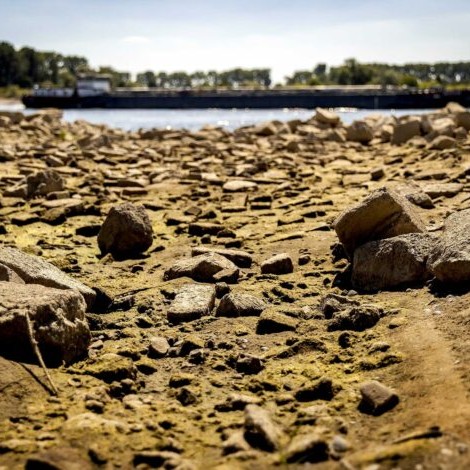
Early Heatwave in Europe Causes Havoc on River Transportation and Energy
An early summer heatwave in Europe is driving up temperatures in major rivers and reducing water levels, disrupting energy transportation, electricity production, and critical supply chain routes. The heatwave began in June with record temperatures for consecutive weeks in Europe's largest economies, Germany and France.
The consequences of this heatwave include severely restricted rainfall and significant maritime limitations on important inland waterways, with reduced cargo capacity per vessel. This has increased transportation costs and added pressure on European economies at a time when prolonged Hormuz Strait crisis has already elevated energy costs and inflation in the region.
Impact on French Energy Production
Beyond economic and inflation impacts in Germany, the heatwave has actually constrained electricity supply in France. Earlier this week, nuclear power production in France was reduced by 6.4 gigawatts (GW), equivalent to approximately 14% of the country's daily electricity demand, as the heatwave increased river temperatures and limited the ability to use water for cooling reactors.
This is not the first time France has had to reduce output at nuclear reactors and limit nuclear power production due to high summer temperatures. France continues to export electricity to neighboring countries despite reduced nuclear production, but these events appear to be becoming more frequent as heatwaves last longer with more extreme temperatures.
Disruption on the Rhine River
A similar situation is occurring with transportation disruptions on the 800-mile Rhine River, Europe's largest inland waterway, which is critically important for energy supplies, diesel, and goods transportation in Germany and Central Europe.
The Rhine flows northwest from Switzerland through Germany, France, and the Netherlands into the North Sea, serving as a vital petroleum product transportation route in Europe. Due to the heatwave and drought, water levels on the river have dropped and are now too shallow for many oil tankers to navigate. Vessels are not being fully loaded to keep them lighter on the water, which increases transportation costs and slows the transport of coal, fuel, and other goods.
The Kaub measurement point, midway along the Rhine between Koblenz and Mainz, is located at the river's narrowest and shallowest point. It sets the maximum draft and thus the cargo weight for each vessel moving between the Amsterdam-Rotterdam-Antwerp (ARA) seaports and the industrial Rhine Valley region, shared by Germany, France, and Switzerland.
Economic Impact
Water levels at the Kaub bottleneck are currently at multi-decade lows for mid-July, increasing diesel transportation costs from Rotterdam to southern Germany by more than 50% in the past week. The early heatwave and low river levels are putting pressure on German industry and the economy, which has just recently recovered from the initial shock from the Middle East crisis.
In 2018, low water levels on the Rhine in November led to a 1.5% decline in German industrial production, reducing Germany's GDP by 0.4%, according to the Kiel Institute for the World Economy. This year, the June heatwave has cost the German economy more than $6.8 billion, or 6 billion euros, as an exclusive analysis by the economic research company Prognos revealed to the German business daily Handelsblatt this week.
| Year | Rhine Water Levels at Kaub (cm) | Economic Impact |
|---|---|---|
| 2023 | Near record levels (mid-July) | Transportation costs increased by 50% |
| 2022 | Very low | First energy crisis following Ukraine conflict |
| 2018 | Low | Industrial production decreased by 1.5%, GDP decreased by 0.4% |
According to forecasts, in the future, Germany may face three or four heatwaves each summer with temperatures exceeding 35°C (95°F). Prognos estimates that Germany could lose 1 billion euros ($1.14 billion) for each day over 35°C. Therefore, the annual damage to the German economy could amount to over 20 billion euros ($23 billion).
Conclusion
Early summer heatwaves in Europe are not merely a weather phenomenon but are becoming a serious economic challenge, especially when combined with geopolitical crises like the Hormuz Strait situation. The combination of extreme weather and geopolitical tensions is creating a double blow to supply chains, energy, and the continent's economy, with consequences that could extend for many years.
The reduction in nuclear power production in France and disruptions to Rhine River transportation are just two prime examples of how climate change is directly impacting Europe's infrastructure and economic operations. Nations need to reconsider energy policies and invest in more resilient infrastructure that can better withstand extreme weather conditions in the future.