A bank reported a loss in the second quarter even though bad debt decreased. Is this just a temporary difficulty or a signal that the banking industry's profit pressure is entering a new phase?
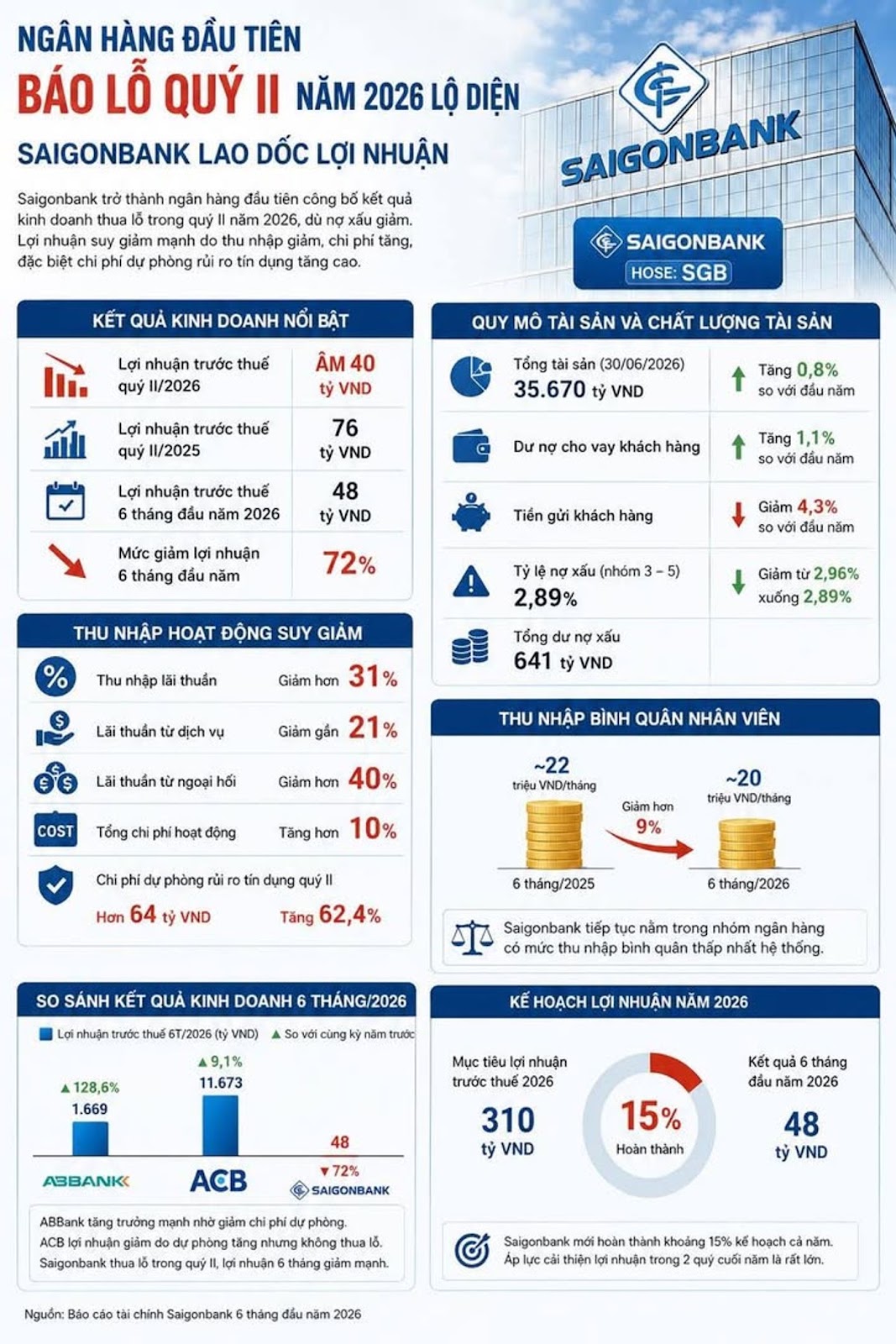
Saigonbank became the first bank to announce loss-making business results in the second quarter of 2026. The financial report showed a negative second quarter pre-tax profit of 40 billion VND, while the same period last year still recorded a profit of 76 billion VND. Accumulated in the first 6 months of the year, pre-tax profit was only 48 billion VND, down 72 percent over the same period, reflecting the simultaneous decline of many core business segments.
The main reason comes from a sharp decrease in operating income while costs continue to increase. Net interest income decreased by more than 31 percent, net interest income from services decreased by nearly 21 percent, and foreign exchange trading activities decreased by more than 40 percent. Meanwhile, total operating costs increased by more than 10 percent, while credit risk provision costs increased by more than 62 percent to over 64 billion VND, causing business results to change from profit to loss.
Summary table of theoutstanding targets
Result Indicators
Profit before tax in the second quarter was negative 40 billion VND
Profit before tax in the second quarter of last year was 76 billion VND
Profit before tax for 6 months 48 billion VND
Six-month profit decline of 72 percent
Net interest income Declined more than 31 percent
Net service profit Decreases nearly 21 percent
Net foreign exchange gains Decrease more than 40 percent
Provision costs for the second quarter were more than 64 billion VND, an increase of 62.4 percent
Although profits dropped sharply, asset quality showed positive signs. By June 30, 2026, total assets reached VND 35,670 billion, an increase of 0.8 percent compared to the beginning of the year. Outstanding customer loans increased by 1.1 percent, while customer deposits decreased by 4.3 percent, belonging to a rare group of banks that recorded a decline in capital mobilization in the first half of the year. The bad debt ratio from group 3 to group 5 decreased from 2.96 percent to 2.89 percent, with a total outstanding bad debt of about 641 billion VND.
Another notable point is that workers' income is also clearly affected. Average employee income decreased from about 22 million VND per month to about 20 million VND per month, a decrease of more than 9 percent. Saigonbank continues to be in the group of banks with the lowest average income in the system.
Compared to banks that have announced their business results dAt the same time as ABBank and ACB, Saigonbank's developments created a clear contrast. ABBank still maintains profit growth thanks to a sharp reduction in provision costs, while ACB, although profits are affected by increased provisions, still does not fall into a loss situation. This shows the increasing level of differentiation in the banking industry when the ability to control costs, grow credit and handle risks is creating a significant gap between credit institutions.
In 2026, Saigonbank sets a pre-tax profit target of 310 billion VND, doubling the results in 2025. However, with a new result of 48 billion VND after the first half of the year, the bank has only completed about 15 percent of the whole year plan. That means the pressure to improve profits in the last two quarters of the year will be huge if you want to complete the set goals. #Saigonbank #SGB #Banking #Finance #Economy #Stocks #Profit #Business Results #Investment #Vietnam