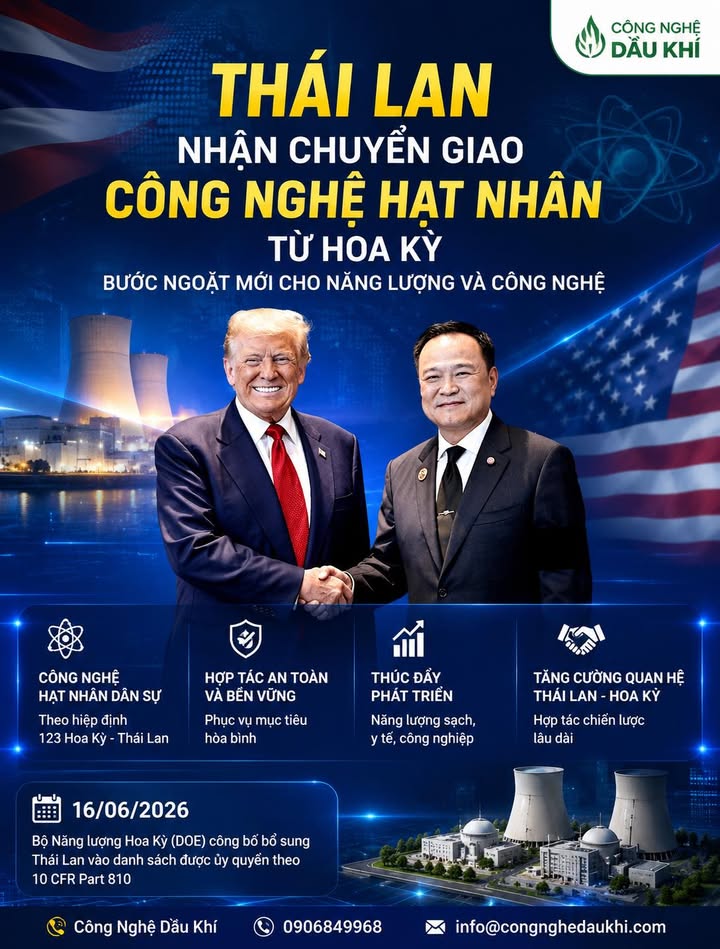
Thailand Receives Official Nuclear Technology Transfer from United States: A Potential Energy and Technology Turning Point for Southeast Asia?
In a significant development for Southeast Asia's technological landscape, the United States has officially granted Thailand access to nuclear technology and knowledge, marking a potential strategic leap for the nation in the regional technology race.
On June 16, 2026, the US Department of Energy announced the addition of Thailand to the authorization list under 10 CFR Part 810 regulations. This legal mechanism allows US businesses and organizations to export nuclear technology, specialized knowledge, technical data, and services related to civil nuclear energy to partner nations for peaceful purposes.
The decision represents a milestone following the implementation of the Civil Nuclear Cooperation Agreement under Section 123 between the United States and Thailand, which officially took effect in July 2025.
The Global Context: Nuclear Energy's Resurgence
This development occurs amid a global trend where numerous nations are returning to nuclear energy to ensure energy security, reduce carbon emissions, and meet the growing electricity demands driven by artificial intelligence, data centers, and high-tech industries.
As countries worldwide seek to balance economic growth with environmental commitments, nuclear energy has re-emerged as a viable solution for providing stable, low-carbon baseload power. The transfer of nuclear technology to Thailand aligns with this broader global strategy while potentially positioning the nation as a regional leader in peaceful nuclear applications.
Significance of the New Authorization
Being included in the US authorization list grants Thailand facilitated access to:
- Research reactor technology
- Nuclear safety systems
- Training programs for engineers and specialists
- Nuclear simulation software
- Nuclear medical technology
- Civilian fuel processing and radioactive material handling technology
It's important to note that this authorization does not immediately mean Thailand will construct commercial nuclear power plants. Instead, it creates a legal and technical foundation for the nation to develop its nuclear industry in the future while establishing protocols for peaceful nuclear cooperation.
Key Timeline of Developments
| Date | Event |
|---|---|
| July 2025 | US-Thailand Civil Nuclear Cooperation Agreement under Section 123 takes effect |
| June 16, 2026 | US Department of Energy announces Thailand's addition to the 10 CFR Part 810 authorization list |
| 2026 onwards | US businesses can transfer nuclear technology and knowledge to Thailand |
| Future phase | Expansion of research, training, and peaceful nuclear applications cooperation |
Thailand's Energy Strategy and Challenges
According to Thailand's long-term energy strategies, the country faces several significant challenges:
| Challenge | Impact |
|---|---|
| Increasing electricity demand | Pressure on the national electricity system |
| Dependence on natural gas | Fuel price volatility risks |
| Carbon reduction commitments | Need for large-scale clean energy sources |
| High-tech industry development | Requirement for stable, continuous power supply |
Nuclear energy is being considered as one of the long-term solutions alongside solar power, wind energy, and energy storage systems. The authorization from the US provides Thailand with the technical foundation to explore nuclear energy as part of a diversified energy portfolio.
Implications for the ASEAN Region
This development is particularly noteworthy as Thailand becomes one of the few ASEAN countries with comprehensive civil nuclear cooperation agreements with the United States. If Thailand effectively leverages this opportunity, it could potentially emerge as a regional center for training, research, and application of modern nuclear technology in Southeast Asia.
Sectors that would directly benefit from this cooperation include:
- Nuclear medicine
- Cancer diagnosis and treatment
- Advanced materials industry
- High-tech agriculture
- Oil and gas industry verification
- Nuclear engineering training programs
Strategic Perspective
The US authorization for transferring nuclear technology and knowledge to Thailand is not merely an energy story. It signals that Bangkok is being regarded as a reliable partner in the global high-technology supply chain.
In the current landscape of rapidly expanding AI, data centers, semiconductor manufacturing, and high-tech industries, nations with established nuclear science foundations often possess significant advantages in human resources, research capabilities, and technological expertise. This development could potentially influence the technological balance of power across Southeast Asia for decades to come.
Quick Summary
| Content | Information |
|---|---|
| Recipient country | Thailand |
| Transfer country | United States |
| Announcement date | June 16, 2026 |
| Announcing agency | US Department of Energy |
| Legal basis | 10 CFR Part 810 |
| Foundational agreement | US-Thailand Section 123 Civil Nuclear Cooperation Agreement |
| Purpose | Civil nuclear cooperation for peaceful purposes |
| Benefiting sectors | Energy, medicine, research, industry |
A decision that appears technically oriented could potentially influence the technological balance of power across Southeast Asia for decades to come. Will Thailand become the first ASEAN nation to break through with a modern nuclear technology ecosystem, leveraging this opportunity to establish itself as a regional leader in peaceful nuclear applications?