Vietnam's Rooftop Solar Policy Revolution: Limit on Surplus Electricity Sales Raised to 50%
A Landmark Decision That Could Transform Millions of Homes into Mini Power Plants
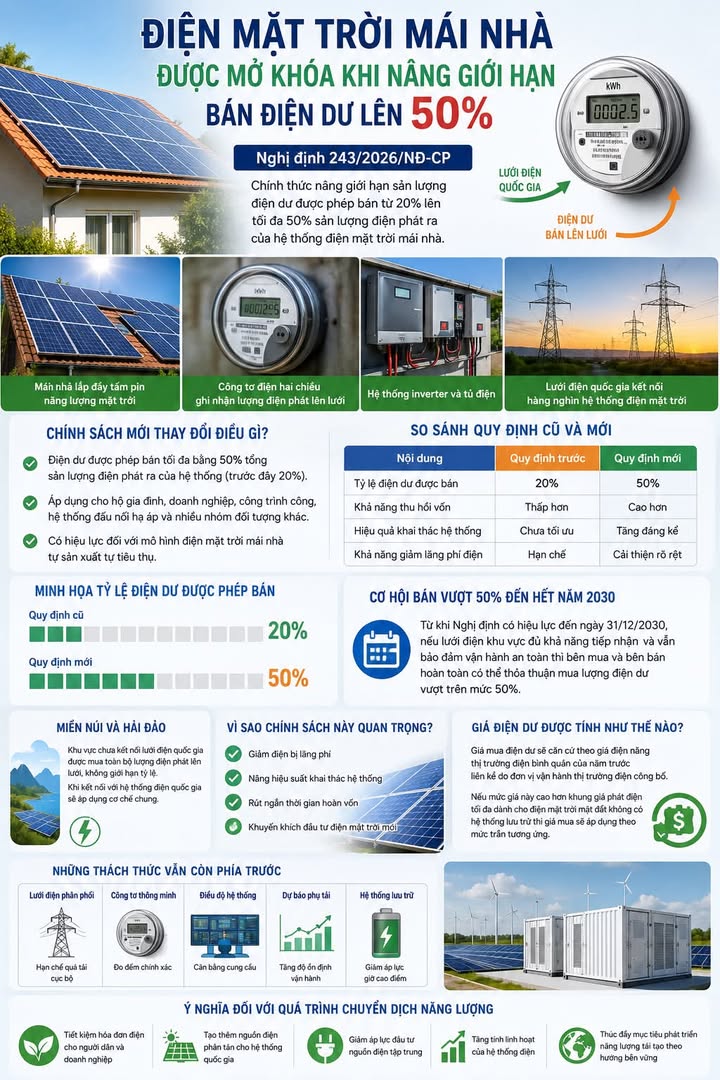
In a significant move that could reshape Vietnam's energy landscape, the Vietnamese government has issued Decree 243/2026/NĐ-CP, dramatically increasing the limit on surplus electricity that can be sold to the national grid from 20% to 50% of total electricity generated by rooftop solar systems. This policy shift represents one of the most notable changes in the renewable energy sector in recent years, potentially transforming how electricity is consumed and distributed across the country.
The new regulation not only improves investment efficiency for households and businesses but also expands the role of rooftop solar from a self-consumption model to a hybrid approach that supplements both self-use and the national power system. As Vietnam continues its ambitious energy transition, this policy could unlock the potential of millions of rooftops, turning them into distributed energy generation points that enhance grid resilience and sustainability.
Understanding the Policy Change
Key Provisions of Decree 243/2026/NĐ-CP
The newly implemented decree introduces several critical changes to Vietnam's rooftop solar framework:
- Maximum permitted surplus electricity sales increased from 20% to 50% of total system output
- Applies to households, businesses, public facilities, and low-voltage connection systems
- Covers rooftop solar systems operating under the self-generation, self-consumption model
- Effective immediately, with special provisions extending through December 31, 2030
Comparing Old and New Regulations
The following table illustrates the key differences between the previous and current regulatory frameworks:
| Aspect | Previous Regulation | New Regulation |
|---|---|---|
| Maximum surplus electricity sales | 20% of total generation | 50% of total generation |
| Investment payback period | Longer | Shorter |
| System utilization efficiency | Suboptimal | Significantly improved |
| Electricity waste reduction | Limited | Markedly improved |
Visualizing the Policy Change
The shift in policy can be visualized as follows:
Previous Regulation:
████░░░░░░░░░░░░░░ 20%
New Regulation:
██████████░░░░░░░░ 50%
Special Provisions and Exceptions
Flexible Surplus Sales Above 50%
A noteworthy provision of the decree allows for electricity sales exceeding 50% of total generation between the effective date of the decree and December 31, 2030. This flexibility is contingent upon the regional grid's capacity to safely absorb additional electricity while maintaining operational stability. This approach demonstrates a shift from rigid limitations to a more adaptive management style based on the actual capacity of the electrical system.
Special Treatment for Remote Areas
The policy includes particularly favorable terms for mountainous, border, and island regions not yet connected to the national grid. In these areas, all electricity fed to the grid can be purchased without percentage limitations. Once these regions connect to the national grid, the standard 50% regulation will apply. This provision aims to accelerate electrification and renewable energy adoption in underserved areas.
Why This Policy Matters
The Midday Solar Generation Challenge
Solar power systems typically reach peak generation capacity around midday. However, this period often coincides with minimal electricity consumption as households are at work, offices are closed during lunch breaks, and many commercial facilities experience reduced demand. This mismatch creates substantial surplus electricity that, under the previous 20% limit, could not be fully utilized, reducing the return on investment for solar installations.
Benefits of the 50% Limit
The increase to 50% surplus electricity sales delivers multiple advantages:
- Reduced Electricity Waste: More generated solar power can be utilized rather than curtailed
- Improved System Efficiency: Solar installations can operate at closer to their full potential
- Faster Investment Payback: Increased revenue from surplus electricity shortens the return period
- Enhanced Investment Incentives: Higher potential returns encourage new solar installations
Electricity Pricing Mechanism
Under the new decree, the price of surplus electricity will be determined based on the average market electricity price of the preceding year, as published by the electricity market operator. If this market price exceeds the maximum generation price cap for ground-based solar without storage systems, the purchase price will be capped accordingly. This pricing mechanism ensures that electricity prices more accurately reflect market conditions rather than being fixed for extended periods.
Challenges and Infrastructure Needs
The integration of hundreds of thousands of solar systems simultaneously generating electricity presents new challenges for Vietnam's power sector. Several infrastructure areas require continued investment and development:
| Infrastructure Area | Development Objective |
|---|---|
| Distribution Grid | Prevent localized overloading |
| Smart Meters | Enable accurate measurement |
| System Dispatch | Balance supply and demand |
| Load Forecasting | Improve operational stability |
| Energy Storage | Reduce peak pressure |
Significance for Vietnam's Energy Transition
This policy change offers multiple benefits beyond simple cost savings for consumers. By creating distributed energy sources, it enhances the resilience and flexibility of Vietnam's power system. As electricity demand continues to rise sharply—driven by industrial development, AI data centers, and the broader electrification of the economy—the efficient utilization of millions of rooftops will help reduce pressure on centralized power investments while advancing Vietnam's sustainable renewable energy development goals.
The policy represents a crucial step in Vietnam's journey toward a more decentralized, sustainable energy future, where consumers become both users and producers of electricity—transforming the traditional one-way power flow into a dynamic, interactive energy ecosystem.