#TrungQuoc #TauSanBayHatNhan #HaiQuanTrungQuoc #PLAN #GeraldRFord #PhucKien #QuanSu #DiaChinhTri #SucManhBien #CongNgheQuanSu
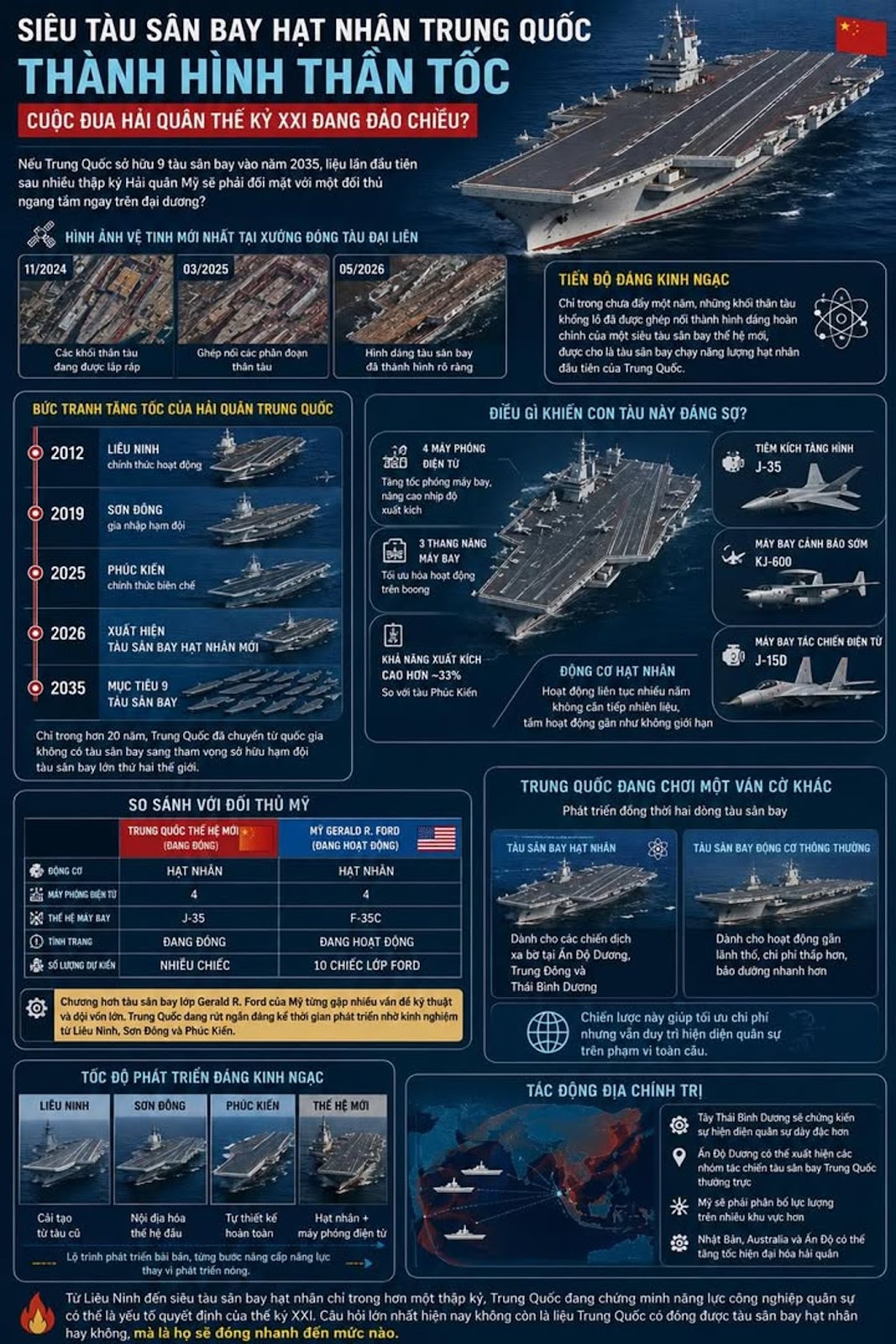
If China owns 9 aircraft carriers by 2035, will the US Navy face a peer opponent right on the ocean for the first time in decades?
The latest satellite images from the Dalian shipyard are drawing special attention from the global military community. In just a short time, giant ship hull blocks have been assembled into the complete shape of a new generation super aircraft carrier, said to be China's first nuclear-powered aircraft carrier.
What surprised experts was not only the scale of the project but also the speed of construction. While many aircraft carrier programs around the world typically last decades, progress at Dalian is happening faster than expected.
Picture of China's Navy Accelerating
Achievement Stage
2012 Liaoning officially opened
2019 Shandong joined the fleet
2025 Fujian officially staffed
2026 New nuclear aircraft carrier appears
2035 Target 9 aircraft carriers
In just over 20 years, China has transformed from a country without aircraft carriers to the ambition of owning the world's second largest aircraft carrier fleet.
What Makes This Ship Scary?
Unlike conventional aircraft carriers that have to be refueled periodically, nuclear engines allow ships to operate continuously for many years.
Reviews hNow shows that the new generation can own it
✅ 4 electromagnetic launchers
✅ 3 aircraft elevators
✅ J-35 stealth fighter air group
✅ KJ-600 early warning aircraft
✅ J-15D electronic warfare aircraft
✅ Sorting ability is about 33% higher than Fujian
If these parameters are correct, this will be the most powerful aircraft carrier ever built in Asia.
⚔️ Compare with American competitors
Criteria for China's new generation America Gerald R. Ford
Nuclear Nuclear Engine
Electromagnetic discharge machine 4 4
J-35 F-35C generation aircraft
Status Closed Active
Expected quantity: Many 10 Ford class cars
It is worth noting that the US Gerald R. Ford-class aircraft carrier program encountered a series of technical problems and a huge capital expenditure.
Meanwhile, China is trying to take advantage of experience from Liaoning, Shandong and Fujian to significantly shorten development time.
China is Playing a Different Game
Observers say Beijing is not just building nuclear aircraft carriers.
They are simultaneously developing two lines of warships
Nuclear aircraft carriers for offshore operations in the Indian Ocean, Middle East and Pacific
Conventional engine carriers for close-to-territory operations at lower costs
This strategy helps optimize costs while still maintaining military presence on a global scale.
Incredible Development Speed
Aircraft Carrier Origins
Liaoning Renovated from an old ship
Shandong First generation localization
Fujian completely self-designed
New generation Nuclear + electromagnetic launcher
Looking at this roadmap, we can see that TChina is moving step by step very methodically instead of developing rapidly.
Geopolitical Impact
If the goal of 9 aircraft carriers by 2035 becomes a reality
• The Western Pacific will see a denser military presence
• The Indian Ocean may have permanent Chinese aircraft carrier battle groups
• The US will have to distribute forces across more areas
• Japan, Australia and India can accelerate naval modernization
This does not mean that the balance of power will reverse immediately, but certainly the gap between the Chinese Navy and the US Navy is narrowing faster than many people thought.
From Liaoning to nuclear supercarriers in just over a decade, China is demonstrating that its military industrial capabilities could be the deciding factor of the 21st century. The biggest question today is no longer whether China can build a nuclear aircraft carrier, but how quickly it will build it.
#TauSanBayHatNhan #TrungQuoc #PLAN #GeraldRFord #HaiQuanMy #J35 #PhucKien #QuanSuTheGioi #DiaChinhTri #CongNgheQuanSu #TinNongTheGioi #TimKiemTop