#USA #DonaldTrump #Dieu301 #ThuongMaiToanCau #ThueQuan #XuatKhau #KinhTeTheGioi #USTR #ChuoiCungUng #CongNgheDauKhi
Is this the opening shot in a new global trade war that puts trillions of dollars in export value at risk of reallocation in just the next few years?
A new move from Washington is making financial circles, export businesses and policymakers around the world watch closely.
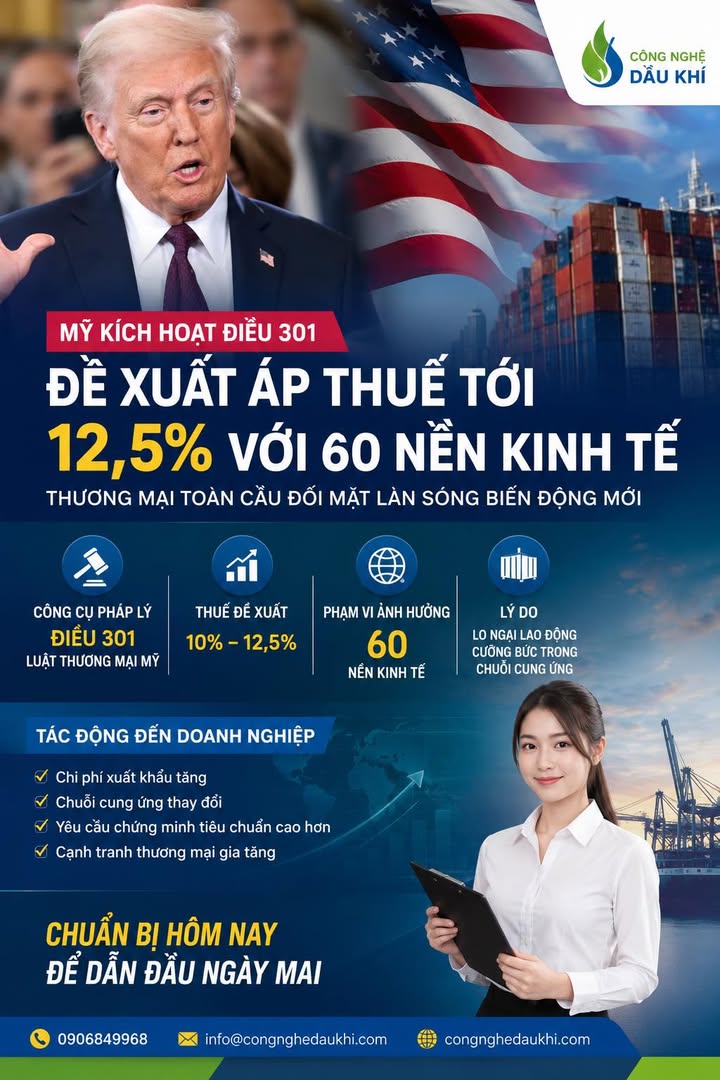
President Donald Trump's administration has just proposed using Article 301 of the US Trade Law to impose additional tariffs from 10% to 12.5% on imported goods from about 60 economies.
The reason given is that many countries have not fully implemented measures to prevent trade activities related to goods suspected of using forced labor in the supply chain.
This is not just a simple tariff policy but also a sign that the US is reactivating one of the most powerful trade tools ever used in many major economic confrontations.
What is Article 301?
Article 301 of the US Trade Law allows Washington to investigate and apply countermeasures to activities deemed to damage or create barriers to US trade.
In the past, Article 301 has been used in many large-scale trade disputes and is considered one of America's most effective pressure tools.Notable points
Content Details
Legal Instrument Article 301 of the US Commercial Code
Proposed tax 10% to 12.5%
Scope About 60 economies
Main reason: Fear of forced labor in the supply chain
Recommended agency Office of the United States Trade Representative USTR
Objective Increase pressure to reform the global supply chain
Why is the market worried?
What attracts investors' attention is not just the tax rate.
More importantly, the US is expanding the scope of trade standards.
If in the past trade wars mainly revolved around price, subsidies or trade deficit, now standards on labor, environment, technology and origin of production are becoming new "economic weapons".
This means that businesses wanting to access the US market will have to demonstrate more and more standards throughout the entire supply chain.
Potential impact
Affected group Level of impact
Export enterprise Very high
Global supply chain High
Logistics industry Medium to high
My Cao importer
Average American Consumer
Financial markets Medium to high
New game of supply chain
Many experts believe that this is part of Washington's long-term strategy to restructure the global supply chain.
Businesses may have to move factories, change suppliers or increase product traceability to meet new standards.
That means higher costs but also creates opportunities for countries with systemsTransparent management and supply chain meeting international standards.
Who benefits?
Some domestic manufacturing businesses in the US could benefit if imported goods become more expensive.
Countries that are able to demonstrate transparent supply chains may also attract more investment as multinational corporations seek alternative production locations.
⚠️ Biggest risk
The biggest risk is not the 10% or 12.5% tax rate.
What is worth noting is the possibility of a chain effect when many countries respond with similar measures or apply their own standards to US goods.
If that happens, international trade could enter a new phase of competition based on labor, environmental and technological standards instead of just production costs.
Overall perspective
The message from Washington is increasingly clear.
The US wants to use its market power to reshape global trade rules.
In the future, cheap production capacity may no longer be the sole deciding factor.
The ability to meet labor, environmental, technology and supply chain transparency standards could become a mandatory condition to participate in the global trade game.
In your opinion, is this a move to protect workers and create a level playing field or is it a new escalation in global economic competition?
#DonaldTrump #My #Dieu301 #ThuongMaiToanCau #ThueQuan #XuatKhau #KinhTe #ChuoiCungUng #USTR #CongNgheDauKhi #DauTu #TaiChinh #ThiTruongToanCau #KinhTeTheGioi #TinNongKinhTe