China Launches World's Largest LNG Carriers for Qatar: A New Era in Global Energy?
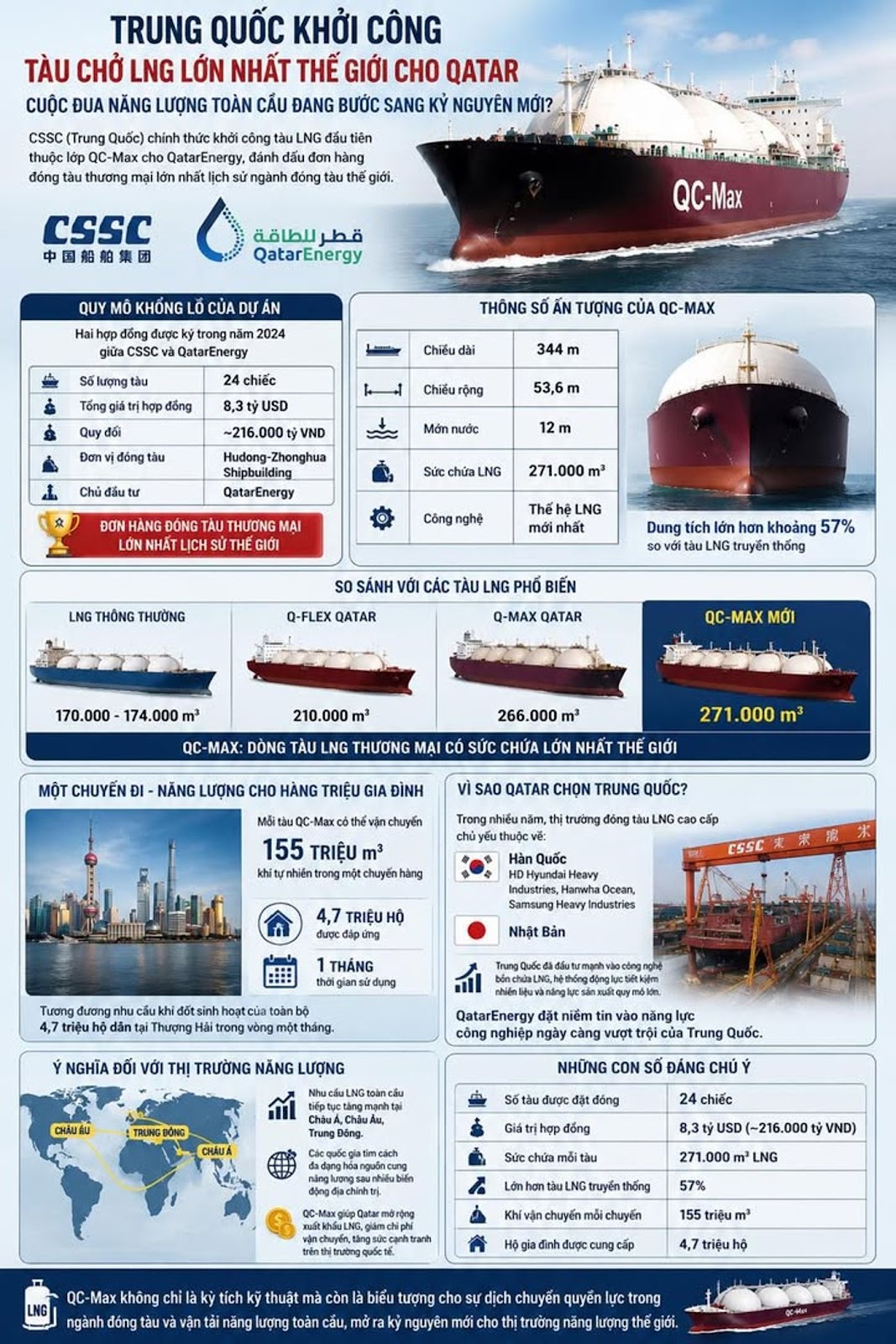
In a move signaling a potential shift in global energy and shipbuilding dynamics, China State Shipbuilding Corporation (CSSC) has officially commenced construction of the first QC-Max LNG carrier for QatarEnergy. This monumental project represents not just a technological marvel but also a significant realignment in the international shipbuilding and energy sectors.
The signing of two contracts in 2024 between CSSC and Qatar, valued at approximately $8.3 billion (equivalent to about 216,000 billion VND), marks the largest commercial shipbuilding order in recorded history. This strategic partnership between the world's leading LNG exporter and the world's largest shipbuilding nation is reshaping global maritime energy transportation.
Project Scale and Significance
The comprehensive agreement encompasses the construction of 24 advanced LNG carriers, representing a substantial vote of confidence in China's shipbuilding capabilities. The vessels are being constructed by Hudong-Zhonghua Shipbuilding, a subsidiary of CSSC, demonstrating China's growing technical prowess in specialized ship construction.
| QC-Max Project Overview | |
|---|---|
| Number of vessels: | 24 |
| Total contract value: | $8.3 billion |
| Vietnamese Dong equivalent: | Approximately 216,000 billion VND |
| Shipyard: | Hudong-Zhonghua Shipbuilding |
| Client: | QatarEnergy |
Technical Specifications: Engineering Marvels
The QC-Max class vessels represent cutting-edge maritime engineering with specifications that set new industry standards. Measuring 344 meters in length with a beam of 53.6 meters and a draft of 12 meters, these massive carriers can accommodate 271,000 cubic meters of liquefied natural gas.
To appreciate the scale of these vessels, consider that a single QC-Max carrier has approximately 57% more capacity than conventional LNG ships currently in operation. This increased capacity directly translates to greater efficiency in global LNG transportation and distribution.
| QC-Max Technical Specifications | |
|---|---|
| Length: | 344 m |
| Beam (width): | 53.6 m |
| Draft: | 12 m |
| LNG capacity: | 271,000 m³ |
| Technology: | Latest generation LNG systems |
Comparative Analysis: Setting New Industry Standards
The QC-Max class officially surpasses all existing commercial LNG carriers in terms of capacity. To contextualize this achievement, a comparison with other notable LNG vessel classes reveals the significant technological advancement represented by these Chinese-built carriers.
| Ship Class | LNG Capacity (m³) |
|---|---|
| Conventional LNG carriers | 170,000 - 174,000 |
| Q-Flex class (Qatar) | 210,000 |
| Q-Max class (Qatar) | 266,000 |
| QC-Max class (new) | 271,000 |
Energy Impact: Powering Millions of Households
Each QC-Max vessel can transport approximately 155 million cubic meters of natural gas in a single voyage. This substantial quantity of energy is equivalent to the monthly residential gas consumption of 4.7 million households in Shanghai, one of China's largest cities.
| Energy Capacity per QC-Max Voyage | |
|---|---|
| Gas transported per voyage: | 155 million m³ |
| Households supplied: | 4.7 million |
| Duration of supply: | 1 month |
Strategic Implications: China's Rising Shipbuilding Dominance
For decades, the high-end LNG carrier construction market has been dominated by South Korean and Japanese shipbuilders. Companies like HD Hyundai Heavy Industries, Hanwha Ocean, and Samsung Heavy Industries have traditionally controlled this specialized segment of the maritime industry.
However, China has strategically invested in LNG containment technology, fuel-efficient propulsion systems, and large-scale production capabilities. QatarEnergy's decision to commission dozens of ultra-large LNG carriers from Chinese shipyards demonstrates growing confidence in China's industrial capabilities and technical expertise.
Global Energy Market Context
The emergence of the QC-Max fleet occurs against a backdrop of rapidly increasing global LNG demand, particularly in Asia, Europe, and the Middle East. Nations worldwide are seeking to diversify their energy sources following years of geopolitical disruptions and supply chain challenges.
The deployment of these massive carriers will not only expand Qatar's LNG export capacity but also reduce transportation costs per unit of liquefied gas, enhancing the competitiveness of Qatari LNG in international markets. This development comes as countries transition toward cleaner energy sources while maintaining energy security.
Conclusion: Redefining Global Energy Transportation
The successful construction of QC-Max class vessels by China for Qatar represents more than a technological achievement—it signifies a fundamental shift in global shipbuilding and energy transportation dynamics. As LNG continues to play a crucial role in the global energy transition, these "sea giants" may become strategic determinants of worldwide energy flows for decades to come.
This partnership between QatarEnergy and CSSC underscores the evolving nature of global industrial cooperation and the changing landscape of maritime technology. As these massive carriers begin traversing international waters, they will not only transport energy but also symbolize the new era of collaboration and competition in the global energy sector.