## A Global Energy Crisis in the Making?
The most critical oil storage facility in the United States is sending alarming signals to the global energy market. As the Cushing oil storage center in Oklahoma rapidly approaches its minimum operational level, the question emerges: is the world underestimating the risk of the largest fuel price surge since the global energy crisis?
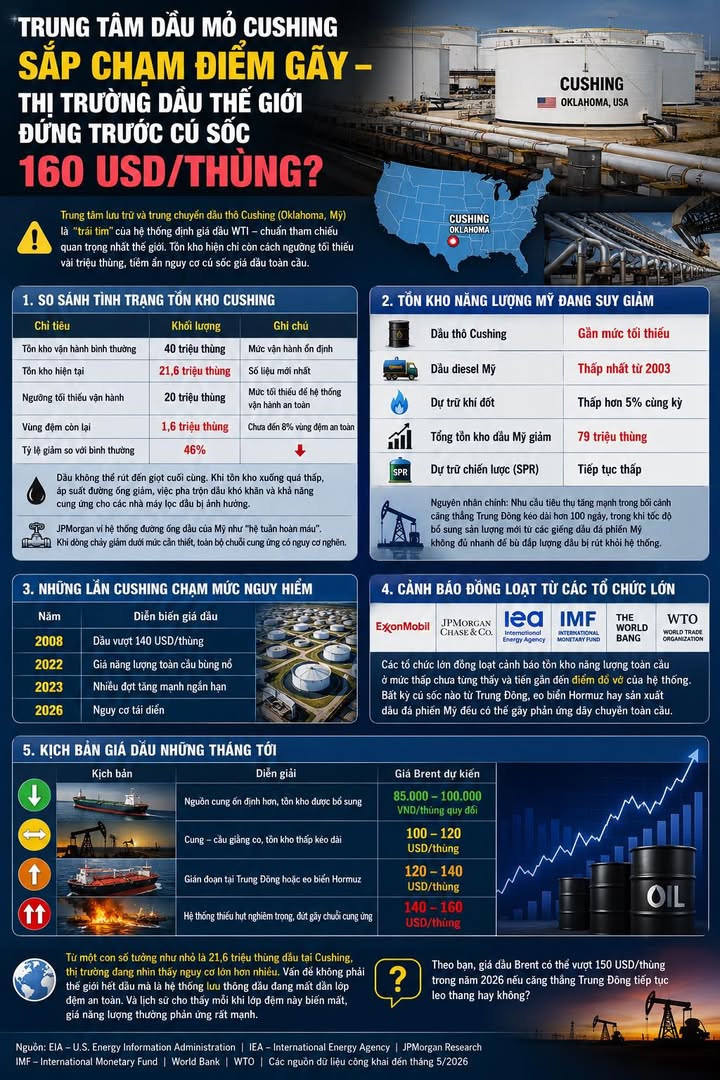
Cushing is not merely an ordinary oil storage facility but the heart of the West Texas Intermediate (WTI) pricing system—the world's most important benchmark for crude oil valuation. With current inventory levels hovering at approximately 21.6 million barrels, and the minimum threshold required for stable operation estimated at around 20 million barrels, the safety buffer has narrowed to just 1.6 million barrels—less than 8% of the operational cushion.
### The Critical State of Cushing's Oil Reserves
The situation at Cushing demands immediate attention as it represents a potential breaking point in the global energy supply chain. The facility's declining inventory levels indicate a systemic vulnerability that could trigger significant market disruptions.
| Cushing Storage Status Comparison | |
|---|---|
| Normal Operating Inventory | 40 million barrels |
| Current Inventory | 21.6 million barrels |
| Minimum Operational Threshold | 20 million barrels |
| Remaining Safety Buffer | 1.6 million barrels |
| Reduction from Normal Levels | 46% |
According to JPMorgan analysts, the US pipeline system functions similarly to the circulatory system in the human body. When oil circulation drops below necessary levels, the entire supply chain can experience dangerous "stagnation" points that threaten market stability.
### Broad Decline in US Energy Inventories
The situation at Cushing is not isolated but part of a broader trend of declining energy reserves across the United States. Multiple energy sectors are experiencing unprecedented inventory levels, creating a systemic vulnerability in the nation's energy infrastructure.
| US Energy Inventory Status | |
|---|---|
| Cushing Crude Oil | Near minimum operational level |
| US Diesel | Lowest levels since 2003 |
| Natural Gas Reserves | 5% below same period last year |
| Total US Oil Inventory | Decreased by 79 million barrels |
| Strategic Petroleum Reserve (SPR) | Continued low levels |
### Historical Precedents and Warning Signs
History has shown that when Cushing approaches dangerous inventory levels, global oil markets often experience significant volatility. Several notable instances demonstrate the correlation between critically low storage levels and market disruptions.
| Historical Instances When Cushing Reached Dangerous Levels | |
|---|---|
| 2008 | Oil prices exceeded $140/barrel |
| 2022 | Global energy price explosion |
| 2023 | Multiple short-term sharp increases |
| 2026 (Potential) | Risk of recurrence |
Neil Chapman, Senior Vice President of ExxonMobil, has stated that current inventory levels are at unprecedented lows and approaching the breaking point of the system. "When the oil buffer disappears, any shock from the Middle East, the Strait of Hormuz, or US shale oil production could trigger chain reactions worldwide," Chapman warned.
### Potential Oil Price Scenarios for the Coming Months
The implications of critically low inventory levels at Cushing could manifest in various price scenarios depending on market developments and geopolitical tensions.
| Potential Brent Oil Price Scenarios | |
|---|---|
| Tension Reduction Scenario | $85-$100/barrel (approximately 85,000-100,000 VND/barrel converted) |
| Status Quo Maintenance | $100-$120/barrel |
| Major Supply Disruption | $120-$140/barrel |
| Global Inventory Crisis | $140-$160/barrel |
### Conclusion: The Disappearing Safety Buffer
From what might seem like a small figure—21.6 million barrels of oil at Cushing—the market is witnessing a much larger systemic risk. The issue is not that the world is running out of oil, but that the oil circulation system is losing its safety buffer. History shows that whenever this buffer disappears, energy prices tend to react violently.
The situation at Cushing represents a critical juncture in global energy markets. As the storage center approaches its operational minimum, the world watches with growing concern whether this will trigger a new era of energy volatility and price shocks that could reshape the global economic landscape.
The question remains: Could Brent oil prices exceed $150/barrel in 2026 if Middle East tensions continue to escalate? The answer may depend on how quickly the global energy community responds to the warning signs now emanating from the heart of America's oil infrastructure.