China's Super-Deep Gas Discovery: A Potential Game-Changer for Asian Energy Markets
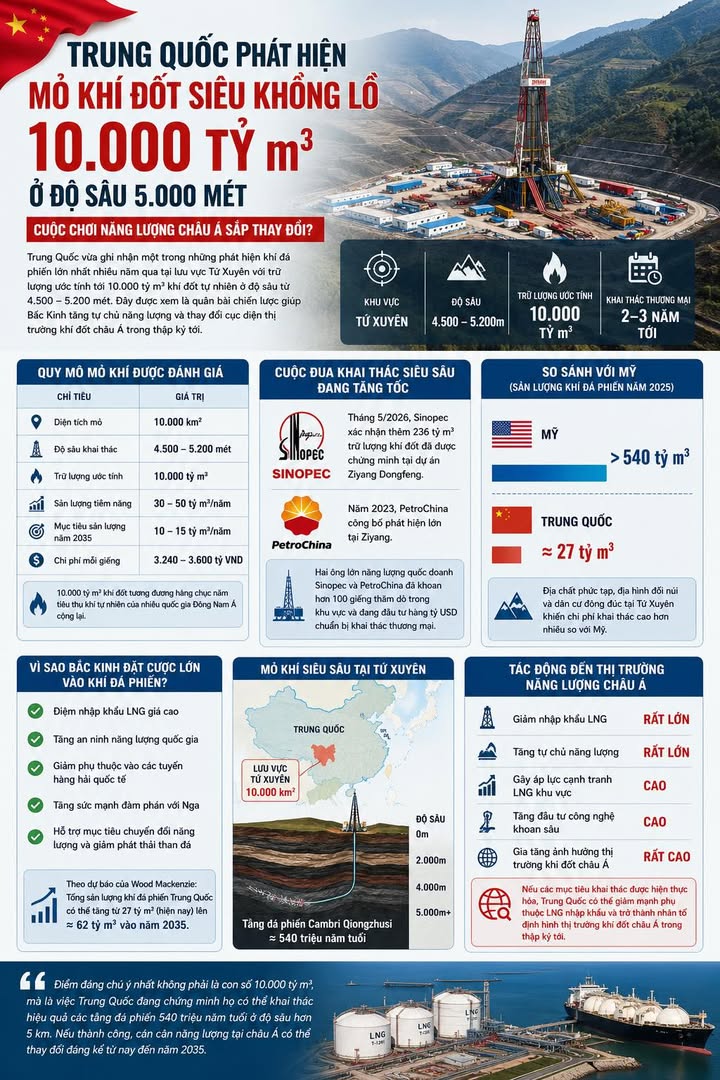
China has announced what could be one of the most significant energy discoveries of the decade: a massive shale gas field in the Sichuan Basin with estimated reserves of 10,000 billion cubic meters. Located at extraordinary depths of 4,500-5,200 meters below the surface, this find has the potential to reshape Asia's energy landscape and dramatically alter global liquefied natural gas (LNG) dynamics.
Unprecedented Scale and Depth
The discovery, situated in one of China's most geologically complex regions, represents not only a substantial reserve but also a remarkable technical achievement. The field spans approximately 10,000 square kilometers and targets the Cambrian Qiongzhusi shale formation, which is approximately 540 million years old.
"This is more than just a geological find; it's a strategic asset that could transform China's energy security position," noted energy analyst Dr. Zhang Wei from the Beijing Energy Research Institute. "The ability to extract gas from such depths and ancient formations demonstrates China's advancing technical capabilities in ultra-deep drilling."
| Sichuan Basin Shale Gas Field Specifications | |
|---|---|
| Area | 10,000 km² |
| Depth | 4,500 - 5,200 meters |
| Estimated Reserves | 10,000 billion cubic meters |
| Target Formation | Cambrian Qiongzhusi Shale |
| Current Status | Exploration and appraisal phase |
Intensifying Exploration Efforts
China's state-owned energy giants, Sinopec and PetroChina, have accelerated exploration activities in the region, drilling over 100 appraisal wells to assess the field's commercial viability. These efforts have yielded promising results:
- In 2023, PetroChina announced a significant discovery at the Ziyang block within the basin
- In May 2026, Sinopec confirmed an additional 236 billion cubic meters of proven gas reserves at the Ziyang Dongfeng project
- Both companies are investing billions of dollars to prepare for large-scale commercial production within the next 2-3 years
The technological challenges involved in extracting gas from such depths cannot be overstated. Each well requires an investment of approximately 3.24-3.6 trillion Vietnamese Dong (roughly $130-145 million USD), reflecting the complexity of ultra-deep drilling operations.
Strategic Implications for China's Energy Security
As the world's largest LNG importer, China's energy security has become increasingly dependent on international supply chains and vulnerable to geopolitical tensions. The development of this super-deep gas field could address several critical concerns:
- Reducing LNG import dependence: The field could potentially supply 30-50 billion cubic meters annually, significantly reducing China's need for expensive LNG imports
- Enhancing energy security: Domestic production would decrease vulnerability to supply disruptions and international shipping disruptions
- Strengthening negotiation positions: Increased domestic production could provide China with greater leverage in negotiations with suppliers like Russia and Turkmenistan
- Supporting climate goals: Natural gas could serve as a transition fuel, helping China reduce coal consumption and lower emissions
China's Shale Gas Ambitions: A Comparative Perspective
Despite the impressive scale of the discovery, China's shale gas production still lags significantly behind the United States, which pioneered the shale revolution. According to industry data:
| Country | Shale Gas Production (2025 estimate) |
|---|---|
| United States | 540+ billion cubic meters |
| China | Approximately 27 billion cubic meters |
"China's shale gas potential is enormous, but they face challenges that the US didn't encounter," explains energy consultant Sarah Johnson. "The Sichuan Basin's complex geology, mountainous terrain, and dense population make extraction significantly more expensive and technically challenging than in many US shale basins."
According to Wood Mackenzie's forecasts, China's total shale gas production could increase from the current 27 billion cubic meters to approximately 62 billion cubic meters by 2035, assuming successful development of the deep formations in the Sichuan Basin.
Potential Impact on Asian Energy Markets
The successful commercialization of this discovery could have profound implications for energy markets across Asia:
| Impact Area | Potential Effect |
|---|---|
| LNG Import Reduction | Very Significant |
| Energy Self-Sufficiency | Very Significant |
| Regional LNG Competition | High |
| Deep Drilling Technology Investment | High |
| Asian Gas Market Influence | Very High |
"If China achieves its production targets, it could fundamentally alter the supply-demand balance in Asian gas markets," warns LNG market analyst Michael Chen. "This could create pricing pressure that would affect LNG exporters from Australia to the Middle East, potentially reshaping long-term contracts and investment decisions across the region."
Future Development Timeline and Challenges
China has set ambitious targets for the development of this resource, with a goal of achieving 10-15 billion cubic meters of annual production by 2035. However, several challenges must be overcome:
- Technological advancement in ultra-deep drilling and hydraulic fracturing
- Environmental considerations and water resource management
- Economic viability at current price levels
- Infrastructure development to transport gas from remote mountainous regions
- Regulatory frameworks for unconventional gas development
"The most significant aspect of this discovery isn't just the 10,000 billion cubic meter figure, but China's demonstration that it can effectively extract gas from 540-million-year-old shale formations at depths exceeding 5 kilometers," states Professor Li Ming from Tsinghua University's School of Energy Research. "If they succeed in commercializing this resource, the energy balance in Asia could shift dramatically between now and 2035."
As China continues to invest in this super-deep gas field and related technologies, the global energy landscape may be approaching a significant inflection point. The potential reduction in China's LNG imports could create ripple effects throughout global energy markets, while simultaneously reinforcing China's position as an increasingly important player in the global energy transition.