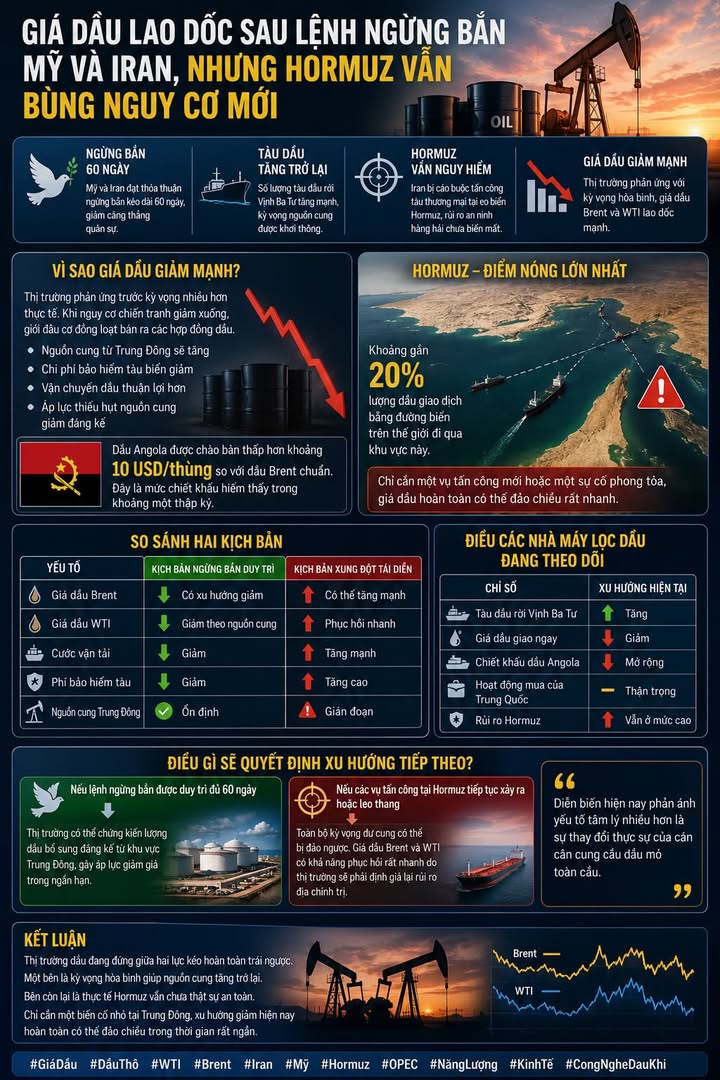
Oil Prices Plummet After US-Iran Ceasefire, But Hormuz Risks Remain High
The global oil market has experienced one of its most contradictory movements this year, with prices dropping sharply following a ceasefire agreement between the United States and Iran, while security incidents in the Strait of Hormuz continue to pose significant threats to energy supplies. Is the market being overly optimistic, and could a price shock return within just hours?
Market Reaction to the Ceasefire Agreement
The global oil market witnessed a dramatic downturn immediately after reports emerged of a 60-day ceasefire agreement between the United States and Iran. Investors quickly interpreted this development as a de-escalation of military tensions, expecting that oil supplies from the Middle East would flow more freely and numerous oil tankers would resume normal operations.
Following this news, the number of oil tankers departing from the Persian Gulf increased rapidly, leading traders to anticipate that millions of additional barrels of oil would soon reach the market, thereby alleviating supply concerns that had pushed prices upward in previous weeks.
The Reality Check: Continued Hormuz Tensions
Despite the positive market reaction, the reality on the ground tells a different story. Iran was accused of attacking a commercial vessel in the Strait of Hormuz, one of the world's most critical energy transport corridors. This incident demonstrates that despite the ceasefire agreement, maritime security risks in the region have by no means disappeared.
The Strait of Hormuz remains a geopolitical flashpoint where approximately 20% of globally traded oil passes through. Even a single new attack or blockade incident could completely reverse the current price trend in a very short timeframe.
Factors Behind the Oil Price Decline
Financial markets often react to expectations rather than actual changes in fundamentals. When the perceived risk of war decreased, speculative traders simultaneously sold off oil contracts, believing that:
- Oil supplies from the Middle East would increase
- Marine insurance costs would decrease
- Oil transportation would become more efficient
- Supply shortage pressures would significantly diminish
According to multiple trading reports, Angolan crude is currently being offered at approximately $10 per barrel below Brent crude benchmarks. This rare discount level, not seen in nearly a decade, reflects significant short-term oversupply pressures in the market.
The Hormuz Factor: Lingering Risks
While oil tankers are indeed resuming operations, the Strait of Hormuz continues to pose substantial risks. The geopolitical tensions in this strategically vital waterway could disrupt global energy supplies at any moment.
The market's current assessment appears to underestimate these persistent risks. Any escalation of hostilities or even a single successful attack on commercial shipping could trigger an immediate and significant price reversal.
Scenario Analysis: Two Possible Paths Forward
The future direction of oil prices hinges on whether the ceasefire holds or tensions escalate further. The following table compares these two potential scenarios:
| Factor | Maintained Ceasefire Scenario | Renewed Conflict Scenario |
|---|---|---|
| Brent Oil Price | Downward trend expected | Potential for sharp increases |
| WTI Oil Price | Decline in line with supply increases | Rapid recovery likely |
| Freight Rates | Decreasing | Significant increase |
| Marine Insurance Premiums | Lower | Higher |
| Middle Eastern Supply | Stabilizing | Disruptions likely |
Key Indicators Being Monitored by Refineries
Oil refining companies and market participants are closely watching several key indicators to gauge market direction:
| Indicator | Current Trend |
|---|---|
| Oil tankers leaving Persian Gulf | Increasing |
| Spot oil prices | Declining |
| Angola oil discount | Widening |
| China's purchasing activity | Cautious |
| Hormuz security risks | Remain high |
Factors Determining Future Oil Price Trends
If the 60-day ceasefire is successfully maintained, the market could witness significant additional oil supplies from the Middle East, putting downward pressure on prices in the short term.
Conversely, if attacks in the Strait of Hormuz continue or escalate, all oversupply expectations could be reversed. In such a scenario, Brent and WTI oil prices could recover very quickly as the market would need to reprice geopolitical risks.
This is why many experts believe the current market dynamics reflect psychological factors more than actual changes in the global oil supply-demand balance.
Conclusion: Market Caught Between Opposing Forces
The oil market currently stands between two completely opposing forces. On one hand, there are expectations of peace leading to increased oil supplies. On the other hand, the reality that the Strait of Hormuz remains unsafe.
Even a minor incident in the Middle East could quickly reverse the current downward trend in oil prices within a very short timeframe. This volatility underscores the continued sensitivity of energy markets to geopolitical developments, particularly in regions critical to global energy security.
As the 60-day ceasefire period unfolds, market participants will need to remain vigilant, as the situation in the Middle East remains fluid and potentially subject to rapid changes that could have immediate and profound impacts on global oil prices.