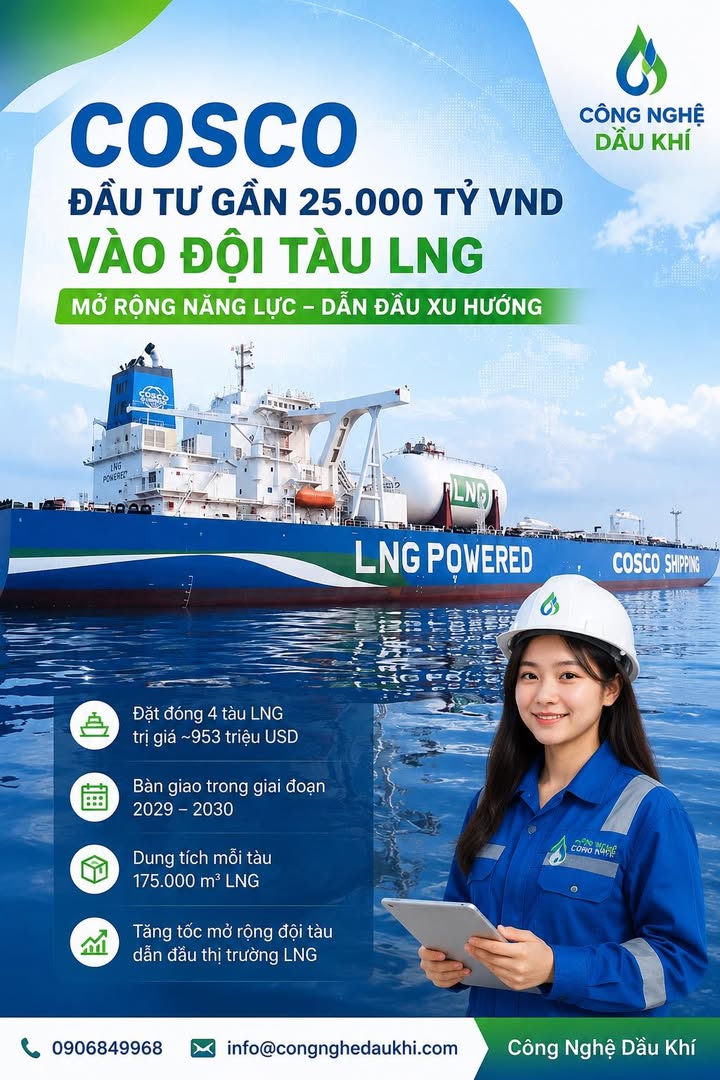
COSCO Makes Bold $953 Million Investment in Four New LNG Carriers, Betting on Global Energy Future
In a strategic move signaling strong confidence in the long-term growth of the global liquefied natural gas (LNG) market, COSCO Shipping Energy has announced a substantial investment through its subsidiary Future Ocean LNG Investment. On June 2, 2026, the company officially signed a contract with Jiangnan Shipyard to construct four new LNG carriers, each with a capacity of 175,000 cubic meters. This significant investment underscores COSCO's commitment to expanding its LNG transportation capabilities in anticipation of sustained global energy demand.
Strategic Investment in Fleet Expansion
The newly signed contract represents a major financial commitment of approximately $953 million, equivalent to around 24,780 billion Vietnamese Dong at current exchange rates. The four vessels are scheduled for delivery between 2029 and 2030, positioning COSCO to capitalize on the anticipated growth in LNG transportation during the latter part of this decade.
This development comes as COSCO Shipping Energy continues to diversify its energy transportation portfolio beyond its traditional stronghold in crude oil and petroleum product shipping. The company's strategic focus on LNG reflects broader industry trends and the global energy transition.
| Investment Details | Specifications |
|---|---|
| Number of vessels | 4 |
| Capacity per vessel | 175,000 m³ |
| Total investment | $953 million USD |
| Vietnamese Dong equivalent | Approx. 24,780 billion VND |
| Delivery timeline | 2029-2030 |
| Shipbuilder | Jiangnan Shipyard |
COSCO's Growing LNG Fleet
According to industry sources, COSCO Shipping Energy has significantly expanded its LNG fleet in recent years. As of the first quarter of 2026, the company's investment portfolio includes 87 LNG vessels, demonstrating its substantial commitment to this segment of the maritime industry.
| Fleet Status | Number of Vessels |
|---|---|
| Currently in operation | 65 |
| Under construction | 22 |
| Total fleet | 87 |
This impressive fleet size indicates that LNG has evolved from a supplementary business to one of COSCO's core strategic operations. The company's continued investment in this sector suggests a long-term vision aligned with global energy transition trends.
Why COSCO is Betting Big on LNG
The strategic focus on LNG by COSCO Shipping Energy reflects several key market dynamics:
- Asian Energy Demand: Countries across Asia, including China, Japan, South Korea, and India, are increasing their LNG imports to reduce dependence on coal and enhance energy security.
- European Energy Diversification: Following recent energy crises, European nations are actively diversifying their energy supplies, increasing imports from the United States, Qatar, and other emerging sources.
- Market Resilience: Despite fluctuations in other energy markets, LNG demand has remained consistently high, driving continuous newbuilding orders at major shipyards in China and South Korea.
- Transition Fuel: As a cleaner alternative to coal and oil, LNG serves as a crucial transition fuel in the global shift toward lower-carbon energy sources.
The Global LNG Market Landscape
Several factors are contributing to the robust outlook for the LNG market:
- United States LNG exports continue to expand, with new facilities coming online regularly
- Qatar is significantly increasing its LNG production capacity through major development projects
- China is securing long-term LNG import contracts to meet growing domestic energy needs
- Europe continues to diversify its natural gas supplies beyond traditional Russian imports
- Multiple new LNG projects are receiving approval and moving forward across different regions
These dynamics are creating substantial demand for LNG carriers over the next decade, positioning shipowners like COSCO to benefit from this anticipated growth trajectory.
Jiangnan Shipyard's Rising Role in LNG Construction
Jiangnan Shipyard has emerged as one of China's fastest-growing players in the specialized LNG carrier construction sector. In 2026 alone, the shipyard has secured multiple large-scale LNG vessel orders from international shipowners. The contract with COSCO further strengthens Jiangnan's position in the competitive global LNG shipbuilding market.
The shipyard is increasingly competing with established South Korean leaders like Hyundai Heavy Industries, Hanwha Ocean, and Samsung Heavy Industries. This competition has driven innovation and efficiency in LNG vessel construction, benefiting shipowners worldwide with more options and potentially more favorable terms.
Strategic Partnership with Shell
A noteworthy aspect of this deal is the involvement of Shell, one of the world's largest energy companies. Following delivery, the four new LNG carriers will be chartered to Shell Tankers Singapore under a long-term agreement. The seven-time charter contract is valued at approximately $799 million, equivalent to over 20,700 billion Vietnamese Dong.
This long-term charter agreement provides COSCO with significant market stability by securing revenue streams years in advance. It also demonstrates the confidence that major energy companies like Shell have in COSCO's operational capabilities and the long-term viability of the LNG market.
Market Implications and Future Outlook
COSCO's substantial investment in LNG carriers reflects a broader industry recognition of the crucial role that LNG will play in the global energy mix during the coming decades. The company's strategy appears focused on long-term positioning rather than short-term market fluctuations.
The continued expansion of LNG infrastructure worldwide, including liquefaction plants, regasification terminals, and transportation networks, suggests that this growth trajectory is likely to continue. Shipowners who make strategic investments now, like COSCO, may be well-positioned to capture value from this expanding market.
Implications for Vietnam and the Asian Region
Several Asian nations, including Vietnam, are actively developing LNG infrastructure to support their growing energy needs. Vietnam is implementing multiple LNG power projects across various provinces including Bac Lieu, Long An, Hai Phong, Quang Ninh, and Ninh Thuan.
As these projects come online, the demand for LNG transportation in the Asian region is expected to increase significantly. COSCO's continued investment in LNG carriers suggests that the company anticipates this growth and is positioning itself to capture a substantial share of the regional transportation market.
The development of Vietnam's LNG infrastructure, combined with similar initiatives across Southeast Asia, will likely contribute to increased regional demand for specialized maritime transportation services. This creates opportunities for shipping companies with established LNG capabilities and modern vessel fleets.
Conclusion: A Strategic Bet on the Energy Transition
COSCO's $953 million investment in four new LNG carriers represents more than just fleet expansion—it demonstrates a strategic bet on the future of global energy. By committing substantial resources to this sector years in advance of delivery, COSCO is positioning itself as a key player in the evolving energy landscape.
The company's approach of securing long-term charter agreements with major energy companies like Shell further mitigates market risks and ensures stable returns on these significant investments. This strategy likely serves as a model for other shipping companies considering similar expansions into the LNG sector.
As the world continues its transition toward cleaner energy sources, LNG is expected to play an increasingly important role. Companies like COSCO that recognize and prepare for this transition early may well reap substantial rewards in the decades to come. The company's bold move in the LNG sector could signal the beginning of a new era in maritime energy transportation, with implications that extend far beyond shipping to the broader global energy ecosystem.