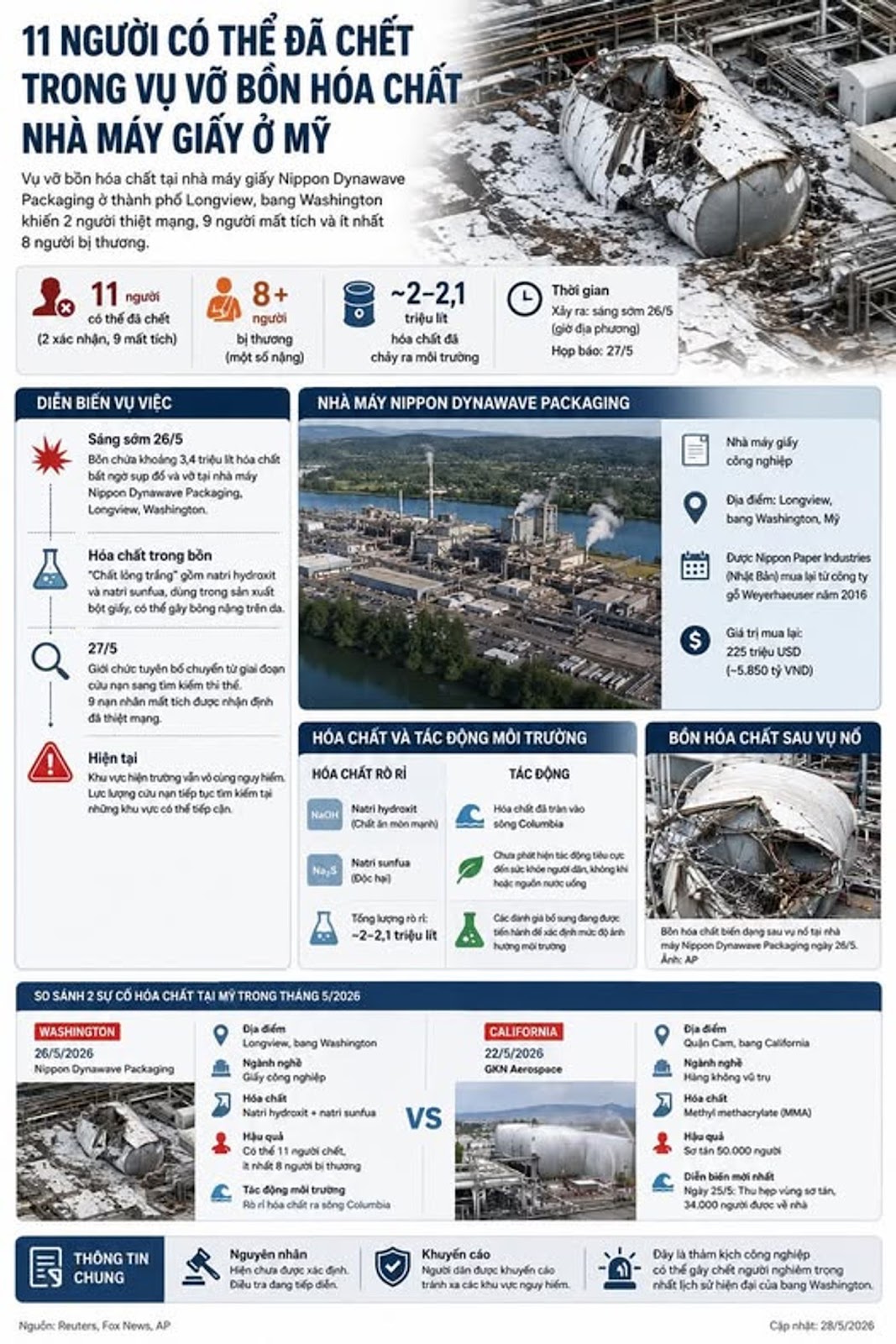
11 people may have died in the chemical tank disaster in the US
Is this just a technical accident or a sign that many industrial factories in the US are operating with outdated safety systems?

Washington state is facing one of the most serious industrial disasters in years after a giant chemical tank burst at the Nippon Dynawave Packaging paper mill in Longview city, USA.
At least 2 people have been confirmed dead, 9 others are still missing and US officials have officially moved from the rescue phase to searching for bodies. This means that the possibility that all 11 people have died is extremely high
The incident occurred when a tank containing about 3.4 million liters of chemicals suddenly deformed and exploded, creating a flow of toxic chemicals that spread throughout the factory area and flowed into the Columbia River.
 The numbers make many people shudder
Category Information
Location Longview, Washington state
Nippon Dynawave Packaging factory
Tank capacity ~3.4 million liters
Chemical Sodium hydroxide + sodium sulfide
11 people died and are missing
Injured people At least 8
The amount of chemicals leaked was ~2 million liters
Factory value when acquired ~5,850 billion VND
The chemical stored in the tank is a solution used in pulp production, which is extremely corrosive and can cause severe burns if directly exposed.
Firefighters described the scene as a "death environment" where rescue teams had to work extremely slowly because of the risk of further collapse or chemical poisoning.
 What worries the American public more is that this is the second major chemical incident in less than a week.
Previously in California, aerospace company GKN Aerospace also forced more than 50,000 people to evacuate because a methyl methacrylate tank was at risk of exploding.
 Compare two chemical incidents in the US in May 2026
Washington California incident
Nippon Dynawave Packaging GKN Aerospace Company
Industry Paper Industry Aerospace
Sodium hydroxide MMA chemical
Level of damage: 11 people may die. Evacuate 50,000 people
Environmental impact Leaks into the Columbia River Risk of widespread explosion
 It is worth noting that Nippon Paper Industries — the factory's parent corporation — is Japan's second largest paper enterprise by revenue. The factory was acquired for about $225 million from Weyerhaeuser in 2016.
Many American experts are now questioning the industrial safety inspection of large chemical tanks. Some storage systems in the US have been operating for decades but have not been thoroughly replaced.
 Environmental impact is also becoming a new obsession when chemicals have spilled into the Columbia River - an extremely important river for the North American ecosystem and transportation.
Officials have not yet detected a serious impact on drinking water or air quality, but tests are continuing.
 If this incident is confirmed to have killed 11 people, this could become the deadliest industrial disaster in modern Washington state history.
 Many people are arguing fiercely
Whether large industrial corporations are placing profits above labor safety or not