Trump's Foreign Policy Strategy: Iraq and Geopolitical Power Dynamics
The United States' foreign policy under President Donald Trump is currently operating across three primary geographic regions, each dominated by a major power. According to the National Security Strategy 2025, these three areas include: Asia, with China as the dominant power; Europe, where Russian and European NATO nations hold influence; and the Americas, encompassing both North and South America with the United States as the key player. However, Washington continues to view the Middle East as critically important to its political and economic interests for three main reasons.
| Strategic Importance Factors | Description |
|---|---|
| Geographic Strategic Location | The Middle East serves as a bridge between the Asian and European continents. |
| Military Bases | The region hosts numerous active military bases for the U.S. Army, particularly south of Russia and west of China. |
| Energy Resources | The Middle East contains substantial oil and gas reserves that China needs to fuel economic growth and support military expansion. |
Iraq: The Epicenter of the Middle East
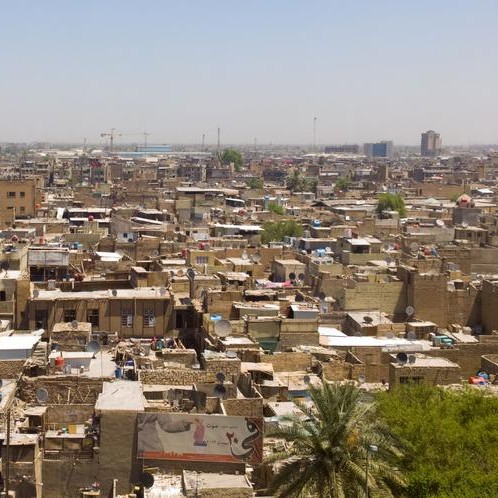
Iraq occupies a central position in the Middle East geographically, politically, and religiously, while also housing one of the world's largest oil and gas reserves. It comes as no surprise that the United States is actively working to pull Iraq out from under Chinese and Russian influence, aiming to realign the country with the Western bloc. The meeting between Iraqi Prime Minister Ali al-Zaidi and President Trump at the White House last week marked a significant step toward establishing a new framework for cooperation between the two nations.
The China-Iraq Cooperation Agreement
President Trump's team is focusing on replacing the deep relationship agreements that Iraq currently has with China with similar agreements with the United States. According to a European Union security source, Beijing signed a basic cooperation agreement with Iraq at a time when the United States and its allies were at their weakest since overthrowing President Saddam Hussein in 2003. This led to an increase in attacks by Iran-backed military forces, even after the U.S. announced the end of its combat mission in December 2023.
The 'Oil for Reconstruction and Investment' agreement between China and Iraq, signed in 2019, was expanded in scale and scope through the 'Iraq-China Framework Agreement' in 2021. This agreement not only included discounted rates for Chinese companies but also permitted them to deploy security forces in oil and gas extraction areas, construct infrastructure, and connect with larger transportation networks.
Challenges for U.S. Policy
The United States is fully capable of funding and implementing a comprehensive cooperation agreement that could match or exceed what China currently offers. However, these plans would likely be difficult to implement before the long-standing relationships between Iraq and Iran—Beijing's primary client in the region—are weakened. Trump's more aggressive approach to the Baghdad-Tehran relationship in his second term has altered this context.
Another issue Washington faces is the form of the agreement. The model for Trump's foreign policy to reestablish U.S. influence in the region is the 'normalization of relations' agreements between Arab states and Israel, known as the 'Abraham Accords'. However, the Iraqi parliament passed a strict anti-normalization law in May 2022, which prohibits establishing relations with Israel, making any cooperation agreement involving Tel Aviv politically unfeasible.
| Comparison of Strategic Approaches | China-Iraq Cooperation | Potential U.S.-Iraq Cooperation |
|---|---|---|
| Energy Sector | Discounted rates for Chinese companies in oil and gas extraction | Technology transfer and modernization of extraction infrastructure |
| Security | Deployment of Chinese security forces in extraction areas | Intelligence sharing and counter-terrorism cooperation |
| Infrastructure | Construction of transportation networks and facilities | Development of digital infrastructure and smart cities |
| Regional Influence | Strengthening Iran-backed influence | Enhancing Kurdish regional autonomy and cooperation |
Diversified Cooperation Between the U.S. and Iraq
The solution, according to the EU source, is to build a series of comprehensive agreements between the United States and Iraq, including energy deals, critical infrastructure development, and security and intelligence cooperation. Prime Minister al-Zaidi emphasized that Iraq needs a strategic partner like the United States to overcome economic and technological challenges, with cooperation expected to expand to regions such as Kurdistan, Basra, Anbar, and all Iraqi provinces.
The involvement of the autonomous Kurdistan region is a crucial requirement of Washington in any agreement with Baghdad, as this directly challenges Beijing and Moscow's long-term strategy of establishing control across the entire Middle East. In this context, Western-Kurdish cooperation in security activities has long existed, particularly in the fight against the Islamic State (IS) organization.
The Future of Iraq-U.S. Relations
The meeting between al-Zaidi and Trump in Washington, along with the 48 agreements signed between Iraq and American companies, could mark a significant shift in reshaping Baghdad's geopolitical relations, moving away from Beijing and Moscow's influence. The diversity of cooperation being discussed opens up a practical path for the United States and its partners to reaffirm influence without being overly aggressive.
For the United States and its partners, this moment could not only signify a reduction but also the beginning of a new era of influence in the Middle East.
By Simon Watkins for Oilprice.com