#China #GiaDau #DauTho #WTI #Brent #OPEC #Russia #Iran #My #AnNinhNangLuong #CongNgheDauKhi #Hormuz #NangLuongToanCau
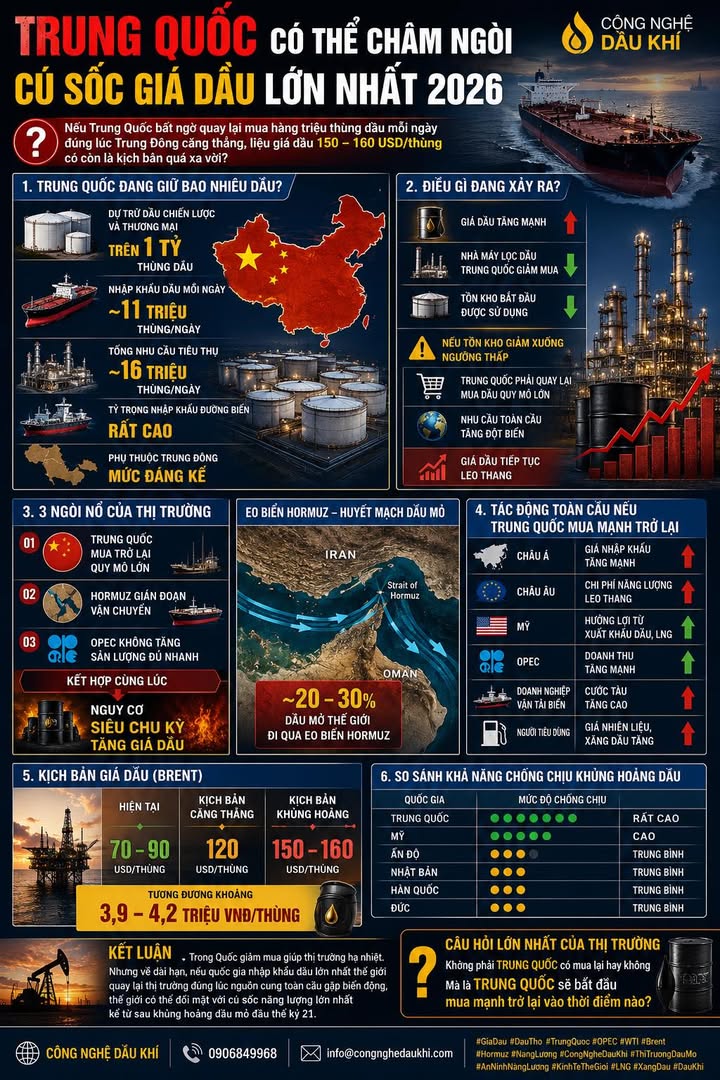
If China suddenly returns to buying millions of barrels of oil every day just as the Middle East is tense, will oil prices of 150 to 160 USD per barrel still be a far-fetched scenario?
For many months, China has been considered the country most resilient to global oil shocks. With strategic and commercial reserves estimated to exceed 1 billion barrels before the Middle East conflict broke out, Beijing has largely stayed out of violent price fluctuations.
However, what is worrying analysts is that that picture could change very quickly.
According to data from Kpler, Chinese oil refineries have reduced oil purchases recently due to sharp increases in prices. This helps the market temporarily reduce demand pressure while global supply is under pressure from geopolitical tensions.
But this can only be a temporary silence.
If China's huge stockpiles begin to decline below the safety threshold, Beijing will be forced to return to the international market to buy in extremely large volumes.
At that time, the already tense oil market may enter a new period of price boom.
Overview of factors affecting oil prices
Impact Factor
Middle East tensions Reduce potential supply
Risk of Hormuz disruption Sharp increase in shipping prices
China temporarily reduces purchases Pressure reliefshort-term demand
China strongly re-imports Shocking global demand
OPEC keeps output cautiously, limiting its ability to make up for the shortfall
The US increases shale oil production. Relieving pressure but not big enough
Why is China especially important?
China is currently the world's largest oil importer.
Any change in demand in this economy could shake up the entire energy market.
Recent statistics
Estimated Index
Daily oil demand About 16 million barrels
Daily oil imports About 11 million barrels
Strategic and commercial oil reserves Over 1 billion barrels
The proportion of seaborne imports is very high
Middle East Dependency Significant level
It's worth noting that while many countries react by buying oil when prices rise for fear of shortages, China often does the opposite.
They buy strongly when prices are low and reduce buying when prices are high.
This strategy helps Beijing save tens of billions of dollars every year.
But every strategy has its limits.
If inventory drops too deeply, re-buying is inevitable.
The scariest scenario for the market
Suppose tensions in the Strait of Hormuz persist.
Suppose OPEC doesn't increase production fast enough.
Suppose China decides to replenish its strategic reserves.
These three factors appearing together will create a "super bull cycle".
At that time, supply competition will take place between
• China
• India
• Japan
• Korea
• European Union
These countries all rely heavily on energy imports.
Impact table if CentralQuoc returned to buy strongly
Area of Influence
Asia Import prices increased sharply
Europe Escalating energy costs
America Benefits from oil and LNG exports
OPEC Revenue increased sharply
Shipping companies ship freight rates increased
Consumers Fuel prices increase
Comparing oil crisis resilience
Country Level of resilience
China Very high
My Cao
India Average
Japan Average
Korean Average
German Average
What worries investors is not China buying more oil.
What's scary is the timing of the purchase.
If Beijing returns to the market just as global supply is choked by fighting or new sanctions, oil prices could rise at a rate that many current forecast models do not fully reflect.
Some international financial organizations have proposed a scenario in which Brent prices exceed approx
3,900,000 VND to 4,200,000 VND per barrel
Equivalent to around 150 to 160 USD per barrel.
That will be a price level enough to impact inflation, transportation, production and global economic growth.
Conclusion
In the short term, China's reduction in oil purchases is giving the market more space to cool down.
But in the long term, this may just be the calm before the storm.
If the planet's largest oil importer returns to the market with huge demand just as global supply fluctuates, the world could face one of the biggest energy shocks since the oil crisis of the early 21st century.
The question being watched by the whole market is not whether TruWill Quoc buy it back or not?
But at what point will China start buying strongly again?
#GiaDau #DauTho #TrungQuoc #OPEC #WTI #Brent #Hormuz #NangLuong #CongNgheDauKhi #ThiTruongDauMo #KinhTeTheGioi #AnNinhNangLuong #LNG #XangDau #DauKhi