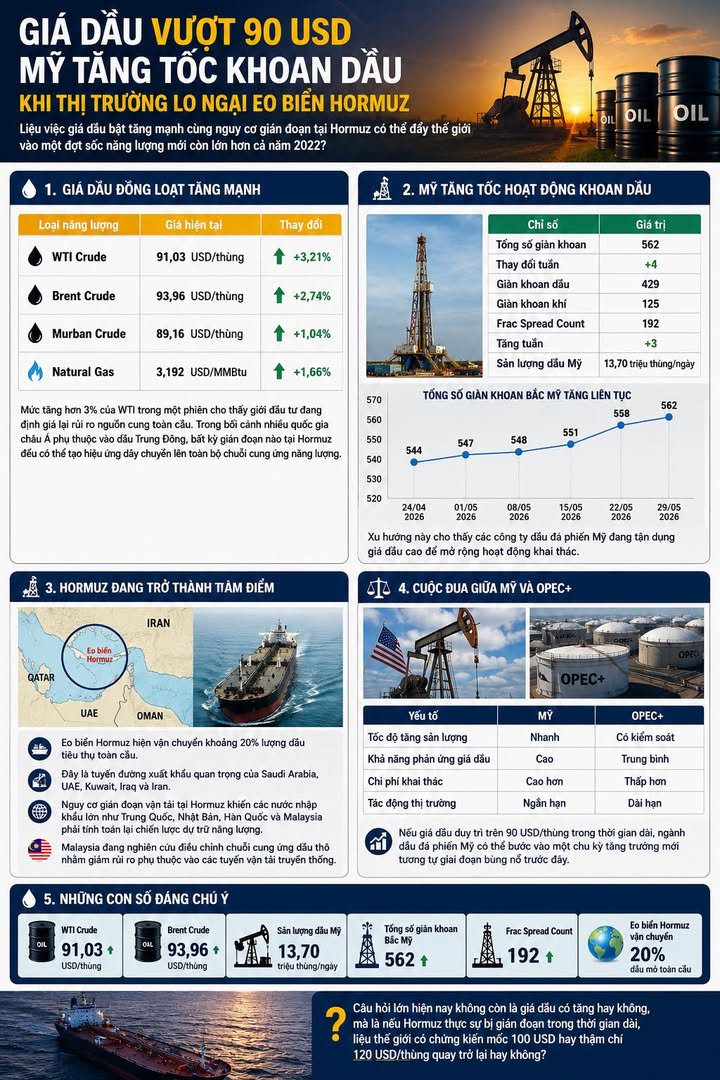
Oil Prices Surpass $90 as US Accelerates Drilling Amid Hormuz Security Concerns
Global oil markets are experiencing significant volatility as crude prices climb above $90 per barrel, with investors increasingly concerned about potential disruptions in the Strait of Hormuz. This critical waterway, through which approximately 20% of global oil consumption is transported, has become a focal point for energy security concerns as geopolitical tensions in the region escalate.
Oil Prices Reach Multi-Month Highs
The benchmark West Texas Intermediate (WTI) crude has surged past the $91 mark, while Brent crude has neared $94 per barrel, representing increases of over 3% and 2.7% respectively in recent trading sessions. This sharp upward movement reflects market participants reassessing global supply risks amid growing concerns about maritime security in the Persian Gulf.
The price surge extends beyond traditional benchmarks, with Murban crude trading at $89.16 per barrel and natural gas at $3.192 per MMBtu, both showing notable increases. This broad-based rally suggests that the market is pricing in significant potential supply disruptions rather than isolated regional issues.
| Energy Type | Current Price | Change |
|---|---|---|
| WTI Crude | $91.03/barrel | +3.21% |
| Brent Crude | $93.96/barrel | +2.74% |
| Murban Crude | $89.16/barrel | +1.04% |
| Natural Gas | $3.192/MMBtu | +1.66% |
The more than 3% increase in WTI within a single trading session indicates that investors are rapidly repricing global supply risks. In an environment where many Asian nations remain heavily dependent on Middle Eastern oil, any disruption to Hormuz could trigger cascading effects throughout the entire global energy supply chain.
US Accelerates Oil Drilling Operations
In response to the price surge, North America's oil and gas industry has demonstrated its characteristic agility by rapidly expanding drilling operations. The latest data reveals a consistent increase in drilling activity since early May, suggesting that US shale producers are capitalizing on elevated prices to expand operations.
According to the most recent figures, the total number of active drilling rigs in North America has reached 562, representing a net increase of 4 rigs over the previous week. This includes 429 oil-directed rigs and 125 gas-directed rigs. Additionally, 192 frac spreads are currently in operation, marking an increase of 3 from the previous week.
US oil production has stabilized at approximately 13.70 million barrels per day, maintaining its position as the world's largest oil producer. The sustained production levels, combined with the expanding drilling activity, indicate that the US industry is well-positioned to respond to market opportunities.
| Date | Total Rigs |
|---|---|
| April 24, 2026 | 544 |
| May 1, 2026 | 547 |
| May 8, 2026 | 548 |
| May 15, 2026 | 551 |
| May 22, 2026 | 558 |
| May 29, 2026 | 562 |
This upward trend in drilling activity demonstrates that US shale companies are leveraging high oil prices to expand their operations. The consistent increase in rig counts since early May suggests a strategic shift toward maximizing production opportunities in the current price environment.
The Strait of Hormuz: A Geopolitical Flashpoint
The Strait of Hormuz has emerged as the central concern for global energy markets due to its critical importance to worldwide oil transportation. This narrow waterway serves as the primary export route for major oil-producing nations including Saudi Arabia, the United Arab Emirates, Kuwait, Iraq, and Iran.
Any disruption to maritime traffic through Hormuz would have immediate and profound implications for global energy markets. For major oil-importing nations such as China, Japan, South Korea, and Malaysia, the potential for supply disruptions has necessitated a reassessment of energy security strategies and reserve management policies.
In response to these concerns, Malaysia has reportedly begun evaluating adjustments to its crude oil supply chain to reduce reliance on traditional transportation routes. Similarly, other Asian importers are likely considering similar measures to mitigate potential risks associated with Hormuz security issues.
The US-OPEC+ Rivalry Intensifies
While OPEC+ producers continue to exercise considerable influence over global supply levels, US shale producers are capitalizing on high prices to expand their market share. The contrasting approaches of these two major production blocs create a complex dynamic in the current market environment.
| Factor | US Shale | OPEC+ |
|---|---|---|
| Production Growth Speed | Rapid | Controlled |
| Response to Oil Prices | High | Moderate |
| Production Costs | Higher | Lower |
| Market Impact | Short-term | Long-term |
If oil prices sustain above $90 per barrel for an extended period, the US shale industry could enter a new growth cycle similar to its previous boom periods. The current price environment provides an opportunity for shale producers to improve profitability, reduce debt burdens, and potentially increase investment in new technologies and infrastructure.
Key Market Indicators
- WTI crude has risen to $91.03 per barrel
- Brent crude has reached $93.96 per barrel
- US oil production stands at 13.70 million barrels per day
- 562 drilling rigs are currently active in North America
- 192 hydraulic fracturing crews are in operation
- The Strait of Hormuz continues to transport approximately 20% of global oil supplies
Future Scenarios and Market Implications
The central question facing energy markets is no longer whether oil prices will rise, but rather whether prolonged disruptions in the Strait of Hormuz could push prices toward $100 or even $120 per barrel. Such a scenario would have profound implications for global economic growth, inflation dynamics, and energy transition strategies.
Market analysts are divided on the likelihood of a major disruption in Hormuz, with some suggesting that diplomatic channels would prevent a prolonged crisis, while others warn that escalating tensions could lead to significant supply interruptions. The uncertainty surrounding Hormuz has created a risk premium in oil pricing that is likely to persist until the geopolitical situation clarifies.
In the meantime, the continued expansion of US shale production, coupled with potential strategic releases from global petroleum reserves, may provide some offset to supply concerns. However, the market remains sensitive to any developments that could affect the free flow of oil through this critical chokepoint.
The current situation underscores the complex interplay between geopolitical risks, market dynamics, and production capabilities that characterizes today's global energy landscape. As the world continues to navigate the transition toward cleaner energy sources, short-term supply disruptions and price volatility remain significant challenges for policymakers, businesses, and consumers alike.