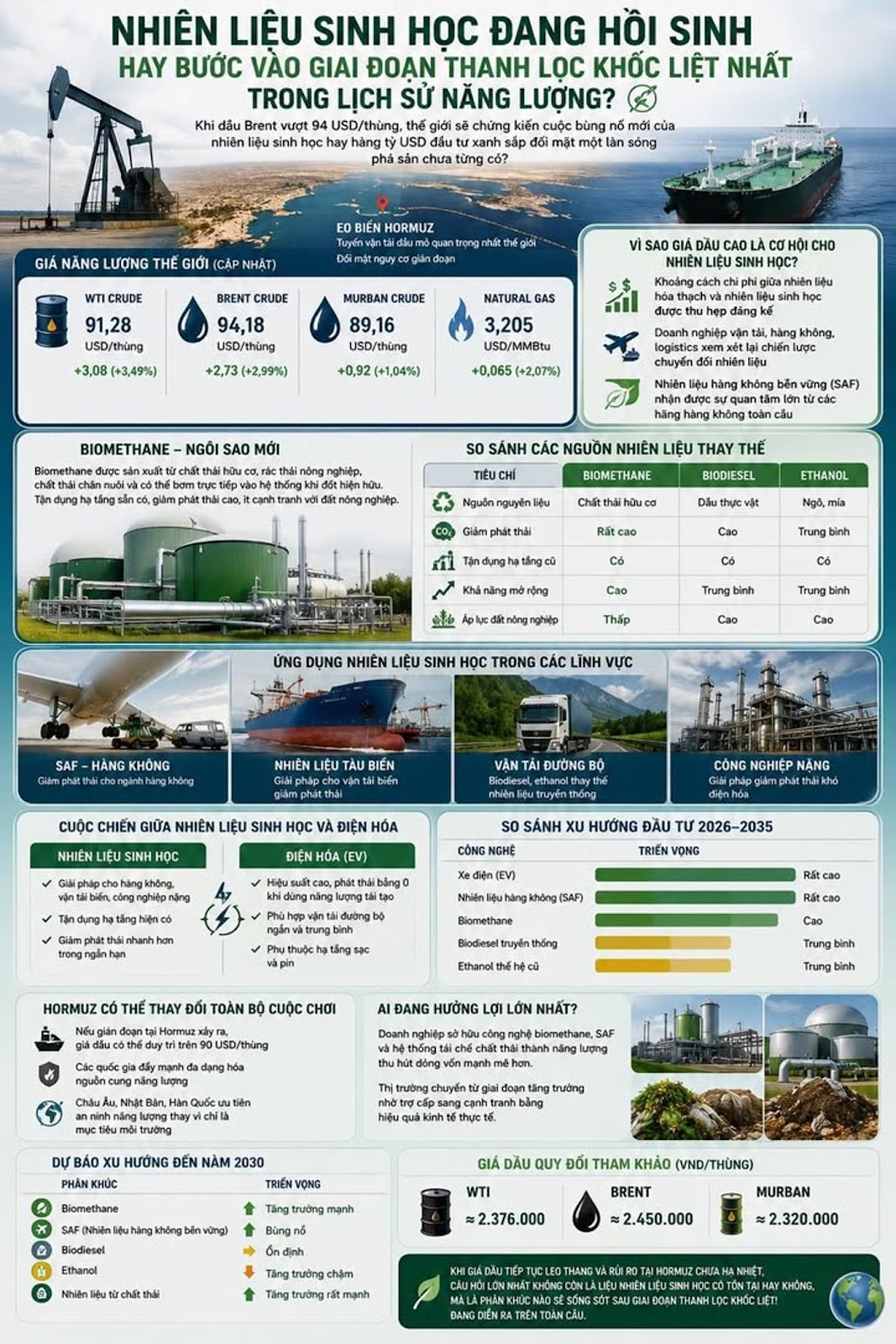
Are Biofuels Experiencing a Renaissance or Facing the Most Severe Purification Phase in Energy History?
As Brent crude oil surpasses $94 per barrel, the world stands at a crossroads: Will we witness a new biofuel boom, or are billions in green investments facing an unprecedented wave of bankruptcies? The current energy landscape is being reshaped by soaring oil prices, with WTI reaching $91.28/barrel and Brent at $94.18/barrel, while natural gas climbs to $3.205/MMBtu. Particularly, the threat of transportation disruptions at the Strait of Hormuz is compelling many nations to seek alternative energy sources to reduce dependence on imported oil.
The New Era of Biofuels
The biofuel industry is entering a completely new phase. No longer is it a race to expand capacity at any cost as seen during the 2020-2024 period. The current market is shifting toward a battle of economic efficiency, raw material sources, and actual emission reduction capabilities.
High oil prices are creating new opportunities for biofuels. As oil prices rise, the cost gap between fossil fuels and biofuels narrows significantly, making biofuels more competitive in the energy mix.
| Energy Index | Current Price |
|---|---|
| WTI Crude | $91.28/barrel |
| Brent Crude | $94.18/barrel |
| Murban Crude | $89.16/barrel |
| Natural Gas | $3.205/MMBtu |
These price levels are prompting many transportation, aviation, and logistics enterprises to reconsider their fuel transition strategies. Particularly, sustainable aviation fuel (SAF) is receiving significant attention from global airlines as emission reduction pressures intensify.
The Unexpected Rise of Biomethane
While ethanol and biodiesel are experiencing slower growth, biomethane is emerging as a new attractive segment. Produced from organic waste, agricultural waste, and livestock waste, biomethane can be directly injected into existing gas pipeline systems.
Many experts believe biomethane holds an advantage over full electrification by leveraging existing gas infrastructure. This makes it a more immediately viable solution for many regions without requiring complete system overhauls.
| Criteria | Biomethane | Biodiesel | Ethanol |
|---|---|---|---|
| Raw Material Source | Organic Waste | Vegetable Oil | Corn, Sugarcane |
| Emission Reduction | Very High | High | Moderate |
| Utilization of Existing Infrastructure | Yes | Yes | Yes |
| Expansion Potential | High | Moderate | Moderate |
| Agricultural Land Pressure | Low | High | High |
The Intensifying Battle Between Biofuels and Electrification
One of the biggest debates today is whether biofuels are truly a long-term solution. Environmental organizations argue that agricultural land should prioritize food production or solar energy rather than growing fuel crops. The biofuel industry counters that sectors like aviation, maritime transport, and heavy industry are nearly impossible to fully electrify in the short term.
This creates direct competition between biofuels and electric vehicles, with each technology having its own advantages and limitations depending on the application.
| Technology | Outlook 2026-2035 |
|---|---|
| Electric Vehicles (EV) | Very High |
| Sustainable Aviation Fuel (SAF) | Very High |
| Biomethane | High |
| Traditional Biodiesel | Moderate |
| Legacy Ethanol | Moderate |
The Strait of Hormuz: Potential Game Changer
The prospect of disruption to the world's most critical energy transportation route is causing many countries to reassess their energy security strategies. If oil prices remain above $90/barrel for an extended period, biofuels could become an important part of the alternative solution mix.
For Europe, Japan, and South Korea in particular, diversifying fuel sources is becoming a strategic priority rather than merely an environmental objective. This shift could fundamentally alter the global energy landscape in the coming years.
Who Benefits Most
Companies owning biomethane technology, sustainable aviation fuel, and waste-to-energy systems are attracting significantly stronger capital flows than traditional biodiesel producers. This indicates that the market is transitioning from growth driven by subsidies to competition based on actual economic efficiency.
Forecast Trends Until 2030
| Segment | Outlook |
|---|---|
| Biomethane | Strong Growth |
| SAF | Explosive Growth |
| Biodiesel | Stable |
| Ethanol | Slow Growth |
| Waste-based Fuels | Very Strong Growth |
Reference Oil Price Conversion
| Oil Type | Converted Price |
|---|---|
| WTI | Approx. 2,376,000 VND/barrel |
| Brent | Approx. 2,450,000 VND/barrel |
| Murban | Approx. 2,320,000 VND/barrel |
As oil prices continue to climb and risks in the Strait of Hormuz show no signs of abating, the biggest question is no longer whether biofuels will exist, but which segments will survive the severe global purification phase currently underway.
The biofuel industry stands at a critical juncture where economic viability, environmental benefits, and technological innovation will determine which players emerge stronger in the post-oil era.