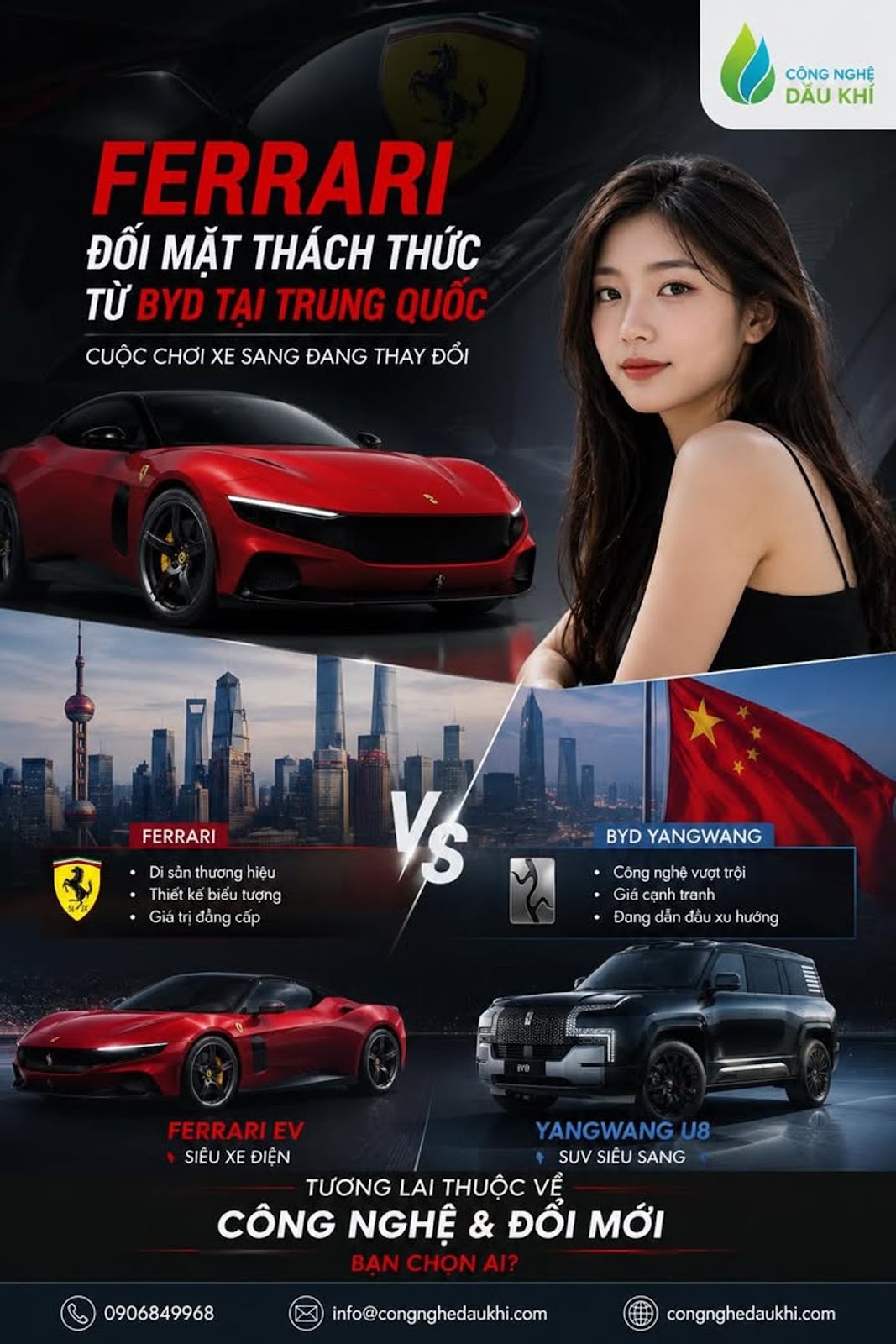
Ferrari Bets on Future in China as BYD Completely Transforms the Luxury Car Game
For the first time in automotive history, a Chinese automaker is selling more luxury vehicles than the combined total of Ferrari, Lamborghini, Bentley, Rolls-Royce, and Aston Martin in their home market. This seismic shift is forcing European luxury marques to reassess their strategies in what has traditionally been their strongest territory.
As Ferrari prepares to enter the electric vehicle era with its first EV model expected in the near future, the Chinese luxury car landscape has transformed dramatically from the era when European brands dominated the ultra-premium segment. For years, Ferrari, Lamborghini, Bentley, Rolls-Royce, and Aston Martin were virtually the status symbols of China's super-rich. However, the rise of BYD and its luxury brand Yangwang is completely rewriting the market's balance of power.
The Shifting Luxury Car Market in China
Chinese consumers are no longer looking exclusively at European logos when making luxury vehicle purchases. They are now placing greater emphasis on several key factors:
- Battery technology and energy efficiency
- Artificial intelligence integration
- Smart driving systems and autonomous capabilities
- Operating costs and efficiency
- Acceleration performance and driving dynamics
- Over-the-air software updates and continuous improvement
In many of these categories, Chinese electric vehicle manufacturers are now significantly ahead of their European counterparts.
Comparison of Notable Models
The following table presents some of the most notable luxury and ultra-luxury vehicles currently competing in the Chinese market:
| Brand | Model | Vehicle Type |
|---|---|---|
| Ferrari | Ferrari EV 2026 | High-performance electric |
| BYD Yangwang | Yangwang U8 | Extended-range luxury electric SUV |
| BYD Yangwang | Yangwang U9 | Electric supercar |
| Lamborghini | Revuelto | Hybrid |
| Rolls-Royce | Spectre | Ultra-luxury electric |
| Bentley | Flying Spur Hybrid | Hybrid |
Estimated Retail Prices in China
The following table provides approximate pricing for these luxury models in the Chinese market:
| Model | Estimated Price (VND) |
|---|---|
| Yangwang U8 | ~3,800,000,000 |
| Yangwang U9 | ~5,300,000,000 |
| Rolls-Royce Spectre | From 12,000,000,000 |
| Ferrari Roma | From 7,500,000,000 |
| Lamborghini Revuelto | From 16,000,000,000 |
The significant price gap is enabling BYD to access the wealthy, younger demographic more easily than traditional European luxury brands.
Why Ferrari Faces Challenges
Ferrari isn't just competing with BYD. The Italian marque must also contend with a growing list of domestic Chinese luxury brands:
- BYD Yangwang
- NIO ET9
- Zeekr 009 Grand
- AITO M9
- Li Auto MEGA
- Xiaomi SU7 Ultra
Each of these models features cutting-edge technology, heavily digitized interiors, and software ecosystems optimized for Chinese users.
What Makes BYD a Phenomenon
BYD is no longer the budget brand many once perceived it to be. The company now controls nearly the entire value chain:
- Self-production of Blade Battery technology
- Self-development of electric vehicle platforms
- Self-researched control chips
- Integrated AI and driving assistance systems
- Complete product range from mass-market to ultra-luxury
This represents an advantage that even many European automakers have yet to achieve.
Brand Strength Comparison
The following table compares key aspects of Ferrari and BYD Yangwang:
| Criteria | Ferrari | BYD Yangwang |
|---|---|---|
| Brand Heritage | Very Strong | Emerging |
| Battery Technology | Average | Very Strong |
| AI & Software | Good | Very Strong |
| Pricing | Very High | Significantly Lower |
| Production Capacity | Limited | Very Large |
| Recognition in China | High | Rapidly Increasing |
The Game Has Changed Forever
The most significant development isn't just Ferrari's entry into electric vehicles. What's noteworthy is that Chinese brands have become strong enough to force European luxury icons to change their strategies in the world's largest luxury car market.
If Ferrari succeeds with its first electric model, the marque could open a new chapter in its more than 80-year history. However, if ultra-wealthy Chinese consumers continue to shift toward domestic brands like BYD Yangwang, NIO, or Xiaomi, the global luxury car revolution may have begun in China rather than Europe.
This transition represents a fundamental shift in the automotive industry's center of gravity, with Chinese automakers leveraging their technological advantages and domestic market strength to challenge the established hierarchy of global luxury brands.