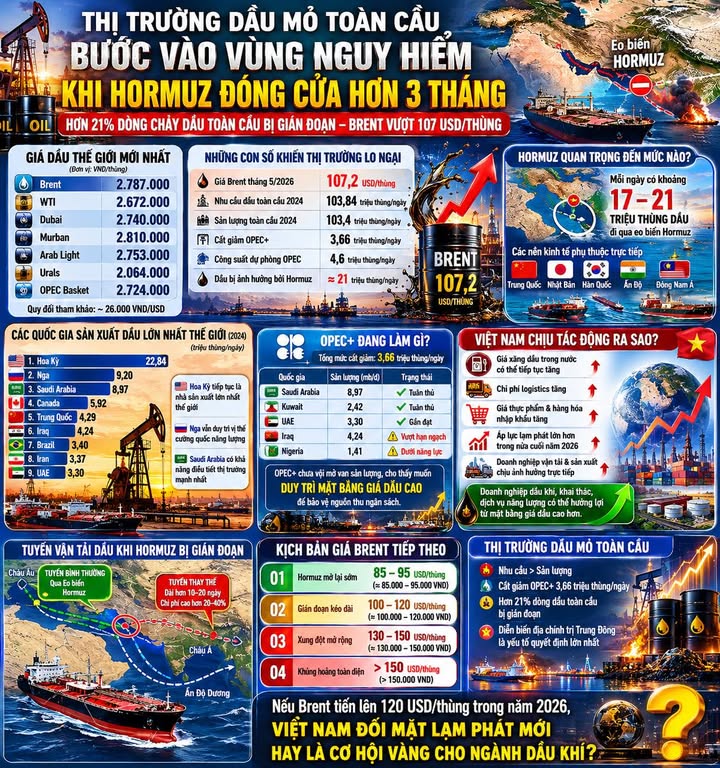
Global Oil Market Enters Dangerous Territory as Hormuz Strait Closure Extends Beyond Three Months
The global energy market is experiencing one of its most tense periods since the Russia-Ukraine conflict. The near-closure of the Strait of Hormuz since late February 2026 has created immense pressure on the global oil supply chain, driving crude prices sharply higher and raising concerns about a new wave of inflation.
With over 21% of global oil flow disrupted and Brent prices exceeding $107 per barrel, the question arises: Is the world facing a new oil shock that could be more severe than 2022?
Current Global Oil Prices
| Oil Type | Current Price |
|---|---|
| Brent | 2,787,000 VND/barrel |
| WTI | 2,672,000 VND/barrel |
| Dubai | 2,740,000 VND/barrel |
| Murban | 2,810,000 VND/barrel |
| Arab Light | 2,753,000 VND/barrel |
| Urals | 2,064,000 VND/barrel |
| OPEC Basket | 2,724,000 VND/barrel |
Reference conversion rate: approximately 26,000 VND/USD
Market Concerns: Key Figures
| Indicator | Value |
|---|---|
| Brent Price (May 2026) | $107.2/barrel |
| Global Oil Demand (2024) | 103.84 million barrels/day |
| Global Production (2024) | 103.4 million barrels/day |
| OPEC+ Cuts | 3.66 million barrels/day |
| OPEC Spare Capacity | 4.6 million barrels/day |
| Oil Affected by Hormuz | Approximately 21 million barrels/day |
Notably, global oil demand has now exceeded actual production. Against the backdrop of OPEC+ maintaining supply control policies, any disruption in the Middle East could push oil prices even higher.
World's Largest Oil-Producing Countries
| Country | Production (2024) |
|---|---|
| United States | 22.84 million barrels/day |
| Russia | 9.20 million barrels/day |
| Saudi Arabia | 8.97 million barrels/day |
| Canada | 5.92 million barrels/day |
| China | 4.29 million barrels/day |
| Iraq | 4.24 million barrels/day |
| Brazil | 3.40 million barrels/day |
| Iran | 3.37 million barrels/day |
| UAE | 3.30 million barrels/day |
The United States continues to be the world's largest oil producer, with output nearly 2.5 times that of Saudi Arabia. Russia maintains its position as an energy power despite prolonged sanctions. Saudi Arabia remains the country with the strongest market influence due to its large spare capacity.
The Critical Importance of the Strait of Hormuz
Each day, approximately 17 to 21 million barrels of oil pass through the Strait of Hormuz. This strategic waterway connects the Persian Gulf with the Gulf of Oman and the Arabian Sea, serving as a critical chokepoint for global energy supplies.
Economies directly dependent on this route include:
- China
- Japan
- South Korea
- India
- Southeast Asian countries
When this shipping route is disrupted, oil tankers must find longer alternative routes, significantly increasing transportation costs, extending delivery times, and pushing oil prices higher.
OPEC+ Response to the Crisis
Despite the supply crisis, OPEC+ has maintained its overall production cuts of approximately 3.66 million barrels per day.
| Country | Production | Status |
|---|---|---|
| Saudi Arabia | 8.97 mb/d | Compliant |
| Kuwait | 2.42 mb/d | Compliant |
| UAE | 3.30 mb/d | Near capacity |
| Iraq | 4.24 mb/d | Exceeding quota |
| Nigeria | 1.41 mb/d | Below capacity |
OPEC+'s reluctance to quickly open the production tap indicates that the organization aims to maintain higher oil prices to protect budget revenues. This strategy becomes more challenging with the Hormuz disruption, as it creates a perfect storm of supply constraints.
Impact on Vietnam
If Brent prices remain around $107 per barrel for several months:
- Domestic gasoline and diesel prices will continue to face upward pressure
- Logistics costs will increase
- Prices of imported food and goods will rise
- Greater inflationary pressure in the second half of 2026
- Transportation and fuel-intensive manufacturing businesses will be directly affected
However, oil and gas companies, exploration and production enterprises, and energy service providers may benefit from higher oil price levels.
Possible Future Scenarios
| Scenario | Expected Brent Price |
|---|---|
| Hormuz reopens soon | 85,000 to 95,000 VND (equivalent to $85 to $95/barrel) |
| Prolonged disruption | $100 to $120/barrel |
| Conflict escalation | $130 to $150/barrel |
| Comprehensive crisis | Above $150/barrel |
Currently, the biggest determining factor is no longer consumption demand but geopolitical developments in the Middle East. If the Strait of Hormuz remains blocked for many more months, the global oil market could enter its strongest upward cycle since the 2022 energy crisis.
A question hotly debated among investors: If Brent reaches $120/barrel in 2026, will Vietnam face a new wave of inflation, or will this be a golden opportunity for the oil and gas sector to make a significant breakthrough?