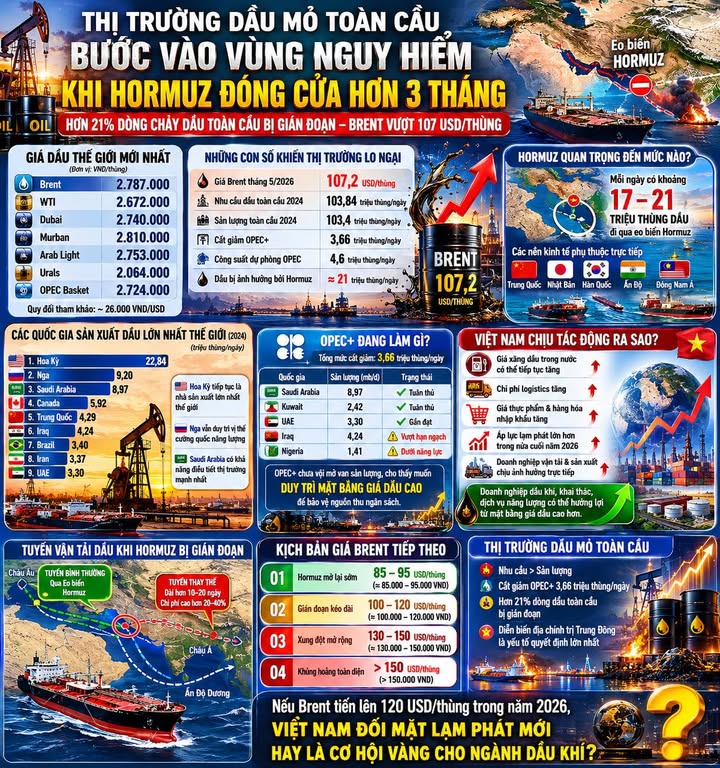
Global Oil Market Enters Dangerous Territory as Strait of Hormuz Closure Enters Third Month
The global oil market is experiencing one of its most volatile periods since the Russia-Ukraine conflict, with the Strait of Hormuz remaining virtually closed since late February 2026. This geopolitical choke point, through which over 21% of global oil flows pass, has created unprecedented pressure on global petroleum supply chains, driving crude prices to multi-year highs and raising concerns about a new wave of inflation.
Current Market Overview
As tensions in the Middle East continue to escalate, Brent crude has surged past $107 per barrel, marking a significant escalation in energy costs worldwide. The following table presents the latest global oil prices:
| Oil Type | Current Price (VND/barrel) |
|---|---|
| Brent | 2,787,000 |
| WTI | 2,672,000 |
| Dubai | 2,740,000 |
| Murban | 2,810,000 |
| Arab Light | 2,753,000 |
| Urals | 2,064,000 |
| OPEC Basket | 2,724,000 |
Reference exchange rate: approximately 26,000 VND/USD
Key Market Statistics
The current market situation is characterized by several concerning indicators:
| Indicator | Value |
|---|---|
| Brent price (May 2026) | 107.2 USD/barrel |
| Global oil demand (2024) | 103.84 million barrels/day |
| Global production (2024) | 103.4 million barrels/day |
| OPEC+ production cuts | 3.66 million barrels/day |
| OPEC spare capacity | 4.6 million barrels/day |
| Daily oil affected by Hormuz closure | Approximately 21 million barrels/day |
Notably, global oil demand has now exceeded actual production levels. Against the backdrop of OPEC+'s continued supply control measures, any further disruptions in the Middle East could push oil prices even higher.
Major Global Oil Producers
The global oil production landscape remains dominated by a few key players:
| Country | Production (2024, million barrels/day) |
|---|---|
| United States | 22.84 |
| Russia | 9.20 |
| Saudi Arabia | 8.97 |
| Canada | 5.92 |
| China | 4.29 |
| Iraq | 4.24 |
| Brazil | 3.40 |
| Iran | 3.37 |
| UAE | 3.30 |
The United States continues to be the world's largest oil producer, with output nearly 2.5 times that of Saudi Arabia. Russia maintains its position as an energy powerhouse despite prolonged international sanctions. Saudi Arabia retains the strongest market influence due to its substantial spare capacity.
The Critical Importance of the Strait of Hormuz
Approximately 17 to 21 million barrels of oil pass through the Strait of Hormuz daily, making it the world's most critical oil choke point. The economies most directly dependent on this route include:
- China
- Japan
- South Korea
- India
- Southeast Asian nations
When this shipping lane is disrupted, oil tankers must take longer alternative routes, significantly increasing transportation costs, extending delivery times, and pushing oil prices higher. The closure of Hormuz has effectively created a global oil supply bottleneck that is difficult to circumvent.
OPEC+ Response and Strategy
Despite the supply crisis, OPEC+ has maintained its collective production cuts of approximately 3.66 million barrels per day. The compliance status of key members is as follows:
| Country | Production (million barrels/day) | Compliance Status |
|---|---|---|
| Saudi Arabia | 8.97 | Compliant |
| Kuwait | 2.42 | Compliant |
| UAE | 3.30 | Near capacity |
| Iraq | 4.24 | Exceeding quota |
| Nigeria | 1.41 | Below capacity |
OPEC+'s reluctance to increase production indicates the organization's intention to maintain higher oil prices to protect budget revenues. This strategy, while beneficial for producer economies, exacerbates the supply constraints facing consuming nations.
Impact on Vietnam's Economy
If Brent prices remain around $107 per barrel for several months, Vietnam could face several economic challenges:
- Continued upward pressure on domestic gasoline and diesel prices
- Increased logistics costs
- Rising prices for imported food and goods
- Greater inflationary pressure in the second half of 2026
- Direct impact on transportation and fuel-intensive manufacturing businesses
However, Vietnamese oil and gas companies and energy service providers could benefit from higher oil price levels, potentially experiencing significant growth in this environment.
Future Scenarios and Price Projections
The following table outlines potential scenarios for the global oil market:
| Scenario | Expected Brent Price Range |
|---|---|
| Hormuz reopens soon | 85-95 USD/barrel |
| Prolonged disruption | 100-120 USD/barrel |
| Conflict escalation | 130-150 USD/barrel |
| Comprehensive crisis | Above 150 USD/barrel |
Currently, the largest determining factor is no longer consumption demand but geopolitical developments in the Middle East. If the Strait of Hormuz remains closed for many more months, the global oil market could enter its strongest price escalation cycle since the 2022 energy crisis.
Conclusion: The Uncertain Path Ahead
A critical question is dividing investors and analysts: if Brent reaches $120/barrel in 2026, will Vietnam face a new wave of inflation, or will this present a golden opportunity for the domestic oil and gas sector to achieve breakthrough growth?
The answer depends on multiple factors including the duration of the Hormuz closure, the effectiveness of alternative supply routes, the response from other major producers, and the ability of consuming nations to implement mitigating measures. What remains certain is that the global oil market is navigating treacherous waters, with geopolitical tensions replacing traditional supply-demand fundamentals as the primary driver of price movements.