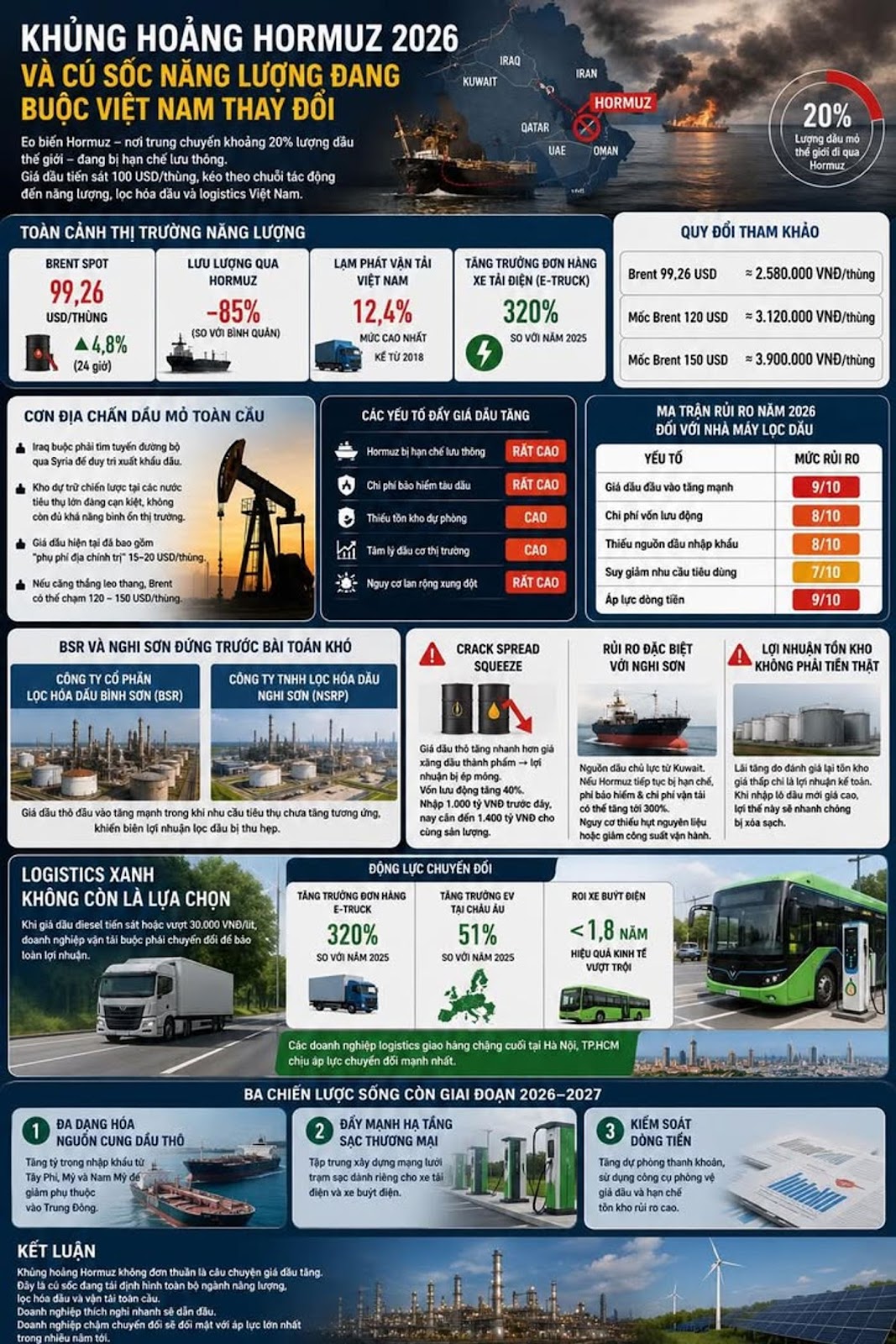
The 2026 Hormuz Crisis and the Energy Shock Forcing Vietnam's Transformation
In an increasingly volatile global energy landscape, the partial blockade of the Strait of Hormuz has sent shockwaves through international markets, pushing Brent crude oil prices toward $100 per barrel and accelerating Vietnam's transition to electric logistics by decades. This geopolitical flashpoint, responsible for approximately 20% of globally traded oil, has created unprecedented pressure across the entire supply chain—from extraction and transportation to refining and logistics.
Global Energy Market Overview
The year 2026 has emerged as one of the most turbulent periods in the global energy market since the historic oil crisis of the 1970s. With escalating geopolitical tensions in the Strait of Hormuz, the entire supply chain—from extraction and transportation to refining and logistics—is facing unprecedented challenges.
| Parameter | Value |
|---|---|
| Brent Spot Price | 99.26 USD/barrel |
| 24-hour Change | +4.8% |
| Hormuz Traffic Volume | 85% reduction |
| Vietnam's Transport Inflation | 12.4% |
| Electric Truck Order Growth | 320% |
Reference Conversion Rates
| Benchmark | Equivalent Value (VND) |
|---|---|
| Brent at 99.26 USD | Approximately 2,580,000 VND/barrel |
| Brent at 120 USD | Approximately 3,120,000 VND/barrel |
| Brent at 150 USD | Approximately 3,900,000 VND/barrel |
The Global Oil Shock: Causes and Consequences
Continuous disruptions to shipping lanes through Hormuz have compelled many oil-exporting nations to seek alternative transportation routes. Iraq, for instance, is reportedly studying land-based routes with significantly higher costs and risks to maintain its export capabilities. Meanwhile, strategic reserves in major consuming regions have lost their capacity to provide the same stabilizing buffer as in previous decades.
Energy experts suggest that current oil prices incorporate a "geopolitical premium" ranging from $15 to $20 per barrel. This implies that if tensions were to de-escalate, oil prices could decrease significantly. Conversely, if the conflict were to escalate further, prices reaching $120 to $150 per barrel become entirely plausible scenarios.
Factors Driving Oil Price Increases
| Factor | Impact Level |
|---|---|
| Hormuz traffic restrictions | Very High |
| Oil tanker insurance costs | Very High |
| Insufficient inventory buffers | High |
| Market speculation psychology | High |
| Risk of conflict spreading | Very High |
Vietnam's Energy Sector: Challenges for BSR and Nghi Son
Vietnam's two largest oil refineries, Binh Son Refining and Petrochemical Company (BSR) and Nghi Son Refinery and Petrochemical Company, are facing a dual pressure scenario. On one hand, crude oil input costs have surged dramatically. On the other hand, domestic consumption demand has not increased proportionally, significantly narrowing refining profit margins.
2026 Risk Matrix
| Risk Factor | Risk Level (1-10) |
|---|---|
| Rising crude oil input costs | 9/10 |
| Working capital costs | 8/10 |
| Insufficient imported oil sources | 8/10 |
| Declining consumer demand | 7/10 |
| Cash flow pressure | 9/10 |
The Crack Spread Squeeze: A Dangerous Phenomenon for Refiners
One of the most precarious situations facing oil refineries is the "Crack Spread Squeeze." This occurs when crude oil prices rise faster than the prices of refined petroleum products, severely compressing profit margins. Refining companies must allocate significantly more capital to purchase the same volume of crude oil without being able to proportionally increase their product selling prices.
For example, what previously required 1,000 billion VND to purchase a batch of crude oil may now demand up to 1,400 billion VND for the same output volume. This margin compression creates severe financial pressure on refinery operations.
Special Risks for Nghi Son
Nghi Son Refery faces particular vulnerabilities due to its primary raw material sourcing from Kuwait. Should Hormuz restrictions persist, war insurance premiums and transportation costs could potentially increase by up to 300%. This significantly elevates the risk of material shortages or reduced operational capacity at the facility.
Accounting Profits vs. Real Profits
Many refining companies may report substantial profit growth during periods of rising oil prices through the revaluation of low-cost inventory. However, this represents merely accounting profit rather than actual cash flow. When new batches must be imported at higher prices, this apparent advantage can quickly evaporate, revealing the true financial health of the operation.
Green Logistics Acceleration: Electric Vehicles as a Survival Strategy
One of the most significant consequences of the Hormuz crisis has been the accelerated adoption of commercial electric vehicles. As diesel prices approach or exceed 30,000 VND per liter, transportation companies are fundamentally reassessing their business models. Electric vehicles have transitioned from a future-oriented choice to a survival imperative for protecting profit margins.
Transformation Drivers
| Indicator | Value |
|---|---|
| Electric truck order growth | 320% |
| EV growth in Europe | 51% |
| ROI for electric buses | Under 1.8 years |
Logistics companies specializing in last-mile delivery in Hanoi and Ho Chi Minh City are experiencing the most intense pressure to transition. The escalating costs of conventional fuels are rendering electric vehicles not just an environmentally conscious choice but an economic necessity for maintaining viable profit margins.
Three Survival Strategies for 2026-2027
- Diversify Crude Oil Supply Sources
Increasing the proportion of imports from West Africa, the Americas, and other regions to reduce dependency on the Middle East. This geographical diversification mitigates vulnerability to regional disruptions. - Strengthen Commercial Charging Infrastructure
Focusing on developing dedicated charging networks for electric trucks and buses. This infrastructure development is critical to support the transition to electric logistics and ensure operational continuity. - Implement Rigorous Cash Flow Management
Increasing liquidity reserves, utilizing oil price hedging instruments, and minimizing high-risk inventory holdings. Financial resilience becomes paramount in navigating this period of extreme market volatility.
Conclusion: The New Energy Paradigm
The Hormuz crisis transcends mere oil price escalation; it represents a fundamental reshaping of the global energy, refining, and transportation sectors. Companies that demonstrate rapid adaptation to new supply sources, implement robust cash flow management, and accelerate transformation toward electric logistics will emerge as leaders in the emerging energy cycle. Conversely, organizations with complete dependency on traditional models face potentially the most sustained period of operational pressure in recent history.
As Vietnam navigates this energy shock, the crisis presents both challenges and opportunities. The forced acceleration of electric mobility infrastructure and diversification of energy sources may ultimately position Vietnam as a more resilient and forward-thinking player in the global energy landscape.