#Energy #Offshore Wind Power #LNG Power #Infrastructure #Public Investment #Power PlanningVIII #VietnamEnterprise #Energy Security #PPP #PetroTimes
If construction businesses, BOTs and industrial parks all rush into wind power, LNG and power transmission, will Vietnam's new "energy giants" no longer come from the power industry in the next 10 years?
Vietnam's energy market is entering a period of unprecedented transformation. While many years ago, infrastructure businesses focused on roads, ports, airports and industrial parks, currently capital flows are shifting strongly to the energy sector.
This is no longer a simple story of industry expansion but a long-term repositioning strategy to hold assets capable of generating stable cash flows for decades.
What is driving this wave?
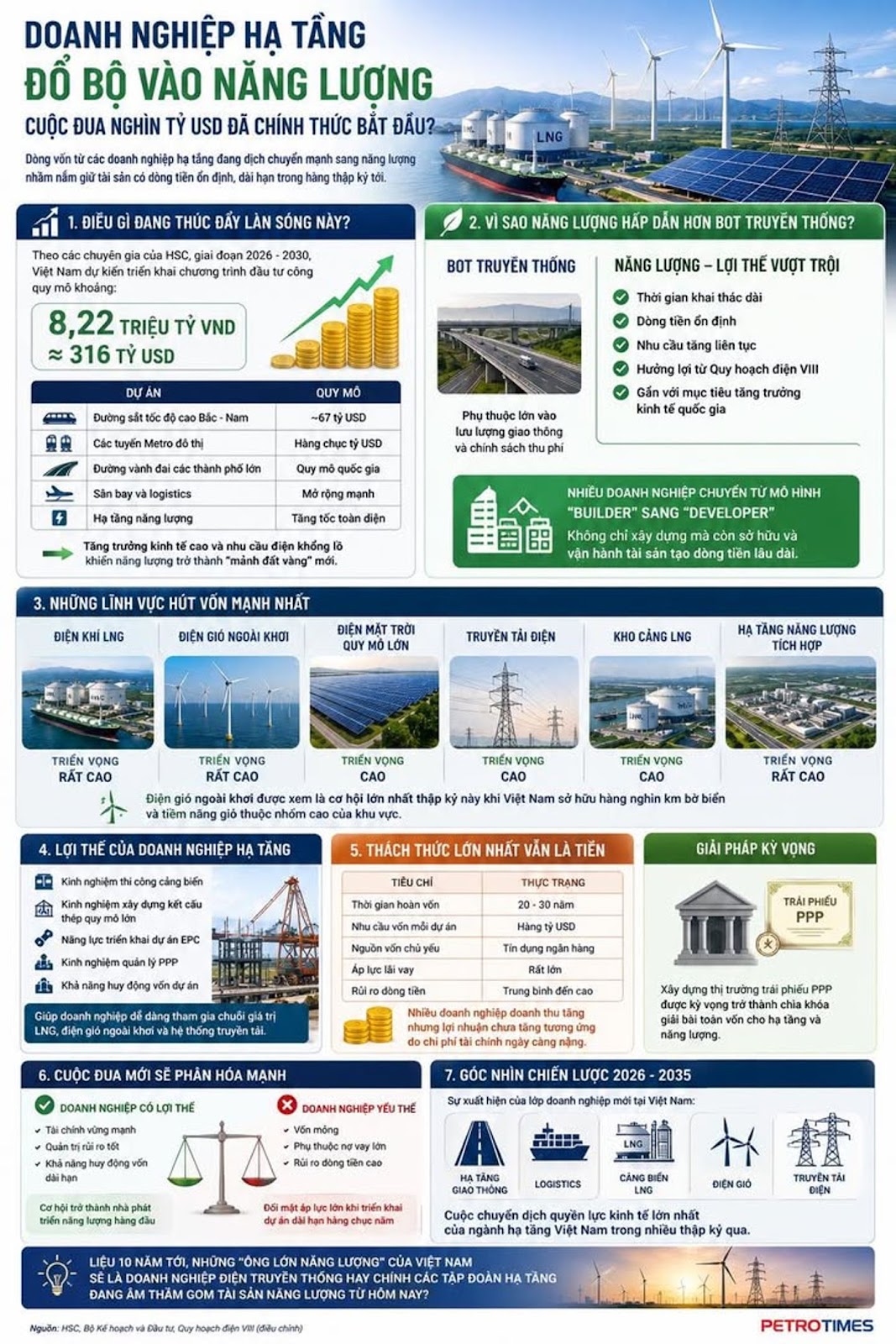
According to HSC experts, in the period 2026 - 2030, Vietnam plans to implement a public investment program with a scale of about 8.22 million billion VND, equivalent to about 316 billion USD.
Among them, highlights include:
Project Scale
North-South high-speed railway ~67 billion USD
Urban Metro lines Tens of billions of dollars
Ring roads of major cities National scale
Airport and logistics Strong expansion
Energy Infrastructure Comprehensive Acceleration
The high economic growth rate and huge electricity demand have made energy the new "golden land".
Why is energy more attractive than traditional BOT?
For many years, the doaBOT businesses depend largely on traffic flow and toll collection policies.
In contrast, LNG, offshore wind power or power transmission projects have notable advantages
✅ Long exploitation time
✅ Stable cash flow
✅ Demand increases continuously
✅ Benefit from Power Planning VIII
✅ Associated with national economic growth goals
Many businesses are shifting from a "builder" to a "developer" model, which means not only building but also owning and operating assets.
The areas that attract the strongest capital
Prospect Segment
LNG Gas Electrification Very High
Offshore wind power Very high
Large-scale solar power Cao
High power transmission
Cao LNG Terminal
Very highly integrated energy infrastructure
In particular, offshore wind power is considered one of the biggest opportunities this decade when Vietnam owns thousands of kilometers of coastline and has high wind potential in the region.
Advantages of infrastructure businesses
Large construction enterprises currently hold many advantages that traditional energy enterprises cannot easily obtain
✔ Experience in seaport construction
✔ Experience in building large-scale steel structures
✔ Capacity to implement EPC projects
✔ Experience in PPP management
✔ Ability to mobilize project capital
This makes it easier for them to participate in the value chain of LNG, offshore wind power and transmission systems.
⚠️ The biggest challenge is still money
Although the prospects are very attractive, the capital problem is still the biggest barrier.
Current Situation Criteria
Payback period 20 - 30 years
Capital needs for each project Billions of USD
Main source of capital: Bank creditg
Loan interest pressure is huge
Cash flow risk Medium to high
Many businesses have increased revenue but profits have not increased correspondingly due to increasingly heavy financial costs.
That is why building the PPP bond market is expected to become the key to solving the capital problem for infrastructure and energy.
The new race will be strongly divided
Not every business that enters energy will be successful.
Businesses with financial advantages, good risk management and the ability to mobilize long-term capital will have the opportunity to become leading energy developers in the coming period.
On the contrary, businesses with thin capital or too much reliance on debt can face great pressure when implementing projects that last decades.
Strategic perspective
The period 2026 - 2035 may witness the emergence of a new class of businesses in Vietnam.
Not just a construction contractor.
Not just BOT investors.
They are corporations that simultaneously own transportation infrastructure, logistics, seaports, LNG, wind power and electricity transmission.
This may be the biggest economic power shift in Vietnam's infrastructure industry in decades.
The question worth pondering is whether in 10 years the leading names in Vietnam's energy industry will be traditional electricity enterprises or the infrastructure corporations that are quietly gathering energy assets from today?
#Public Investment #Offshore Wind Power #LNG #Energy Security #Power PlanningVIII #Vietnam Infrastructure #Vietnam Business #PPP #Renewable Energy #Vietnam Economy #ElectricityGas #EconomicGrowth #PetroTimes #Energy2026 #EnergyInvestment