#China #GiaDau #DauTho #WTI #Brent #OPEC #Russia #Iran #My #AnNinhNangLuong #CongNgheDauKhi #Hormuz #NangLuongToanCau
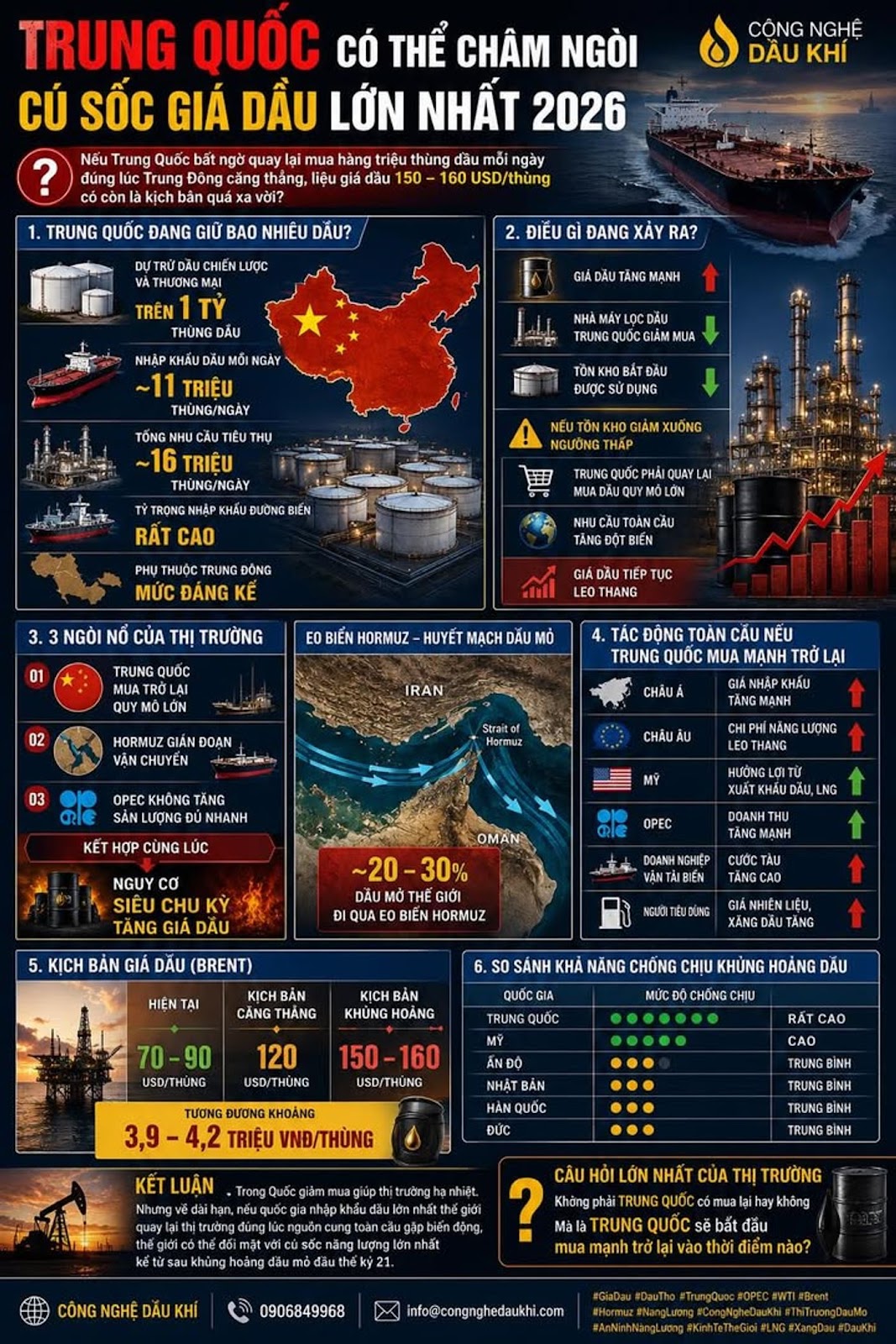
🤔 If China suddenly returns to buying millions of barrels of oil every day just as the Middle East is tense, will oil prices of 150 to 160 USD per barrel still be a far-fetched scenario?
For many months, China has been considered the country most resilient to global oil shocks. With strategic and commercial reserves estimated to exceed 1 billion barrels before the Middle East conflict broke out, Beijing has largely stayed out of violent price fluctuations.
However, what is worrying analysts is that that picture could change very quickly.
According to data from Kpler, Chinese oil refineries have reduced oil purchases recently due to sharp increases in prices. This helps the market temporarily reduce demand pressure while global supply is under pressure from geopolitical tensions.
But this can only be a temporary silence.
If China's huge stockpiles begin to decline below the safety threshold, Beijing will be forced to return to the international market to buy in extremely large volumes.
At that time, the already tense oil market may enter a new period of price boom.
Overview of factors affecting oil prices
Impact Factor
Middle East tensions Reduce potential supply
Risk of Hormuz disruption Sharp increase in shipping prices
China temporarily reduces purchases Reduces short-term demand pressure
China strongly re-imports Shocking global demand
OPEC keeps output cautiously, limiting its ability to make up for the shortfall
The US increases shale oil production. Relieving pressure but not big enough
Why is China especially important?
China is currently the world's largest oil importer.
Any change in demand in this economy could shake up the entire energy market.
Recent statistics
Estimated Index
Daily oil demand About 16 million barrels
Daily oil imports About 11 million barrels
Strategic and commercial oil reserves Over 1 billion barrels
The proportion of seaborne imports is very high
Middle East Dependency Significant level
It's worth noting that while many countries react by buying oil when prices rise for fear of shortages, China often does the opposite.
They buy strongly when prices are low and reduce buying when prices are high.
This strategy helps Beijing save tens of billions of dollars every year.
But every strategy has its limits.
If inventory drops too deeply, re-buying is inevitable.
The scariest scenario for the market
Suppose tensions in the Strait of Hormuz persist.
Suppose OPEC doesn't increase production fast enough.
Suppose China decides to replenish its strategic reserves.
These three factors appearing together will create a "super bull cycle".
At that time, supply competition will take place between
• China
• India
• Japan
• Korea
• European Union
These countries all rely heavily on energy imports.
Impact table if China returns to strong buying
Area of Influence
Asia Import prices increased sharply
Europe Escalating energy costs
America Benefits from oil and LNG exports
OPEC Doanh thu tăng mạnh
Doanh nghiệp vận tải biển Cước tàu tăng cao
Người tiêu dùng Giá nhiên liệu tăng
So sánh khả năng chống chịu khủng hoảng dầu
Quốc gia Mức độ chống chịu
Trung Quốc Rất cao
Mỹ Cao
Ấn Độ Trung bình
Nhật Bản Trung bình
Hàn Quốc Trung bình
Đức Trung bình
Điều khiến giới đầu tư lo ngại không phải là việc Trung Quốc mua thêm dầu.
Điều đáng sợ là thời điểm mua.
Nếu Bắc Kinh quay lại thị trường đúng lúc nguồn cung toàn cầu bị bóp nghẹt bởi chiến sự hoặc các lệnh trừng phạt mới, giá dầu có thể tăng với tốc độ mà nhiều mô hình dự báo hiện nay chưa phản ánh đầy đủ.
Một số tổ chức tài chính quốc tế từng đưa ra kịch bản giá Brent vượt mức khoảng
💰 3.900.000 VNĐ đến 4.200.000 VNĐ mỗi thùng
Tương đương vùng 150 đến 160 USD mỗi thùng.
Đó sẽ là mức giá đủ sức tác động đến lạm phát, vận tải, sản xuất và tăng trưởng kinh tế toàn cầu.
Kết luận
Trong ngắn hạn, việc Trung Quốc giảm mua dầu đang giúp thị trường có thêm không gian để hạ nhiệt.
Nhưng về dài hạn, đây có thể chỉ là khoảng lặng trước cơn bão.
Nếu quốc gia nhập khẩu dầu lớn nhất hành tinh quay trở lại thị trường với nhu cầu khổng lồ đúng lúc nguồn cung toàn cầu gặp biến động, thế giới có thể phải đối mặt với một trong những cú sốc năng lượng lớn nhất kể từ sau khủng hoảng dầu mỏ đầu thế kỷ 21.
🌿 Câu hỏi đang được cả thị trường theo dõi không phải là liệu Trung Quốc có mua lại hay không.
🤔 Mà là Trung Quốc sẽ bắt đầu mua mạnh trở lại vào thời điểm nào.
#GiaDau #DauTho #TrungQuoc #OPEC #WTI #Brent #Hormuz #NangLuong #CongNgheDauKhi #ThiTruongDauMo #KinhTeTheGioi #AnNinhNangLuong #LNG #XangDau #DauKhi