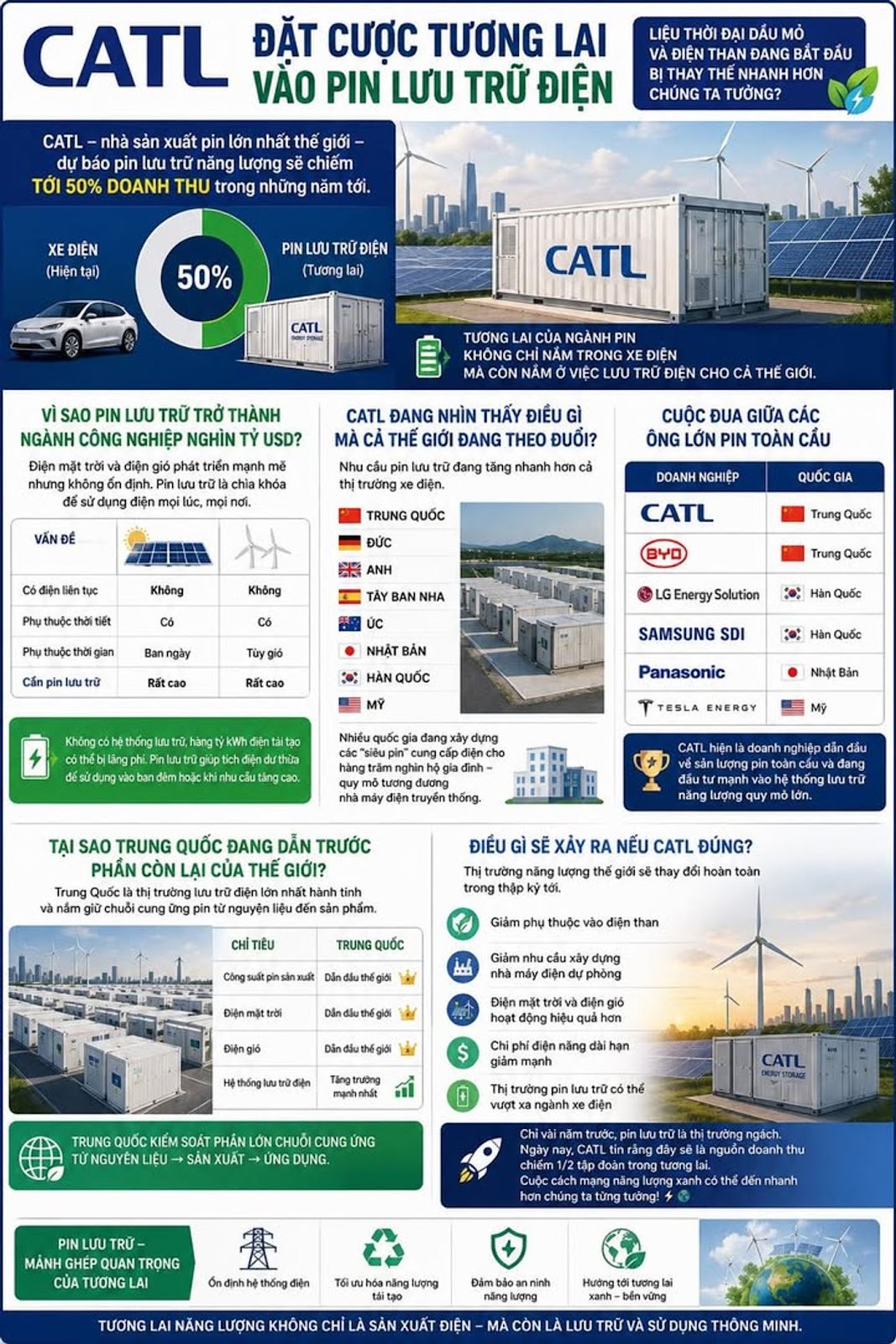
CATL Bets Big on Energy Storage: Is the Fossil Fuel Era Ending Faster Than Expected?
Would you believe that in just a few years, half of the revenue from the world's largest battery manufacturer might come not from electric vehicles but from "super batteries" capable of storing electricity for entire cities and even nations?
For years, when mentioning CATL (Contemporary Amperex Technology Co. Limited), most people immediately think of the lithium-ion batteries that power Tesla, BMW, Mercedes-Benz, Volkswagen, and numerous Chinese electric vehicle brands. However, a significant transformation is underway.
CATL has recently revealed that in the coming years, its energy storage division could account for up to 50% of the company's total revenue. This announcement is noteworthy because CATL is currently the world's largest battery manufacturer and is considered the "bellwether" of the entire new energy industry.
This indicates that the future of the battery industry lies not only in electric vehicles but also in storing electricity for the world.
Why Energy Storage is Becoming a Trillion-Dollar Industry
Solar and wind power are experiencing explosive growth globally. The problem is that solar power is only generated during daylight hours, while wind power is entirely dependent on weather conditions. Meanwhile, human electricity demand occurs continuously 24 hours a day.
This is precisely why energy storage has become the most crucial piece of the green energy revolution.
| Challenge | Solar Power | Wind Power |
|---|---|---|
| Continuous Power Supply | No | No |
| Weather Dependency | Yes | Yes |
| Time Dependency | Daytime only | Wind-dependent |
| Energy Storage Need | Very High | Very High |
Without storage systems, billions of kWh of renewable energy could be wasted. Conversely, with energy storage, excess electricity generated during the day can be used at night or during periods of sudden demand spikes.
What CATL Sees That the World is Pursuing
According to energy experts, the demand for energy storage is growing even faster than the electric vehicle market. The countries investing most heavily in this sector currently include:
- China
- Germany
- United Kingdom
- Spain
- Australia
- Japan
- South Korea
- United States
Many of these nations have begun constructing "super batteries" capable of powering hundreds of thousands of homes. Some projects are even on a scale comparable to traditional power plants.
The Global Race Among Battery Giants
| Company | Country |
|---|---|
| CATL | China |
| BYD | China |
| LG Energy Solution | South Korea |
| Samsung SDI | South Korea |
| Panasonic | Japan |
| Tesla Energy | United States |
Among these, CATL remains the global leader in battery production production. Notably, CATL is not only manufacturing batteries for electric vehicles but is also heavily investing in large-scale energy storage systems.
Why China is Leading the Rest of the World
China currently has the largest energy storage market on the planet. Not only does it produce most of the world's lithium batteries, but the country is also building numerous massive battery farms to support solar and wind power.
| Indicator | China's Position |
|---|---|
| Battery Production Capacity | World leader |
| Solar Power | World leader |
| Wind Power | World leader |
| Energy Storage Systems | Fastest growing |
This gives China control over most of the supply chain from raw materials to finished products.
What Will Happen if CATL is Right
If CATL's prediction materializes, the global energy landscape could change completely within the next decade:
- Countries reducing dependence on coal-fired power plants
- Decreased need for backup power plant construction
- More efficient operation of solar and wind power
- Sharp reduction in long-term energy costs
- The energy storage market potentially surpassing the electric vehicle industry
What's worth contemplating is that just a few years ago, energy storage was considered a niche market. Today, the world's largest battery manufacturer believes it will become half of the company's revenue in the future.
If that happens, the green energy revolution could be arriving much faster than the world once predicted.