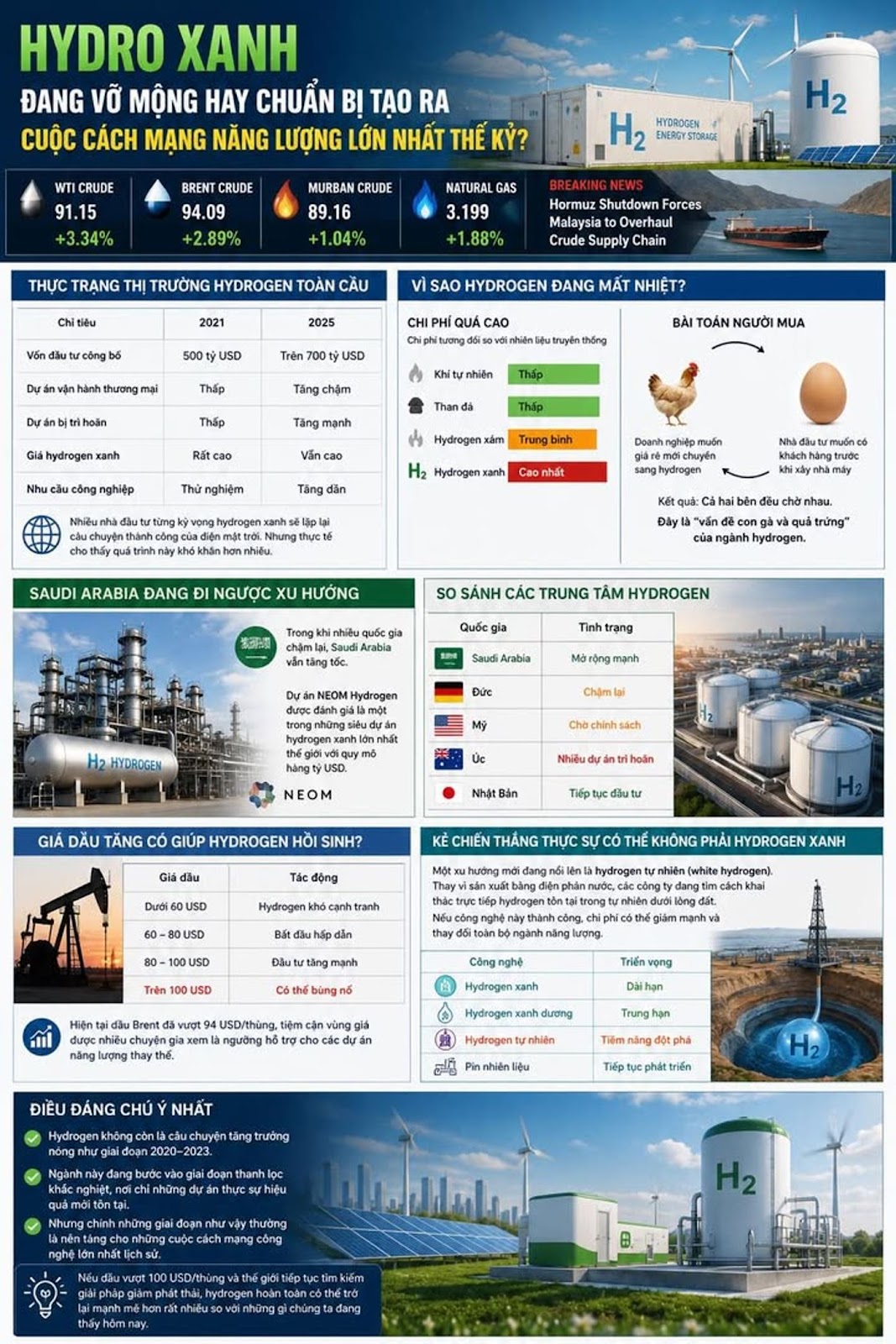
Is Green Hydrogen Building a Dream or Preparing for the 21st Century's Greatest Energy Revolution?
As hundreds of billions of dollars flow into green hydrogen, is this becoming the world's largest "energy bubble," or is this merely a purification phase before the trillion-dollar industry truly takes off? While WTI crude oil prices rise to $91.15 per barrel and Brent reaches $94.09, the global energy market is witnessing an intriguing paradox. Oil and gas are becoming increasingly expensive with rising tensions in Hormuz, yet green hydrogen isn't exploding as expected.
Many green hydrogen projects in Europe, the United States, and Australia have been delayed or canceled in 2024-2025. Production costs remain too high, infrastructure is incomplete, and industrial customers are not ready to sign long-term contracts. However, this doesn't signify hydrogen's failure but rather indicates a maturation process in the energy transition.
Global Hydrogen Market Status
| Indicator | 2021 | 2025 (Projected) |
|---|---|---|
| Announced Investment | $500 billion USD | Over $700 billion USD |
| Commercial Operational Projects | Low | Slow Growth |
| Delayed Projects | Low | Significant Increase |
| Green Hydrogen Price | Very High | Still High |
| Industrial Demand | Experimental | Gradual Increase |
Many investors had hoped green hydrogen would repeat the success story of solar power. However, reality shows this process is considerably more challenging. The complexity of green hydrogen production, storage, and transportation creates significant hurdles that solar energy didn't face to the same extent.
Why Hydrogen Is Losing Momentum
Excessive Costs
| Energy Source | Relative Cost |
|---|---|
| Natural Gas | Low |
| Coal | Low |
| Gray Hydrogen | Moderate |
| Green Hydrogen | Highest |
Green hydrogen requires renewable electricity, water electrolysis, and specialized storage and transportation systems. This makes current production costs significantly higher than traditional fuels. The entire value chain needs substantial investment before costs can compete with established energy sources.
The Buyer's Dilemma
Industrial companies want affordable prices before switching to hydrogen. Investors want guaranteed customers before building production facilities. This creates a classic "chicken and egg" problem in the hydrogen industry. Both sides are waiting for each other to make the first move, creating a temporary standstill in market development.
Saudi Arabia's Contrarian Approach
While many countries are slowing down, Saudi Arabia is accelerating its green hydrogen initiatives. The NEOM Hydrogen project is now considered one of the world's largest green hydrogen super-projects with a multi-billion dollar scale.
| Country | Status |
|---|---|
| Saudi Arabia | Rapid Expansion |
| Germany | Slowing Down |
| United States | Waiting for Policy |
| Australia | Many Projects Delayed |
| Japan | Continued Investment |
Saudi Arabia's advantage lies in abundant solar and wind resources, available land, and strong government support. The country's NEOM project aims to produce 600,000 tons of green hydrogen annually by 2030, positioning itself as a future hydrogen export hub.
Can Rising Oil Prices Revitalize Hydrogen?
Historically, every significant increase in oil prices has brought renewed attention to alternative energy sources. The relationship between oil prices and hydrogen competitiveness is crucial for understanding future market dynamics.
| Oil Price Range | Impact on Hydrogen |
|---|---|
| Below $60/barrel | Hydrogen struggles to compete |
| $60-80/barrel | Becomes increasingly attractive |
| $80-100/barrel | Investment increases significantly |
| Above $100/barrel | Potential for explosive growth |
Currently, Brent oil has surpassed $94/barrel, approaching the price range that many experts consider the threshold for supporting alternative energy projects. If oil prices continue to rise, the economic case for hydrogen strengthens considerably.
The Real Winner Might Not Be Green Hydrogen
A new trend is emerging: natural hydrogen, also known as "white hydrogen." Instead of producing hydrogen through water electrolysis, companies are exploring ways to extract hydrogen that naturally exists underground.
| Technology | Prospects |
|---|---|
| Green Hydrogen | Long-term |
| Blue Hydrogen | Medium-term |
| White Hydrogen | Potential breakthrough |
| Fuel Cells | Continued development |
If white hydrogen extraction technology proves successful, costs could decrease dramatically and transform the entire energy industry. Several companies are already exploring natural hydrogen deposits, with some promising discoveries made in Europe, Africa, and the United States.
The Most Notable Development
Green hydrogen is no longer the hot growth story it was during 2020-2023. The industry is entering a stringent purification phase where only truly efficient projects will survive. However, historical technological revolutions often follow such purification periods.
If oil prices exceed $100/barrel and the world continues seeking emission reduction solutions, hydrogen could rebound much more strongly than what we are witnessing today. The current slowdown might be exactly what the industry needs to build a sustainable foundation for future growth.
The energy transition remains a marathon, not a sprint. Green hydrogen's journey may face obstacles now, but its potential role in decarbonizing hard-to-abate sectors ensures it will remain a critical component of the global energy mix for decades to come.