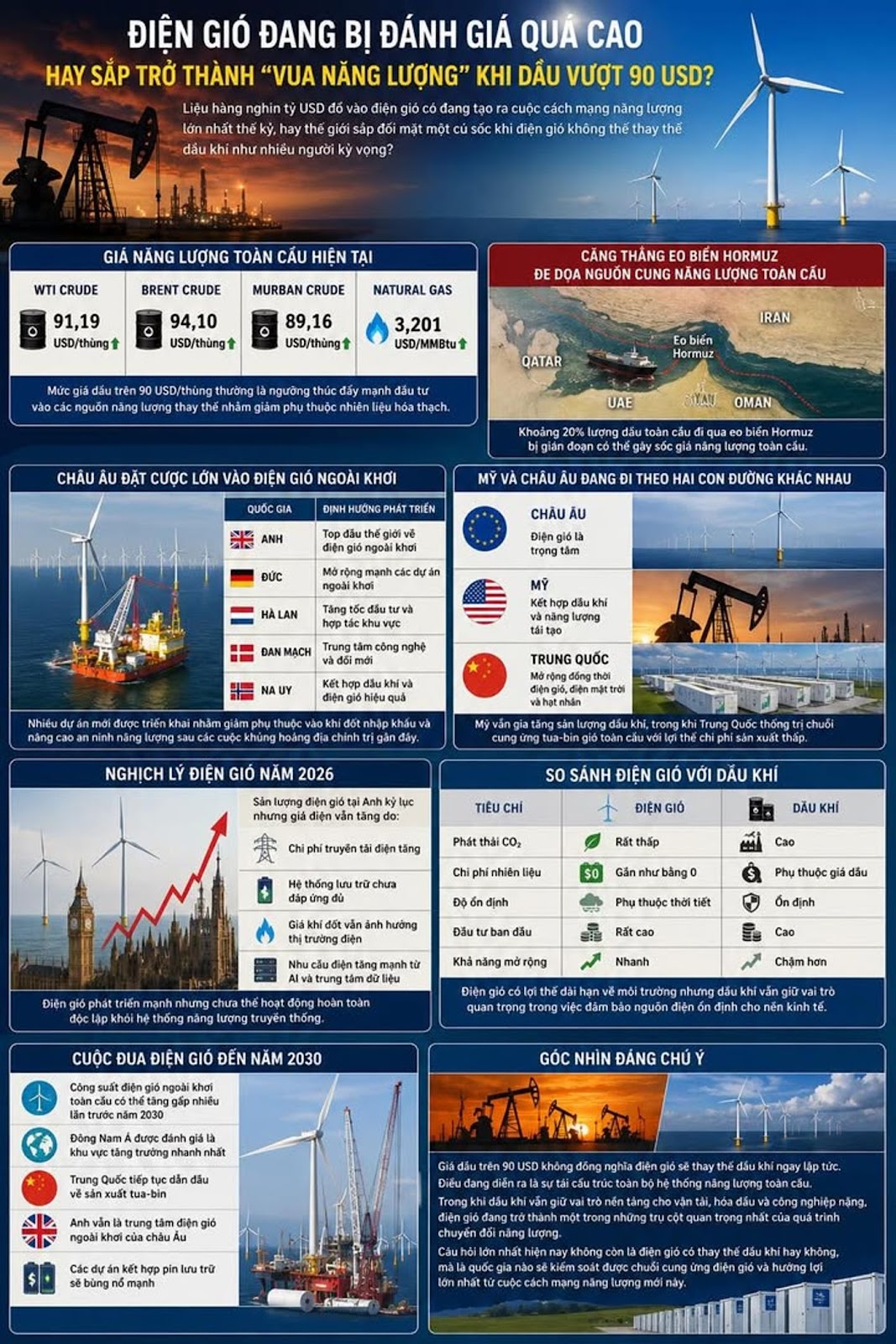
Wind Power: Overhyped or the Future of Energy as Oil Surpasses $90?
In the rapidly evolving global energy landscape, a critical question emerges: Are the trillions of dollars being invested in wind power creating the most significant energy revolution of the century, or is the world facing a potential shock as wind fails to replace oil and gas as many anticipate? With crude oil prices continuing to surge—WTI reaching $91.19 per barrel and Brent hitting $94.10 per barrel—amid tensions in the Strait of Hormuz threatening energy supplies, the global wind power industry stands at a historic crossroads.
The Current Global Energy Price Landscape
As oil prices climb above the critical $90 per barrel threshold, traditionally a catalyst for increased investment in alternative energy sources aimed at reducing fossil fuel dependence, the wind power sector finds itself at a pivotal moment. This price level often triggers significant shifts in energy investment strategies, making renewable sources more economically attractive.
| Energy Index | Price |
|---|---|
| WTI Crude | $91.19 per barrel |
| Brent Crude | $94.10 per barrel |
| Murban Crude | $89.16 per barrel |
| Natural Gas | $3.201 per MMBtu |
Europe's Heavy Bet on Offshore Wind
Europe continues to lead the world in offshore wind development, positioning the continent as the epicenter of this renewable energy transition. The region's commitment to wind power stems from both environmental concerns and strategic considerations following recent geopolitical crises that exposed vulnerabilities in energy supply chains.
Leading European Nations in Offshore Wind
| Country | Position in Offshore Wind |
|---|---|
| United Kingdom | Global leader in offshore wind capacity |
| Germany | Rapidly expanding offshore wind infrastructure |
| Netherlands | Accelerating investment in wind projects |
| Denmark | Global technology hub for wind innovation |
| Norway | Combining oil/gas resources with wind power |
Many new European projects are being strategically deployed to reduce dependence on imported natural gas and enhance energy security following recent geopolitical crises that disrupted traditional energy supply routes.
Divergent Paths: US and European Energy Strategies
While Europe doubles down on wind power as a cornerstone of its energy strategy, the United States and China are pursuing more diversified approaches to energy transition.
| Region | Primary Energy Strategy |
|---|---|
| Europe | Wind power as the central focus of energy transition |
| United States | Combining increased oil/gas production with renewable energy development |
| China | Simultaneously expanding wind, solar, and nuclear power |
Notably, the United States continues to boost its oil and gas production while developing wind power at a slower pace compared to Europe. Meanwhile, China has emerged as the dominant force in global wind turbine supply chains, leveraging significant manufacturing cost advantages.
The 2026 Wind Power Paradox
One of the most controversial phenomena in the energy sector is the paradox occurring in the United Kingdom, where wind power generation reached record levels in 2026, yet electricity prices continued to rise. This seemingly contradictory situation reveals the complex challenges facing renewable energy integration.
Factors Behind the Wind Power Price Paradox
- Increasing transmission costs: As more wind farms come online, the infrastructure needed to transmit power from often remote generation sites to consumption centers requires substantial investment.
- Inadequate energy storage: Current battery and storage technologies cannot yet fully address the intermittency issues of wind power.
- Natural gas price influence: Despite wind's growth, natural gas prices continue to significantly impact overall electricity pricing.
- Surging demand from AI and data centers: The explosion in artificial intelligence applications and data center consumption has outpaced renewable energy deployment.
This paradox demonstrates that while wind power is expanding rapidly, it cannot yet operate completely independently from traditional energy systems.
Wind Power vs. Oil and Gas: A Comparative Analysis
| Criterion | Wind Power | Oil and Gas |
|---|---|---|
| CO2 Emissions | Very low during operation | High emissions throughout lifecycle |
| Fuel Costs | Nearly zero after installation | Subject to volatile global oil prices |
| Reliability | Weather-dependent intermittency | Consistent and dispatchable |
| Initial Investment | Extremely high capital requirements | High but established financing models |
| Scalability | Rapid deployment potential | Slower development cycles |
While wind power offers significant long-term environmental advantages, oil and gas continue to play crucial roles in ensuring stable electricity supply for economic activities, particularly in sectors requiring consistent power delivery.
The Global Wind Power Race to 2030
According to numerous energy industry forecasts, global offshore wind capacity could increase multiple times by 2030, with several key trends shaping this expansion:
- Offshore wind capacity globally projected to grow exponentially before 2030
- Southeast Asia identified as the fastest-growing regional market
- China expected to maintain dominance in wind turbine manufacturing
- United Kingdom poised to remain Europe's offshore wind hub
- Explosive growth anticipated in projects integrated with battery storage systems
Notable Perspectives on the Energy Transition
Oil prices above $90 per barrel do not necessarily mean wind power will immediately replace oil and gas. What is actually occurring is the restructuring of the entire global energy system.
While oil and gas will maintain their foundational role in transportation, petrochemicals, and heavy industry, wind power is emerging as one of the most critical pillars of the energy transition.
The most significant question today is no longer whether wind power will replace oil and gas, but which nations will control the wind power supply chain and benefit most from this new energy revolution.
As the world navigates these complex energy dynamics, the interplay between traditional and renewable sources will continue to evolve, with both technologies playing increasingly important but distinct roles in the global energy mix.