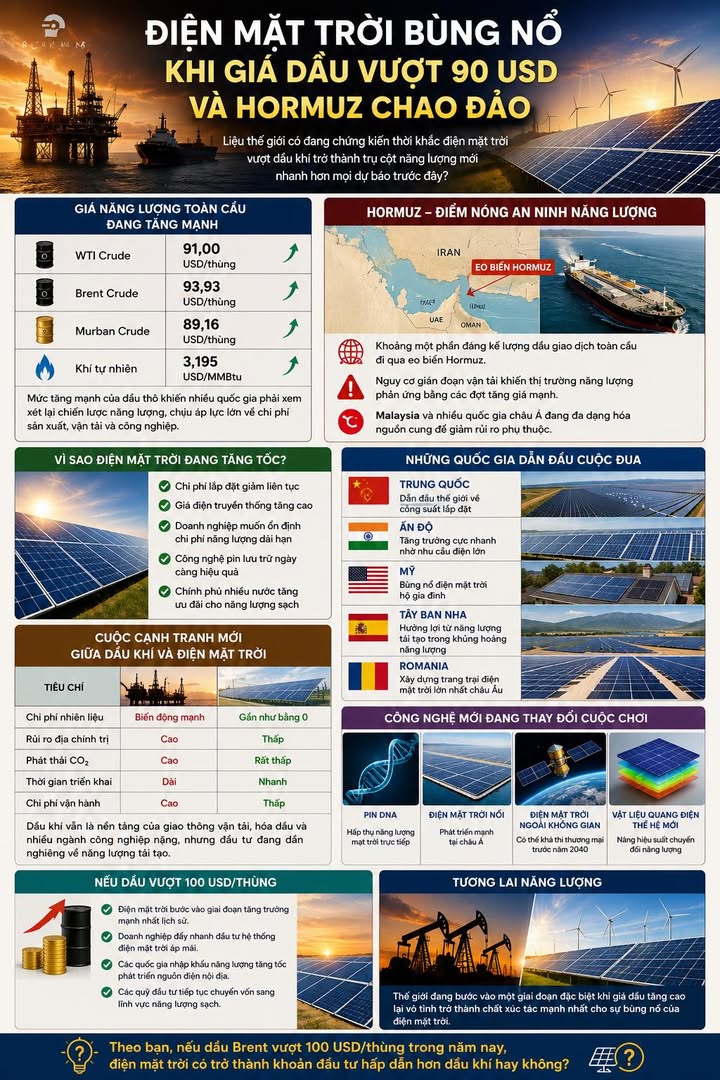
Solar Power Surges as Oil Prices Exceed $90 and Hormuz Faces Instability
Is the world witnessing the historic moment when solar power surpasses oil and gas to become the new energy pillar faster than any previous predictions?
As global oil prices surge with WTI crude exceeding $91 per barrel and Brent crude approaching $94 per barrel, another trend is accelerating worldwide: the wave of solar power investments. While markets express concern about potential disruptions in energy transport through the Strait of Hormuz, solar energy is rapidly gaining global momentum as a more stable alternative.
Notably, the greater the geopolitical instability, the more attractive solar power becomes due to its ability to generate electricity on-site, reduce dependence on imported fuels, and limit exposure to oil price fluctuations.
Global Energy Prices on the Rise
The sharp increase in crude oil prices is putting significant pressure on many countries to reconsider their energy strategies. Economies dependent on fuel imports are facing substantial cost increases in electricity generation, transportation, and industrial production.
| Energy Source | Current Price |
|---|---|
| WTI Crude | $91.00 per barrel |
| Brent Crude | $93.93 per barrel |
| Murban Crude | $89.16 per barrel |
| Natural Gas | $3.195 per MMBtu |
The Strait of Hormuz Reshaping Global Energy Security Perceptions
A substantial portion of globally traded oil passes through the Strait of Hormuz. Any perceived risk of transport disruption immediately triggers strong price increases in energy markets.
Malaysia has begun adjusting its crude oil supply chains as Hormuz disruption risks increase. Many Asian nations are also diversifying their energy sources to reduce dependence on this strategic transport route.
Why Solar Power is Accelerating
Unlike oil or natural gas, solar power does not depend on fuel transportation. Key factors driving this acceleration include:
- Continuously decreasing installation costs
- Rising costs of traditional electricity
- Businesses seeking long-term energy cost stability
- Improving efficiency of energy storage technologies
- Government incentives for clean energy in multiple countries
Leading Countries in the Solar Race
| Country | Notable Trends |
|---|---|
| China | World leader in installed capacity |
| India | Extremely rapid growth driven by high electricity demand |
| United States | Explosive growth in residential solar installations |
| Spain | Benefiting from renewable energy during energy crisis |
| Romania | Building Europe's largest solar farm |
The New Competition Between Oil/Gas and Solar Power
| Criteria | Oil & Gas | Solar Power |
|---|---|---|
| Fuel Costs | Highly volatile | Nearly zero |
| Geopolitical Risk | High | Low |
| CO2 Emissions | High | Very low |
| Implementation Time | Long | Short |
| Operating Costs | High | Low |
This does not signify the disappearance of oil and gas. In reality, these resources remain fundamental to transportation, petrochemicals, and many heavy industries. However, investment growth is gradually shifting toward renewable energy sources.
Emerging Technologies Transforming the Landscape
2026 is expected to bring several notable advancements:
- DNA-based solar cells directly absorbing solar energy
- Rapid development of floating solar power in Asia
- Space-based solar power potentially becoming commercially viable by 2040
- Next-generation photovoltaic materials continuing to improve energy conversion efficiency
What Happens If Oil Exceeds $100 per Barrel?
If oil prices continue to escalate due to tensions in Hormuz, solar power could enter its strongest growth period in history.
Businesses would accelerate investment in rooftop solar systems. Energy-importing nations would expedite domestic power development. Investment funds might continue shifting capital toward clean energy sectors.
The world is entering a unique phase where high oil prices inadvertently become the strongest catalyst for the solar power boom.
Conclusion: The Energy Transition Accelerating
The current market dynamics represent more than just temporary fluctuations—they signal a fundamental shift in global energy priorities. As geopolitical tensions in critical regions like the Strait of Hormuz persist, the economic and security advantages of distributed solar power become increasingly compelling.
This transition is not merely environmental; it's a strategic realignment of energy systems toward greater resilience, independence, and sustainability. The confluence of high oil prices, technological advancements in solar and storage, and growing climate awareness is creating perfect conditions for renewable energy to finally achieve mainstream adoption.
As we move forward, the question may no longer be whether solar power will replace traditional energy sources, but rather how quickly and comprehensively this transition will unfold, potentially reshaping global power dynamics in ways we are only beginning to understand.