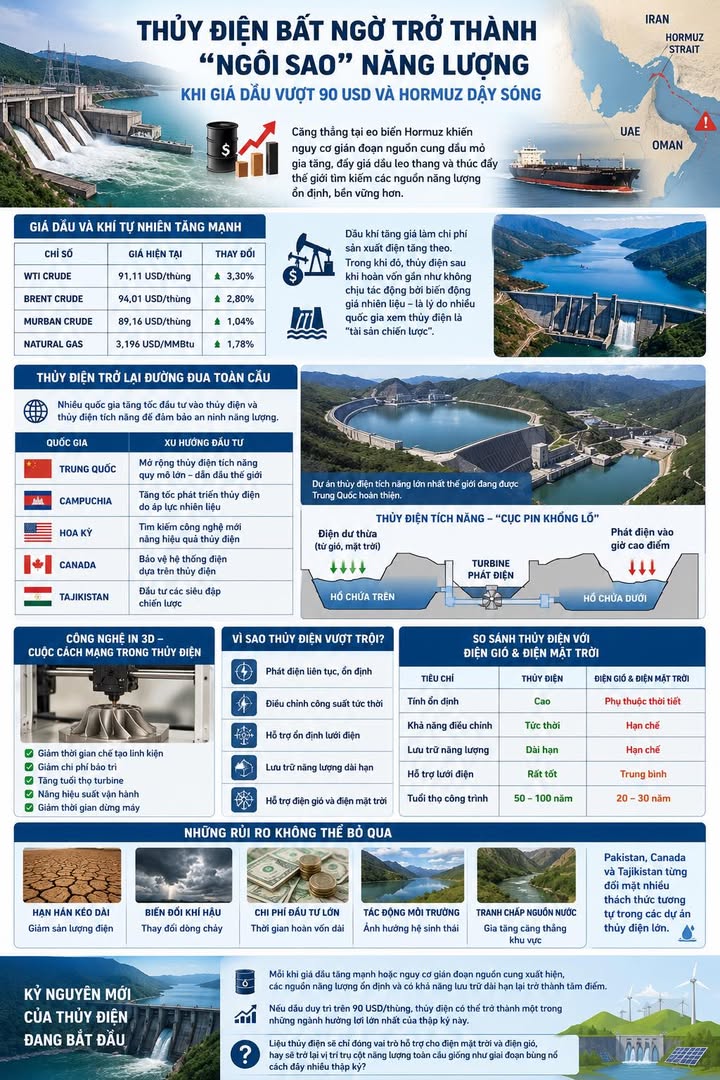
Hydropower Unexpectedly Emerges as Energy Star as Oil Prices Surpass $90 and Hormuz Tensions Rise
The global energy landscape is undergoing a significant shift as oil prices climb above $90 per barrel and tensions in the Strait of Hormuz intensify. In this context, hydropower is quietly returning to center stage as a strategic energy source for many nations, prompting renewed investment in multi-billion dollar hydropower projects worldwide.
When West Texas Intermediate (WTI) crude oil reached $91.11 per barrel and Brent crude climbed to $94.01 per barrel, the global energy market entered a new phase of uncertainty. The escalating tensions in the Strait of Hormuz have raised concerns about potential oil supply disruptions, driving countries to seek more stable energy alternatives.
Surging Oil Prices Reshaping Nations' Approach to Electricity
As oil and natural gas prices continue to rise, electricity generation costs in many fossil fuel-dependent countries have followed suit. In contrast, hydropower facilities, once their initial investment is recovered, remain largely unaffected by fuel price volatility. This has led many governments to view hydropower as a "strategic asset" in an increasingly complex geopolitical environment.
| Current Market Prices | Value |
|---|---|
| WTI Crude | $91.11/barrel |
| Brent Crude | $94.01/barrel |
| Murban Crude | $89.16/barrel |
| Natural Gas | $3.196/MMBtu |
China Leading the Global Hydropower Race
One of the most notable developments is China's completion of the world's largest pumped-storage hydropower project. These facilities not only generate electricity but also function as massive "batteries," storing excess electricity from solar and wind power for use during peak demand hours.
| Country | Hydropower Investment Trends |
|---|---|
| China | Expanding large-scale pumped-storage hydropower |
| Cambodia | Accelerating hydropower development due to fuel pressures |
| United States | Seeking new technologies to improve hydropower efficiency |
| Canada | Protecting hydropower-based electricity systems |
| Tajikistan | Investing in strategic mega-dam projects |
3D Printing Technology Could Revolutionize Hydropower
A new trend attracting attention in the energy sector is the application of 3D printing technology in hydropower construction and maintenance. This innovation could significantly transform how hydropower facilities are built and operated.
Key benefits include:
- Reduced manufacturing time for components
- Lower maintenance costs
- Extended turbine lifespan
- Improved operational efficiency
- Reduced downtime
If successfully implemented at scale, this technology could make many small-scale hydropower projects that were previously economically unfeasible viable.
Hydropower Gaining Advantages Over Wind and Solar Power
While solar and wind power have experienced rapid growth, they remain dependent on weather conditions. Hydropower, by contrast, offers several critical advantages:
- Continuous power generation
- Instant capacity adjustment
- Grid stability support
- Long-term energy storage capabilities
- Integration support for wind and solar power
These are advantages that solar and wind power cannot yet fully replace.
Significant Risisks Cannot Be Overlooked
Despite the positive outlook, the hydropower sector still faces numerous challenges:
| Risk Factor | Potential Impact |
|---|---|
| Prolonged droughts | Reduced electricity generation |
| Climate change | Altered water flow patterns |
| High investment costs | Long payback periods |
| Environmental impact | Ecosystem disruption |
| Water disputes | Increased regional tensions |
Countries such as Pakistan, Canada, and Tajikistan have all faced similar challenges in their large-scale hydropower projects.
A New Era for Hydropower is Beginning
Notably, whenever oil prices surge significantly or when there's a risk of supply disruption like the situation in Hormuz, stable energy sources with long-term storage capabilities become the focus of attention. If oil prices remain above $90 per barrel for an extended period, hydropower could become one of the biggest beneficiaries of this decade.
The question now debated by many experts is whether hydropower will merely serve as a complementary source to solar and wind power, or whether it will unexpectedly return to its position as a global energy cornerstone, similar to the boom period several decades ago.
As the energy transition accelerates, hydropower's unique combination of reliability, storage capability, and grid support may prove invaluable in creating a more resilient and sustainable energy future for nations worldwide.