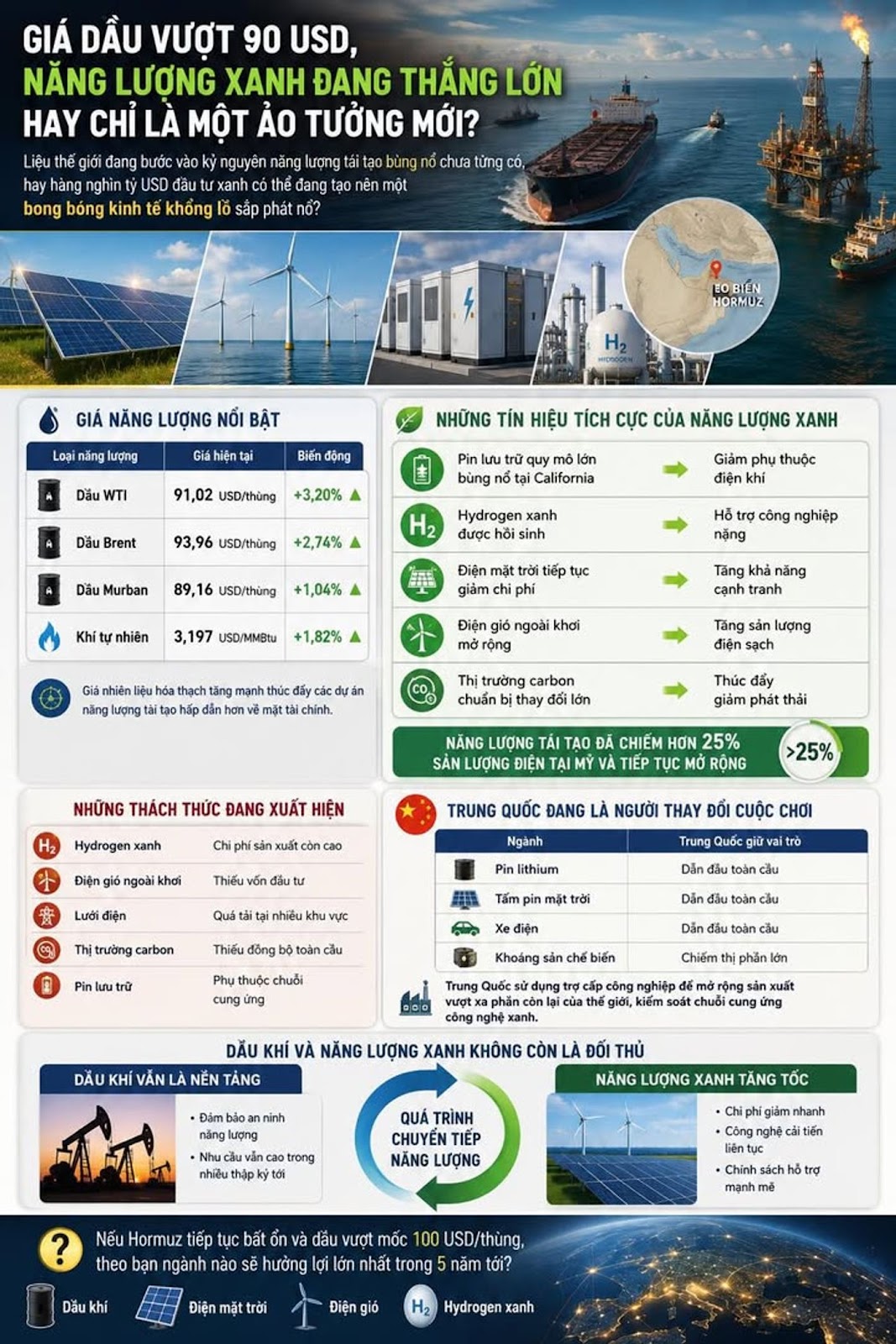
Oil Prices Surpass $90: Is Green Energy Winning or Just Another Fantasy?
In a global energy landscape marked by uncertainty and transition, crude oil prices have surged past the $90 per barrel mark, with WTI reaching $91.02 and Brent climbing to $93.96. This price spike, driven by tensions in the Strait of Hormuz and concerns about potential supply disruptions, has reignited critical questions about the future of energy.
As traditional energy markets experience volatility, the renewable energy sector continues its unprecedented growth trajectory. The juxtaposition of these two phenomena raises fundamental questions: Is the world truly entering an era of unprecedented renewable energy expansion, or are the trillions of dollars being invested in green technologies creating an economic bubble on the verge of collapse?
Current Energy Market Overview
The recent surge in oil prices comes amid geopolitical tensions in critical shipping lanes, with markets reacting to potential disruptions in global energy supplies. Rather than slowing the energy transition, however, this crisis appears to be accelerating investments in solar, wind, energy storage, and green hydrogen on an unprecedented scale.
| Energy Type | Current Price | Change |
|---|---|---|
| WTI Oil | $91.02/barrel | +3.20% |
| Brent Oil | $93.96/barrel | +2.74% |
| Murban Oil | $89.16/barrel | +1.04% |
| Natural Gas | $3.197/MMBtu | +1.82% |
As fossil fuel prices climb, renewable energy projects immediately become more financially attractive. This economic reality is driving many nations to accelerate green energy investments despite high interest rates and slow global economic growth.
The Accelerating Green Energy Transition
Several key indicators demonstrate that the renewable energy transition continues to accelerate at an unprecedented pace:
| Trend | Impact |
|---|---|
| Large-scale battery storage boom in California | Reducing dependence on natural gas |
| Green hydrogen revival | Supporting heavy industry decarbonization |
| Continued cost reduction in solar energy | Increasing competitiveness |
| Expansion of offshore wind capacity | Increasing clean electricity production |
| Major changes in carbon markets | Driving emission reduction initiatives |
International reports confirm that renewable energy now accounts for over 25% of electricity generation in the United States and continues to expand its market share across Europe and Asia. This growth trajectory suggests that the renewable energy transition is not merely a temporary trend but a fundamental shift in global energy infrastructure.
Challenges Facing Green Energy
Despite the optimistic outlook, the renewable energy sector faces significant challenges that could impact its growth trajectory:
| Sector | Challenges |
|---|---|
| Green Hydrogen | High production costs |
| Offshore Wind | Insufficient investment capital |
| Electric Grids | Overloading in many regions |
| Carbon Markets | Lack of global standardization |
| Energy Storage | Supply chain dependencies |
Industry analysts project that by 2026, investment in certain clean energy segments may begin to decline. Many green technology startups in Europe are relocating operations to the United States, attracted by more supportive policy environments. This geographic shift in innovation centers could reshape the global clean energy landscape in the coming years.
China's Role in Shaping the Energy Transition
Perhaps the most significant development in the global energy transition is China's strategic positioning in green technology markets. The country is utilizing industrial subsidies to expand production of batteries, electric vehicles, solar panels, and renewable energy equipment at a pace far exceeding other nations.
| Industry | China's Position |
|---|---|
| Lithium Batteries | Global leader |
| Solar Panels | Global leader |
| Electric Vehicles | Global leader |
| Mineral Processing | Significant market share |
Many experts now argue that the current energy competition is no longer simply a battle between oil and gas, but rather a contest for control of green technology supply chains. China's dominance in critical clean energy technologies has created a new paradigm in global energy geopolitics.
The Coexistence of Traditional and Renewable Energy
Contrary to expectations, oil and gas industries and renewable energy are not eliminating each other as rapidly as many predicted. When oil prices rise, solar and wind projects become more economically viable. Simultaneously, the oil and gas sector continues to invest to ensure global energy security.
This dynamic has created a unique transitional period where conventional energy sources maintain their foundational role while renewable energy grows at an unprecedented rate. The current market conditions suggest that rather than being mutually exclusive, these energy sources are coexisting and, in some cases, even reinforcing each other's development.
Future Outlook
If tensions in the Strait of Hormuz persist and oil prices exceed the $100 per barrel mark, the energy landscape could undergo significant transformation. In such a scenario, several sectors might emerge as major beneficiaries over the next five years:
- Renewable Energy: Solar and wind projects would become even more economically attractive, potentially accelerating deployment timelines and increasing investment flows.
- Energy Storage: Battery technology would likely see accelerated innovation as grids increasingly incorporate variable renewable sources.
- Green Hydrogen: Production costs might become more competitive with traditional hydrogen production methods.
- Oil and Gas: These sectors would benefit from higher prices but face increasing pressure to fund carbon capture and other emission reduction technologies.
Conclusion
The current energy landscape reflects a complex interplay between traditional and emerging energy sources. While oil prices surge to multi-year highs, renewable energy continues its remarkable growth trajectory. Rather than representing a zero-sum game, this dynamic suggests a transitional period where multiple energy systems coexist and evolve.
The rise of green energy is not merely a response to climate concerns but an economic imperative driven by technological innovation, cost reductions, and strategic positioning. As the world navigates this energy transition, the most likely outcome is not the replacement of traditional energy with renewables, but rather a diversified energy portfolio where different technologies play complementary roles.
In this context, the question of whether green energy is "winning" becomes less relevant than understanding how different energy systems can work together to create a more secure, sustainable, and economically viable energy future.